
präsentiert von

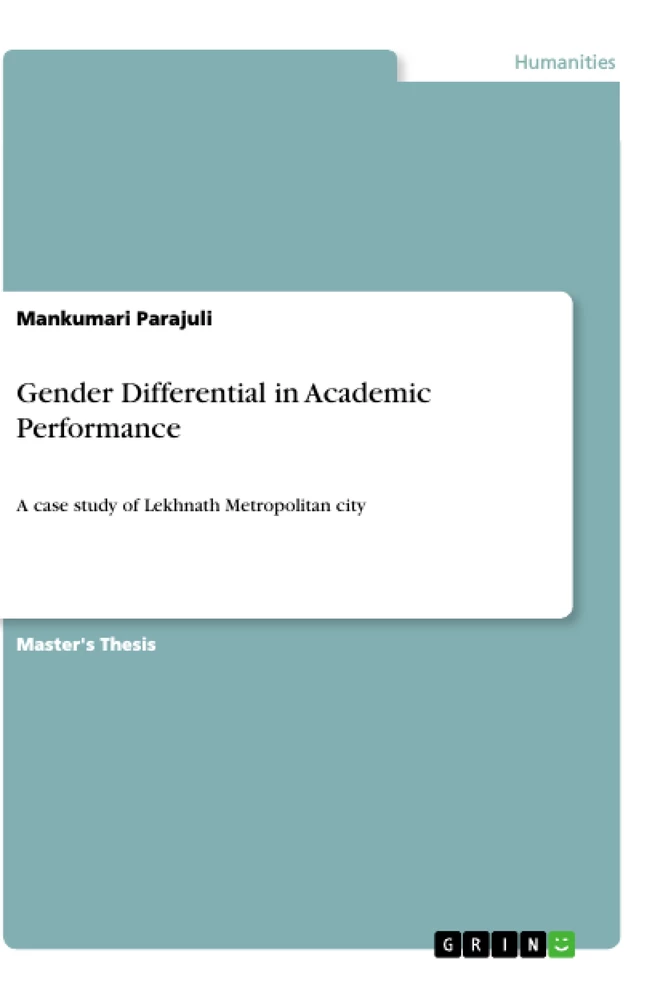
Table of Contents
CHAPTER I INTRODUCTION
1.1 The Context
1.2 Statement of Problem
1.3 Research Rationale
1.4 Research Objective
1.5 Research Hypothesis
1.6 Limitation of the study
1.7 Organization of the Study
CHAPTER II LITERATURE REVIEW
2.1 Definition
2.2. Theoretical background of the study
2.2.1. Genetic explanation
2.2.2. Childhood socialization
2.2.3. Gender, Education and the Curriculum: Relevant Perspective
2.3. Gender and conceptions of equality in relation to education
2.4. Social factors which influence girls’ and boys’ performance and behavior
2.5 Teaching learning (reading) materials
2.6. Subject preference and choice
2.7. Motivational and psychological issues
2.8. School environment
2.9. Teacher attitudes
2.10. Review of empirical studies
CHAPTER III CONCEPTUAL FRAMEWORK
CHAPTER IV RESEARCH METHODOLOGY
4.1. Study Area
4.2. Nature and Sources of Data
4.3. Research design
4.4. Population
4.5. Sample size
4.6. Sampling procedure
4.7. Data collection procedure
4.8. Analytical framework
CHAPTER V DATA ANALYSIS AND INTERPRETATION
5.1. Socio-demographic Profile of the Respondents
5.2. Schools environment
5.3. Academic performance of the students
5.4. Types of school and academic performance
5.5. Information regarding gender differentiates in academic performance
5.6. Association of independent variables with student performance
5.7. Association of student performance with type of school
5.8. Association of student performance with gender
5.9 Factors associated to academic performance
CHAPTER VI FINDINGS AND DISCUSSION
CHAPTER VII SUMMARY, CONCLUSION AND RECOMMENDATION
7.1 Summary
7.2. Conclusion
7.3. Recommendation
Research Objectives and Focus
The primary aim of this study is to examine gender differentials in student academic performance and to analyze how different school environments—specifically public versus private institutions in Lekhnath Municipality—influence educational outcomes, considering socioeconomic factors and family background.
- Assessing academic performance levels in district-level examinations.
- Comparing academic achievement between students in public and private schools.
- Analyzing the impact of gender on academic performance outcomes.
- Evaluating the role of family environment and school resources in student success.
Extract from the Book
1.1 The Context
The socio-economic development is a main thrust of the State. Unless the development is based on inclusive approach, the process of development remains incomplete. For inclusive development, gender development should be taken as a backbone. The goal of gender development in such context is to achieve a social development whereby, both male and female have equal opportunities in all aspects of social life including, education, health, economy, social position, and recognition. In Nepal, the situation is still very far away. The social status of women/girl in Nepal is generally low, a situation attributable to both the general poverty of the country and the gender-biased distribution of power and resources in the family and in society. Nepalese women, in general, have not been able to become active participants in development activities due to illiteracy, poor health, poverty, traditionally conservative attitude towards them and lack of their access to productive resources and information and technology. Discrimination against women/girl begins right from birth. The religious, cultural, traditional beliefs and political scenario promote such discrimination. As a result, wide gender disparity is seen in every sphere of national development.
Summary of Chapters
CHAPTER I INTRODUCTION: Provides an overview of the educational landscape in Nepal and defines the research problem, objectives, and hypotheses regarding gender and school disparities.
CHAPTER II LITERATURE REVIEW: Examines theoretical perspectives on gender, socialization, and academic performance, including genetic, feminist, and sociopolitical frameworks.
CHAPTER III CONCEPTUAL FRAMEWORK: Outlines the variables influencing academic performance, focusing on school environment, family factors, and type of schooling.
CHAPTER IV RESEARCH METHODOLOGY: Describes the descriptive and comparative research design used to study 240 students in the Lekhnath municipality.
CHAPTER V DATA ANALYSIS AND INTERPRETATION: Presents the empirical findings, using chi-square tests to analyze the associations between demographic variables and student performance.
CHAPTER VI FINDINGS AND DISCUSSION: Evaluates the major research results, linking them to broader educational issues and school management practices.
CHAPTER VII SUMMARY, CONCLUSION AND RECOMMENDATION: Summarizes key findings and provides actionable recommendations for stakeholders to improve public school performance and reduce gender gaps.
Keywords
Academic performance, Gender differentials, Public schools, Private schools, Lekhnath Municipality, Education equality, Socio-economic status, School environment, Student attendance, Task completion, Feminist theory, Educational attainment, Family environment, Gender mainstreaming, District level examination.
Frequently Asked Questions
What is the core focus of this dissertation?
The research examines gender differences in academic performance and compares outcomes between public and private school students in Lekhnath Municipality.
What are the key thematic areas addressed?
The study covers gender roles in education, the influence of school infrastructure, family socioeconomic factors, and classroom management practices.
What is the primary objective of this research?
The study aims to understand whether gender-based performance gaps exist and how school types (public vs. private) and school environments impact these outcomes.
Which research methodology was employed?
A descriptive and comparative study was conducted, involving a sample of 240 students, using quantitative data from district-level exam records and qualitative data from questionnaires.
What topics are covered in the main body?
The main body explores the literature on gendered educational experiences, defines the conceptual framework, details the methodology, and analyzes associations between various factors and academic results.
What are the primary keywords characterizing this work?
Key terms include academic performance, gender differentials, school environment, educational equity, and socioeconomic status.
How do school facilities influence performance according to this study?
The study found that superior resources in private schools, such as better-equipped labs and libraries, contribute significantly to higher student performance compared to public schools.
Did the study confirm the hypothesis regarding private school performance?
Yes, the analysis supported the hypothesis that private schools achieve higher academic performance than public schools, largely influenced by better environment and resources.
What role does the family play in student success?
The research identified that parental education levels and family environment significantly correlate with a student's academic achievement, particularly for those from specific caste and economic backgrounds.
Ende der Leseprobe aus 67 Seiten
- nach oben
- Arbeit zitieren
- Mankumari Parajuli (Autor:in), 2017, Gender Differential in Academic Performance, München, Page::Imprint:: GRINVerlagOHG, https://www.diplomarbeiten24.de/document/461269

neugierig - aktuell - relevant
Entdecken Sie hilfreiche Tipps und Tricks rund ums Studium!

Entdecken Sie hilfreiche Tipps und Tricks rund ums Studium!
Ihre Hausarbeit / Abschlussarbeit:

- - Publikation als E-Book und Buch
- - Hohes Honorar auf die Verkäufe
- - Für Sie komplett kostenlos - mit ISBN
- - Es dauert nur 5 Minuten
- - Jede Arbeit findet Leser

- © GRIN Publishing GmbH.
- Alle Inhalte urheberrechtlich geschützt. Kopieren und verbreiten untersagt.
- info@grin.com
- AGB
- Open Publishing
Der GRIN Verlag hat sich seit 1998 auf die Veröffentlichung akademischer eBooks und Bücher spezialisiert. Der GRIN Verlag steht damit als erstes Unternehmen für User Generated Quality Content. Die Verlagsseiten GRIN.com, Hausarbeiten.de und Diplomarbeiten24 bieten für Hochschullehrer, Absolventen und Studenten die ideale Plattform, wissenschaftliche Texte wie Hausarbeiten, Referate, Bachelorarbeiten, Masterarbeiten, Diplomarbeiten, Dissertationen und wissenschaftliche Aufsätze einem breiten Publikum zu präsentieren.
Kostenfreie Veröffentlichung: Hausarbeit, Bachelorarbeit, Diplomarbeit, Dissertation, Masterarbeit, Interpretation oder Referat jetzt veröffentlichen!
Folgen Sie GRIN auf


- GRIN Verlag GmbH
-
- Nymphenburger Str. 86
- 80636
- Munich, Deutschland
- +49 89-550559-0
- +49 89-550559-10
- info@grin.com
-
