
präsentiert von

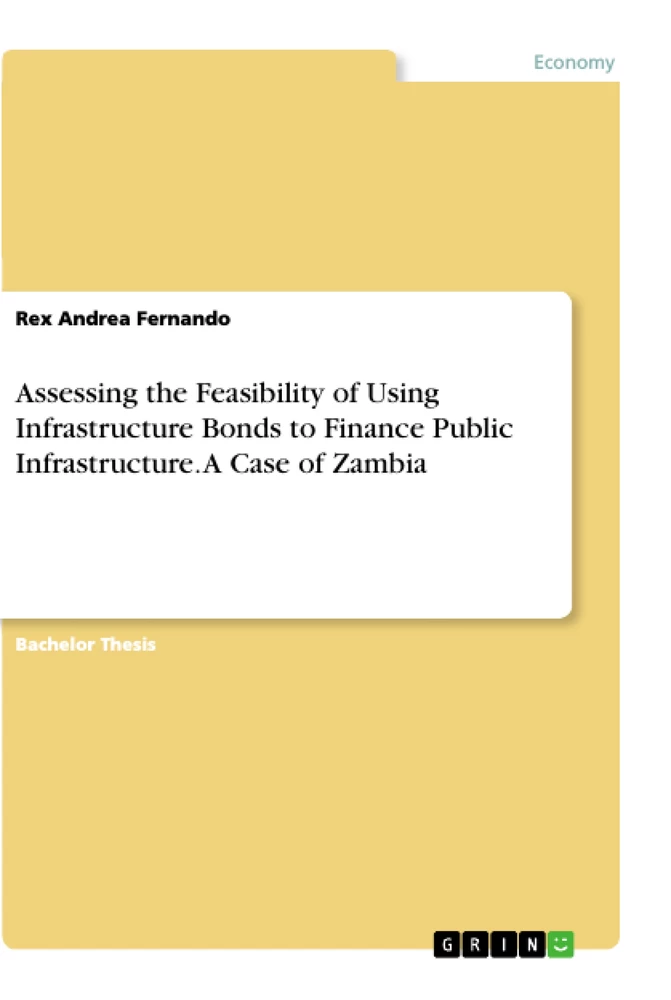
Table of Contents
CHAPTER ONE
1.1 INTRODUCTION
1.2 PROBLEM JUSTIFICATION
1.3 PROBLEM STATEMENT
1.4 PROPOSITION
1.5 IMPORTANCE OF THE STUDY
1.6 OBJECTIVES
1.7 METHODS OF DATA COLLECTION
1.7.1 Primary Data
1.7.2 Secondary Data
1.8 SCOPE OF THE STUDY
1.9 LIMITATION TO THE STUDY
1.10 CHAPTER LAYOUT
CHAPTER TWO
2.1 INTRODUCTION
2.2 INFRASTRUCTURE
2.2.1 Institutional Infrastructure
2.2.2 Personal Infrastructure
2.2.3 Material Infrastructure
2.3 INFRASTRUCTURE FINANCING
2.3.1 Public Sector Participation
2.3.2 Private Sector Participation
2.3.3 Equity Finance
2.3.4 Debt Finance
2.4 FINANCIAL GAP IN INFRASTRUCTURE FINANCING IN ZAMBIA
2.5 BONDS
2.5.1 Key Characteristics of Bond Financing
2.5.2 Bond Market
2.6 WHAT ARE INFRASTRUCTURE BONDS?
2.6.1 Types of Infrastructure/ Project Bonds
2.6.2 Credit Rating of Infrastructure/ Project bonds
2.6.3 Contractual Framework
2.6.4 Risks of Infrastructure Bonds
2.6.5 The Difference with others forms of Finance
2.7 CASE STUDIES
2.8 CHAPTER SUMMARY
CHAPTER THREE
3.1 INTRODUCTION
3.2 RESEARCH STRATEGY
3.2.1 Survey
3.3 RESEARCH DESIGN
3.4 TARGET GROUP
3.5 SAMPLING METHOD AND DESIGN
3.5.1 Sample Design
3.6 SAMPLE SIZE
3.7 DATA COLLECTION
3.7.1 Primary Techniques
3.7.2 Secondary Technique
3.8 DATA ANALYSIS
3.8.1 Qualitative Approach
3.8.2 Quantitative Approach
3.9 CHAPTER SUMMARY
CHAPTER FOUR
4.1 INTRODUCTION
4.2 GENERAL BACKGROUND OF RESPONDENT
4.2.1 Professionals
4. 3 Financial Gap and Infrastructure Bonds
4.3.1 Types of Infrastructure
4.3.2 Sources of Finance
4.3.3 Level of Knowledge on Infrastructure Bonds
4.3.4 Have Infrastructure Bonds ever been used to financing any Infrastructure Development
4.3.5 Characteristics of Bonds
4.3.6 Rating of bonds based on Bond Characteristics
4.3.7 Infrastructure Bonds as a remedy to infrastructure finance gap
4.4 Factors considered in the application for an Infrastructure Bond
4.4.1 Structural Features
4.4.2 Macroeconomic Factors
4.4.3 Public Finance
4.4.4 External Finance
4.4.5 Ways of dealing with risks
4.5 CHAPTER SUMMARY
CHAPTER FIVE
5.1 INTRODUCTION
5.2 SYNOPSIS TO THE STUDY
5.2.1 CHAPTER ONE
5.2.2 CHAPTER TWO
5.2.3 CHAPTER THREE
5.2.4 CHAPTER FOUR
5.3 CONCLUSION
5.3.1 To explore the concept of Infrastructure Bonds
5.3.2 To investigate the requirements for applying of Infrastructure Bonds
5.3.3 To recommend and conclude on the viability of using Infrastructure Bonds for Infrastructure Development
Objectives and Research Themes
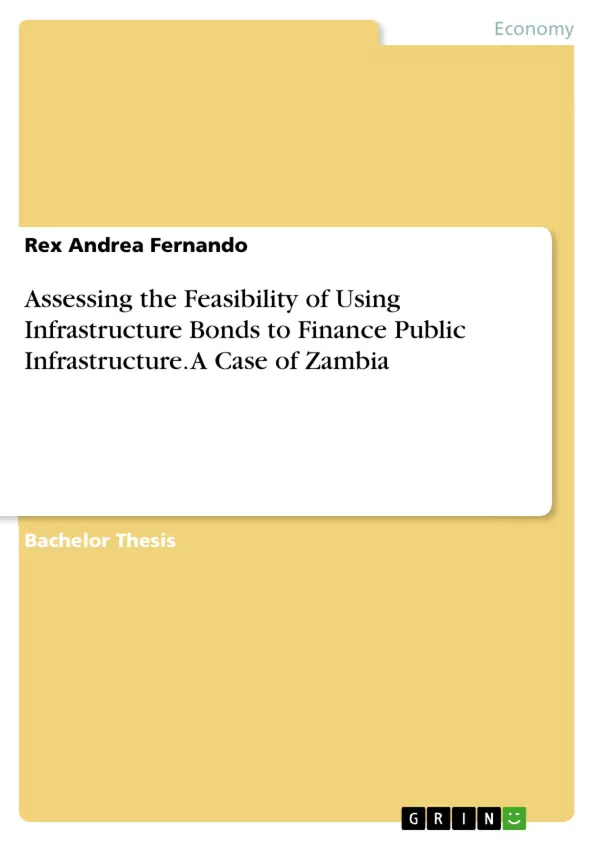
The primary objective of this research is to assess the feasibility of utilizing infrastructure bonds as a viable financial mechanism for funding public infrastructure projects in Zambia, addressing the persistent issue of poor government financial backing that leads to project delays and cost overruns.
- Analysis of existing infrastructure financing gaps in the Zambian public sector.
- Exploration of the concept, characteristics, and application requirements of infrastructure bonds.
- Investigation into the regulatory, legal, and contractual frameworks necessary for bond issuance.
- Evaluation of risk management techniques applicable to infrastructure bond financing.
- Comparison of Zambian economic conditions with regional and international case studies.
Excerpt from the Book
1.1 INTRODUCTION
The Zambian economy has continued to recover in 2017, following a fall in economic growth to 2.9% in 2015, its lowest rate since 1998. The economy was hit hard by lower global copper prices, as well as domestic pressures, including a low harvest after an El-Nino induced drought in 2015, a power crisis, and political uncertainty in the lead-up to the 2016 elections. Growth increased to 3.4% in 2016 and is expected to increase further to 4.1% in 2017 (World Bank, 2017). Falqi (2004) and Borse & Khare (2016) affirms that these and many other occurrences have led to the diversion of money towards solving other problem while crippling the completion of most construction projects on time. Several factors, however, are particularly noteworthy because of their significant impacts on the quality, cost and time of construction. It is self-evident of construction management that a project may be regarded as successful if it is completed on time, within budget, and is of the desired quality It can be accentuated that time, quality and cost complement each other and a limitation in one will directly or inversely affects the other.
Over the past few years most of the infrastructure development projects rolled out in Zambia have suffered from cost overruns, schedule overruns among other. For example, US$ 118.7 million was spent on road projects in 2005, US$ 227 million in 2006 and US$197 million in 2007. However, many road projects were not completed on time and cost hence, leading to loss of revenue due to cost escalation and schedule delays (Kaliba, et al., 2009). Additionally, ZDA (2015) underscores the financial challenges faced by the public sector by stating ‘’ There is a huge infrastructure financing gap and Government is aware that resources from the public sector and development partners are limited and can only cover part of the financing needed ‘’. This then highlights the need to use a financing option that will help to narrow the gap in project financing.
Summary of Chapters
CHAPTER ONE: Provides an introduction to the research, defining the problem of inadequate infrastructure financing, outlining the research objectives, and establishing the study's scope and methodology.
CHAPTER TWO: Reviews literature regarding infrastructure classification, various financing models, the specific role of infrastructure bonds, and the regulatory frameworks required for their successful implementation.
CHAPTER THREE: Details the research methodology, explaining the use of a purposive sampling approach for surveys and interviews conducted within key Zambian government ministries and agencies.
CHAPTER FOUR: Analyzes the data collected from the field, presenting findings on the current knowledge levels, risk management perceptions, and the suitability of infrastructure bonds for the Zambian context.
CHAPTER FIVE: Concludes the study by summarizing key findings and providing recommendations for government bodies to improve infrastructure financing through policy reform and educational initiatives.
Key Words
cost overrun, time overrun, infrastructure bonds, infrastructure development, public infrastructure, project finance, Zambia, economic growth, public debt, financial gap, risk management, credit rating, government spending, fiscal policy, monetary policy.
Frequently Asked Questions
What is the core focus of this research?
This research evaluates the feasibility of using infrastructure bonds as an alternative financial instrument to support public sector infrastructure projects in Zambia, aiming to mitigate chronic underfunding.
What are the primary thematic areas covered?
The work examines infrastructure classification, diverse financing methods, the mechanics of project bonds, institutional and regulatory frameworks, and risk management strategies within the construction sector.
What is the ultimate goal or research question?
The primary goal is to determine if infrastructure bonds can effectively bridge the existing financing gap in Zambia and serve as a sustainable solution to project schedule and cost overruns.
What research methodology was employed?
The study utilized a mixed-method approach, incorporating a detailed literature review and a survey/interview-based field study targeting professionals in the Zambian government and financial regulatory agencies.
What does the main body of the work address?
The core chapters provide a theoretical review of bond financing, describe the current economic and structural landscape of Zambia, and analyze primary data collected from expert stakeholders regarding bond applicability.
Which keywords define the scope of this study?
The study is characterized by terms such as infrastructure development, cost overrun, project finance, credit rating, and debt sustainability, which are central to the analysis of the Zambian financial sector.
Why are "Informed bonds" highlighted in the conclusion?
The study identifies informed bonds as the most favorable type for the Zambian context because their structure, which includes a mandatory advisor and stringent project monitoring, addresses the prevalent concerns of corruption and mismanagement.
What is the author's stance on the current viability of infrastructure bonds in Zambia?
The author concludes that while infrastructure bonds are not immediately feasible under the current conditions, they remain a promising remedy for future public infrastructure challenges, provided that necessary logistical and regulatory improvements are implemented.
Ende der Leseprobe aus 134 Seiten
- nach oben
- Arbeit zitieren
- Rex Andrea Fernando (Autor:in), 2018, Assessing the Feasibility of Using Infrastructure Bonds to Finance Public Infrastructure. A Case of Zambia, München, Page::Imprint:: GRINVerlagOHG, https://www.diplomarbeiten24.de/document/463134

neugierig - aktuell - relevant
Entdecken Sie hilfreiche Tipps und Tricks rund ums Studium!

Entdecken Sie hilfreiche Tipps und Tricks rund ums Studium!
Ihre Hausarbeit / Abschlussarbeit:

- - Publikation als E-Book und Buch
- - Hohes Honorar auf die Verkäufe
- - Für Sie komplett kostenlos - mit ISBN
- - Es dauert nur 5 Minuten
- - Jede Arbeit findet Leser

- © GRIN Publishing GmbH.
- Alle Inhalte urheberrechtlich geschützt. Kopieren und verbreiten untersagt.
- info@grin.com
- AGB
- Open Publishing
Der GRIN Verlag hat sich seit 1998 auf die Veröffentlichung akademischer eBooks und Bücher spezialisiert. Der GRIN Verlag steht damit als erstes Unternehmen für User Generated Quality Content. Die Verlagsseiten GRIN.com, Hausarbeiten.de und Diplomarbeiten24 bieten für Hochschullehrer, Absolventen und Studenten die ideale Plattform, wissenschaftliche Texte wie Hausarbeiten, Referate, Bachelorarbeiten, Masterarbeiten, Diplomarbeiten, Dissertationen und wissenschaftliche Aufsätze einem breiten Publikum zu präsentieren.
Kostenfreie Veröffentlichung: Hausarbeit, Bachelorarbeit, Diplomarbeit, Dissertation, Masterarbeit, Interpretation oder Referat jetzt veröffentlichen!
Folgen Sie GRIN auf


- GRIN Verlag GmbH
-
- Nymphenburger Str. 86
- 80636
- Munich, Deutschland
- +49 89-550559-0
- +49 89-550559-10
- info@grin.com
-
