
präsentiert von

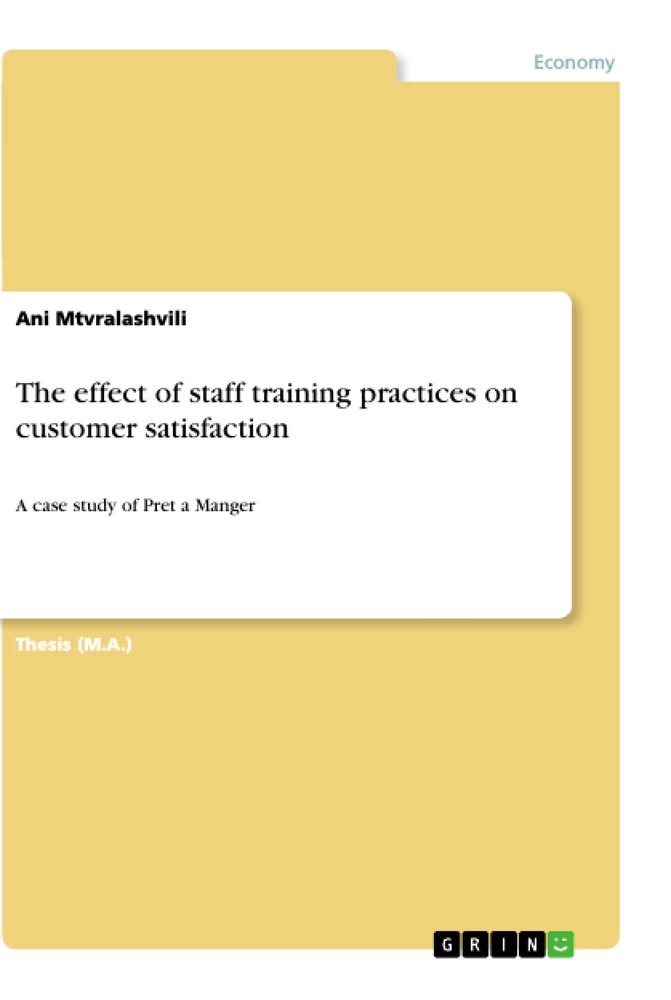
Table of Contents
CHAPTER 1 INTRODUCTION
1.1. Introduction
1.2. Research background
1.3. Academic position
1.4. Research methodology
1.5. Context: Pret A Manger
1.6. Research aims and objectives
1.7. Research layout
1.8. Conclusion
CHAPTER 2 LITERATURE REVIEW
2.1. Introduction
2.2. Research area of Human Resource Management
2.3. Review Staff training practices within HRM
2.4. Customer satisfaction
2.5. Linking staff training practices to customer satisfaction
2.6. Research done on staff training practices and customer satisfaction and the research question
2.7. Scholarly Research: staff training and customer satisfaction
2.7.1. Factors for evaluating customer satisfaction
2.7.1.1. Customer needs and wants
2.7.1.2. Customer expectations
2.7.1.3. Customer repeat purchase intention
2.7.2. Theories of staff training practices
2.7.2.1 Scenistic method of staff training
2.7.2.2. Constructivism learning theory
2.7.3. Models of staff training practices
2.7.3.1. Transitional model of staff training
2.7.4. Factors of staff training practices
2.7.4.1. Training need
2.7.4.2. Staff training methods
2.7.4.3. Staff training programs
2.7.4.4. Employee behaviours and attitudes
2.8. Research context: Pret A Manger
2.9. Academic perspective
2.10. Conclusion
CHAPTER 3 RESEARCH METHODOLGY
3.1. Introduction
3.2. Research philosophy
3.3. Research Approach
3.4. Type of Data
3.5. Research Strategy – Case Study
3.6. Data Collection Methods
3.7. Design of Data Collection
3.8. Data Analysis
3.9. Research Validity
3.10. Research Reliability
3.11. Ethical Consideration
3.12. Conclusion
CHAPTER 4 RESEARCH FINDINGS AND DISCUSSION
4.1. Data Collection – Interviews
4.2. Data Analysis through Thematic Analysis
4.2.1. Initial Themes with Corresponding Codes
4.2.2. Revised Themes
4.2.3. Finalised themes
4.3. Discussion of Findings based on the conceptual framework
4.3.1. Training Need
4.3.2. Employee Behaviour and Attitude
4.4. Discussion of findings based on the literature review
4.4.1. Human resource management
4.4.2. Staff training practices
4.4.3. Customer satisfaction
4.5. Conclusion
CHAPTER 5 CONCLUSION
5.1. Summary of research aim and objectives
5.1.1. Summary of objective 1
5.1.2. Summary of objective 2
5.1.3. Summary of objective 3
5.1.4. Summary of objective 4
5.2. Contributions
5.2.1. Contributions to the academia
5.2.2. Contributions to the industry
5.3. Recommendations
5.3.1. Recommendation to the academia
5.3.2. Recommendation to the industry
5.4. Limitations
5.4.1. Limitations for the academia
5.4.2. Limitations for the industry
5.5. Future work
Research Goals and Themes
This dissertation explores the correlation between staff training practices and customer satisfaction, specifically through a case study of the sandwich retailer Pret A Manger. The research aims to evaluate how training influences employee behavior and subsequent consumer service outcomes.
- Human Resource Management and training strategies
- Methods of measuring customer satisfaction
- The link between employee performance and consumer experience
- Qualitative case study analysis of Pret A Manger
Excerpt from the Book
2.4. Customer satisfaction
Over the last two decades, customer satisfaction (CS) has attracted significant interest in academic research and marketing practice. Hence, many scholars and researchers have examined conceptual and theoretical underpinnings of consumer satisfaction (Luo and Homburg, 2007). On the other hand, Souca (2014) cites that there has been lack of scientific consensus about what the customer satisfaction really is and a clear definition of this concept does not exist. However, the simple definition of consumer satisfaction is that it is a measure of how well services and products meet or exceed the expectation of customers (Eid, 2012). Hill and Alexander (2006) argue that organisations, independent of their size and type, have an increasing understanding of the importance of customer satisfaction. Companies started investing heavily in order to improve performance in such areas, which makes contribution to and facilitates satisfaction of consumer.
Kumari et al. (2013) emphasise that in current competitive business environment, the major aspect of organisational development and success is consumer happiness. Thus, companies are motivated and concentrated on delivering value to satisfy their consumers. Firms are trying to provide superior services and products in order to be competitive in the market. It is believed that organisations which have already succeeded in this highly variable environment are those which have made customer satisfaction a main part of their business strategy.
Summary of Chapters
CHAPTER 1 INTRODUCTION: This chapter provides the background for the research, defining the scope, objectives, and the research layout regarding the relationship between staff training and customer satisfaction.
CHAPTER 2 LITERATURE REVIEW: This chapter analyzes existing theories and models concerning human resource management, training practices, and consumer satisfaction to build a conceptual framework for the study.
CHAPTER 3 RESEARCH METHODOLGY: This chapter outlines the qualitative research design, specifically the choice of interpretivism as a philosophy and the use of semi-structured interviews for data collection.
CHAPTER 4 RESEARCH FINDINGS AND DISCUSSION: This chapter presents the data gathered from interviews at Pret A Manger and discusses the results through thematic analysis.
CHAPTER 5 CONCLUSION: This chapter summarizes the findings, offering contributions to academia and industry, and provides recommendations based on the study's limitations.
Keywords
Staff Training, Customer Satisfaction, Human Resource Management, Pret A Manger, Qualitative Research, Thematic Analysis, Employee Behavior, Service Quality, Customer Loyalty, Organizational Performance, Training Need, Consumer Expectations, Case Study, Workplace Competencies, Employee Development
Frequently Asked Questions
What is the core focus of this research paper?
The paper fundamentally investigates the relationship and potential influence of staff training practices on customer satisfaction within the retail food industry, using Pret A Manger as a specific case study.
Which thematic fields are covered in this dissertation?
The study covers Human Resource Management (HRM) practices, employee behavior and attitudes, customer service metrics, and the development of conceptual frameworks linking training to consumer outcomes.
What is the primary objective of the study?
The primary goal is to identify and evaluate the specific effects of staff training practices on overall customer satisfaction levels, thereby filling a perceived gap in existing academic literature.
Which scientific methodology does the author employ?
The author uses a qualitative research approach, specifically conducting semi-structured, face-to-face interviews with senior staff at Pret A Manger, followed by thematic analysis to evaluate the data.
What topics are discussed in the main body of the work?
The main body discusses the literature regarding training models, the specific case of Pret A Manger, the research methodology used, and the detailed thematic findings regarding training needs, employee performance, and customer satisfaction.
What are the key terms that characterize this work?
Keywords include Staff Training, Customer Satisfaction, HRM, Case Study, Pret A Manger, Thematic Analysis, Employee Behavior, and Service Quality.
Why was Pret A Manger selected as the case study company?
Pret A Manger was selected because of its heavy investment in training and its reputation for excellent customer service in the highly competitive food retail sector, providing a rich context for this research.
How is the effectiveness of training measured according to the findings?
Findings suggest that effectiveness is measured through employee confidence, reduced mistakes, overall profit margins, and qualitative feedback from tools like the Mystery Shopper scheme.
Does the research conclude that training has a positive impact?
Yes, the study concludes that employee training is a vital tool that enhances staff knowledge and service quality, which directly leads to higher levels of customer satisfaction and loyalty.
Ende der Leseprobe aus 90 Seiten
- nach oben
- Arbeit zitieren
- Ani Mtvralashvili (Autor:in), 2017, The effect of staff training practices on customer satisfaction, München, Page::Imprint:: GRINVerlagOHG, https://www.diplomarbeiten24.de/document/464049

neugierig - aktuell - relevant
Entdecken Sie hilfreiche Tipps und Tricks rund ums Studium!

Entdecken Sie hilfreiche Tipps und Tricks rund ums Studium!
Ihre Hausarbeit / Abschlussarbeit:

- - Publikation als E-Book und Buch
- - Hohes Honorar auf die Verkäufe
- - Für Sie komplett kostenlos - mit ISBN
- - Es dauert nur 5 Minuten
- - Jede Arbeit findet Leser

- © GRIN Publishing GmbH.
- Alle Inhalte urheberrechtlich geschützt. Kopieren und verbreiten untersagt.
- info@grin.com
- AGB
- Open Publishing
Der GRIN Verlag hat sich seit 1998 auf die Veröffentlichung akademischer eBooks und Bücher spezialisiert. Der GRIN Verlag steht damit als erstes Unternehmen für User Generated Quality Content. Die Verlagsseiten GRIN.com, Hausarbeiten.de und Diplomarbeiten24 bieten für Hochschullehrer, Absolventen und Studenten die ideale Plattform, wissenschaftliche Texte wie Hausarbeiten, Referate, Bachelorarbeiten, Masterarbeiten, Diplomarbeiten, Dissertationen und wissenschaftliche Aufsätze einem breiten Publikum zu präsentieren.
Kostenfreie Veröffentlichung: Hausarbeit, Bachelorarbeit, Diplomarbeit, Dissertation, Masterarbeit, Interpretation oder Referat jetzt veröffentlichen!
Folgen Sie GRIN auf


- GRIN Verlag GmbH
-
- Nymphenburger Str. 86
- 80636
- Munich, Deutschland
- +49 89-550559-0
- +49 89-550559-10
- info@grin.com
-
