
präsentiert von

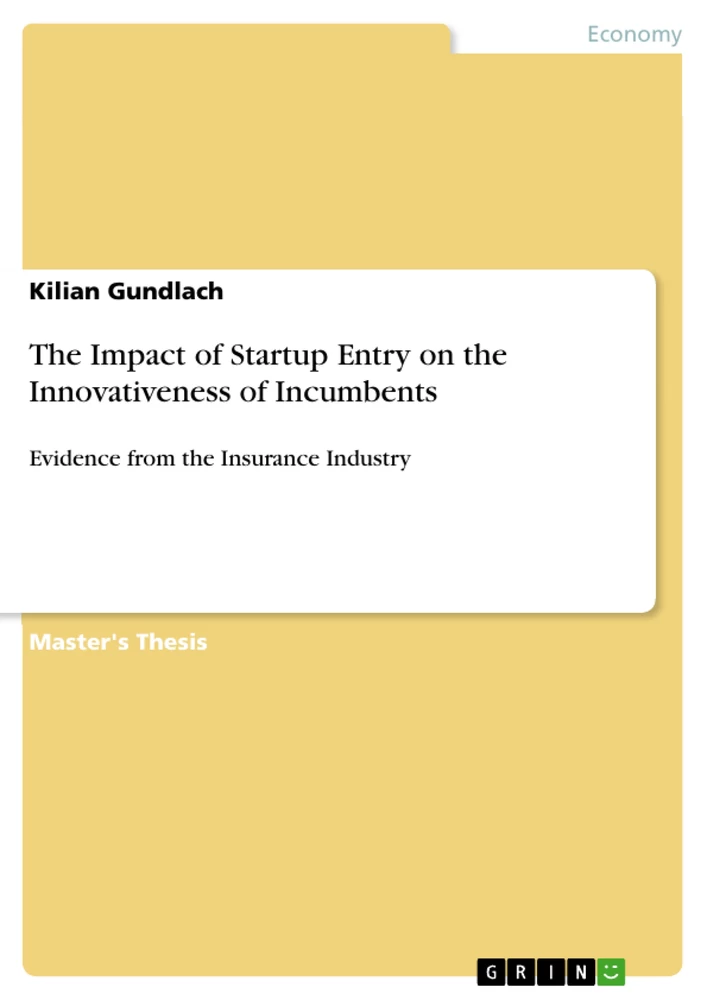
Table of Contents
1. Introduction
2. Related Literature and Hypothesis Development
2.1 Impact of Competition on Innovation
2.2 Moderating Effect of Age
3. Empirical Setting
3.1 Competition and Innovation in the Insurance Industry
3.2 New Market Entrants: InsurTech Startups
4. Data Sample, Method and Empirical Approach
4.1 Data Collection and Sample
4.2 Dependent Variable: Incumbents’ Innovativeness
4.2.1 Measuring Innovation in Financial Services
4.2.2 Coding Guidelines for Innovation Score
4.3 Independent Variable: Startup Entry
4.4 Control Variables
4.5 Research Design
5. Descriptive Statistics and Regression Model Results
5.1 Descriptive Statistics
5.2 Presentation of Results
5.2.1 Effect of Competition on Innovation
5.2.2 Effect of Age on Competition-Innovation Relationship
5.3 Additional Testing
6. Conclusion
Research Objectives and Themes
This thesis investigates how the entry of new startups, specifically within the InsurTech sector, impacts the innovation behavior and performance of established insurance incumbents. The study seeks to determine whether a curvilinear, inverted-U relationship exists between startup entry and incumbent innovation, and explores whether firm age acts as a moderating factor in this dynamic.
- The influence of competition on incumbent innovation patterns.
- The role of InsurTech startups as a new competitive force in the financial services sector.
- The moderating effect of organizational age on innovation responsiveness.
- Methodological approaches to measuring innovation in financial services via annual reports.
- The relationship between firm characteristics (size, profitability, leverage) and innovative output.
Excerpt from the Book
2.1 Impact of Competition on Innovation
The impact of (more intense) competition on innovation and growth has been analyzed for decades, but remains puzzling (Aghion et al., 2005). The seminal work by Schumpeter (1942) argues that product market competition (PMC) discourages innovation, because of decreasing monopoly returns. Aghion and Howitt (1989) reinforce this logic: as the flow of rents for an incumbent is reduced when there is more PMC, its incentive to innovate should decrease alike. Similar conclusions are reached by Salop (1977) and Dixit and Stiglitz (1977) in their research on IO models of product differentiation and monopolistic competition. In the same way, R&D incentives are likely to be negatively influenced through weaker patent protection opportunities and easier imitation, as these levers shorten the expected duration of returns obtained from a certain innovation (Davidson & Segerstrom, 1998).
These models all predict that an incumbent monopolist is unlikely to innovate at all, as it already obtains monopoly rents due to its market power (Aghion & Howitt, 1989). Aghion et al. (2001) state that in Schumpeterian models innovation is rather realized by outsider firms who do not earn rents without innovating. However, in real economy most innovation activity is put forward within competitive industries and within incumbent companies that are already earning rents; thus PMC or an increase in PMC can stimulate innovation activities to increase profits (Aghion et al., 2001). The motivation to innovate in this setting is grounded in the intention to escape competition with neck-and-neck rivals, as pointed out by scholars such as Mookherjee and Ray (1991). These findings reconcile the Schumpeterian paradigm and suggest a positive impact of competition on innovation and firm growth.
Summary of Chapters
1. Introduction: Introduces the research problem, outlines the theoretical context of the competition-innovation relationship, and states the primary aim and hypotheses of the study.
2. Related Literature and Hypothesis Development: Reviews existing academic literature on competition and innovation to establish a theoretical foundation and derive two main research hypotheses.
3. Empirical Setting: Describes the insurance industry landscape, including recent technological trends and the emergence of specialized InsurTech startups.
4. Data Sample, Method and Empirical Approach: Details the data collection process, the construction of the innovation scoring model based on annual reports, and the econometric methodology applied.
5. Descriptive Statistics and Regression Model Results: Presents the statistical analysis of the dataset and discusses the regression findings regarding the impact of startup entry and firm age on innovation.
6. Conclusion: Summarizes the study’s findings, discusses implications for practitioners and policymakers, acknowledges research limitations, and suggests future research directions.
Keywords
Competition, Innovation, Startups, InsurTech, Insurance Industry, Firm Age, Financial Services, Inverted-U Relationship, Incumbents, R&D, Market Entry, Digital Transformation, Quantitative Analysis, Regression Model, Economic Growth
Frequently Asked Questions
What is the core focus of this research?
The research examines the relationship between the entry of startups into the insurance industry and the subsequent innovation behavior of established incumbent firms.
What are the primary thematic areas covered?
The work covers competition theory, the impact of InsurTech on traditional insurance business models, innovation metrics in financial services, and the moderating role of firm age.
What is the primary research objective?
The primary objective is to test whether startup entry has a curvilinear (inverted-U) effect on incumbent innovation and if this effect is stronger for younger incumbents.
Which scientific methodology is utilized?
The author uses a quantitative approach, constructing an innovation score from annual reports of ten major insurance companies and applying a quasi-Poisson regression model to analyze panel data.
What does the main body of the work analyze?
The main body analyzes the competitive landscape of the insurance industry, develops hypotheses based on existing literature, and provides an empirical evaluation of innovation drivers using collected data on 244 InsurTech startups.
Which keywords characterize this thesis?
Key terms include Competition, Innovation, Startups, InsurTech, Incumbents, Firm Age, and Financial Services.
How is "InsurTech" defined in this study?
The study defines InsurTech as an insurance company, intermediary, or value chain segment specialist that utilizes technology to either compete or provide value-added benefits to the industry.
What does the "inverted-U" relationship suggest in this context?
It suggests that startup entry initially has a positive impact on incumbent innovation, but this effect diminishes once competition reaches an excessive level due to the "Schumpeterian effect."
Does firm age play a significant role?
Yes, the findings suggest that the positive effect of startup entry on innovation is slightly stronger for younger incumbents compared to older, more rigid peers.
Are there limitations to the study's findings?
The author acknowledges limitations such as the small sample size, the specific five-year observation period (2011-2015), and potential endogeneity issues like reverse causality.
Ende der Leseprobe aus 57 Seiten
- nach oben
- Arbeit zitieren
- Kilian Gundlach (Autor:in), 2017, The Impact of Startup Entry on the Innovativeness of Incumbents, München, Page::Imprint:: GRINVerlagOHG, https://www.diplomarbeiten24.de/document/468702

neugierig - aktuell - relevant
Entdecken Sie hilfreiche Tipps und Tricks rund ums Studium!

Entdecken Sie hilfreiche Tipps und Tricks rund ums Studium!
Ihre Hausarbeit / Abschlussarbeit:

- - Publikation als E-Book und Buch
- - Hohes Honorar auf die Verkäufe
- - Für Sie komplett kostenlos - mit ISBN
- - Es dauert nur 5 Minuten
- - Jede Arbeit findet Leser

- © GRIN Publishing GmbH.
- Alle Inhalte urheberrechtlich geschützt. Kopieren und verbreiten untersagt.
- info@grin.com
- AGB
- Open Publishing
Der GRIN Verlag hat sich seit 1998 auf die Veröffentlichung akademischer eBooks und Bücher spezialisiert. Der GRIN Verlag steht damit als erstes Unternehmen für User Generated Quality Content. Die Verlagsseiten GRIN.com, Hausarbeiten.de und Diplomarbeiten24 bieten für Hochschullehrer, Absolventen und Studenten die ideale Plattform, wissenschaftliche Texte wie Hausarbeiten, Referate, Bachelorarbeiten, Masterarbeiten, Diplomarbeiten, Dissertationen und wissenschaftliche Aufsätze einem breiten Publikum zu präsentieren.
Kostenfreie Veröffentlichung: Hausarbeit, Bachelorarbeit, Diplomarbeit, Dissertation, Masterarbeit, Interpretation oder Referat jetzt veröffentlichen!
Folgen Sie GRIN auf


- GRIN Verlag GmbH
-
- Nymphenburger Str. 86
- 80636
- Munich, Deutschland
- +49 89-550559-0
- +49 89-550559-10
- info@grin.com
-
