
präsentiert von

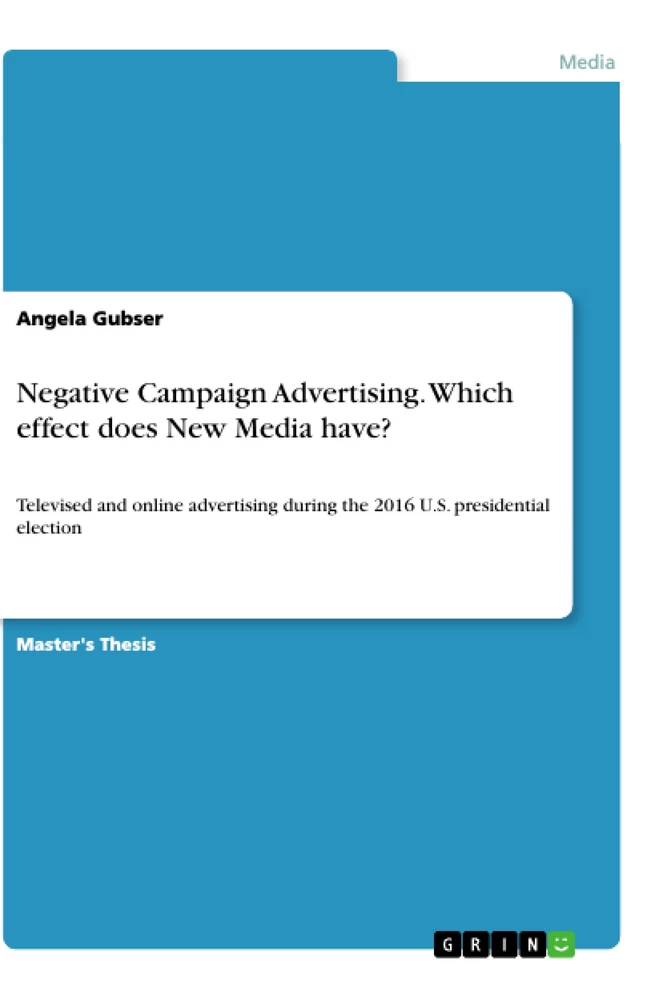
Table of Contents
1. Introduction
1.1 Overview
1.2 Online Advertising in U.S. Presidential Elections
1.3 Advertising in the 2016 Presidential Election
1.4 Regulation of Political Advertising on TV and the Internet
1.5 Research Question
1.6 Structure
2. Theoretical Background
2.1 Political Campaigning and Advertising
2.1.1 Functions of Campaign Messages
2.1.2 Negativity in Political Advertising
2.1.3 Effects of Negative Campaigning
2.1.4 Online Campaigning
2.1.5 Content and Distribution of Online Ads
2.1.6 Image vs. Issue Ads
2.1.7 Negativity in Issue and Image Ads
2.1.8 Emotional Appeals in Political Ads
2.2 Framing Theory
2.2.1 Frames and Types of Framing
2.2.2 Framing Effects
2.2.3 Framing and Emotions
2.2.4 Framing and Distinct Emotional Responses
2.2.5 Implications on Political Decision-Making
2.3 Hypotheses
3. Methodological Approach
3.1 Data Collection and Sampling
3.2 Analysis of the Transcripts
3.2.1 Text analysis
3.2.2 Sentiment analysis
3.3 Regression Analysis
3.3.1 Linear Regression
3.3.2 Logistic Regression
3.4 Operationalization
3.4.1 Preprocessing of Transcript Data
3.4.2 Variables of Interest
3.4.3 Control Variables
3.5 Methodological Challenges
4. Descriptive Results
4.1 Campaign’s Advertising Strategies in the 2016 Election
4.2 Tone of Advertising
4.2.1 The Ten Most Frequent Negative and Positive Words
4.2.2 Positive Campaign Ads
4.2.3 Negative Campaign Ads
4.3 Fear and Anger Appeals
4.3.1 The Ten Most Frequent Words Evoking Fear
4.3.2 Fear Evoking Ad
4.3.3 The Most Frequent Words Evoking Anger
4.3.4 Anger Evoking Ad
5. Empirical Assessment of Theoretical Hypotheses
5.1 Tone of TV and YouTube Ads
5.1.1 Tests using the BING Sentiment score
5.1.2 Tests using the SentimentR score
5.2 Tone of Issue and Image Ads
5.2.1 Tests using the BING Sentiment score
5.2.2 Tests using the SentimentR score
5.3 Issue and Image Ads on TV and YouTube
5.4 Emotional Appeals in Issue and Image Ads
5.4.1 Tests using Percentage of Anger words
5.4.2 Tests using Percentage of Fear words
5.5 Emotional Appeals on TV and YouTube
5.5.1 Tests using Anger
5.5.2 Tests using Fear
6. Discussion
6.1 Overall Tone of Advertising
6.2 Issue and Image Advertising
6.3 Fear and Anger Appeals
7. Conclusion and Research Perspectives
8. References
9. Appendix
9.1 Frequency Tables
9.2 t-test Tables
9.3 Regression Tables
Research Objectives & Key Themes
This master's thesis examines the differences in negativity and content between political advertisements on television and on YouTube during the 2016 U.S. presidential election. It investigates whether online campaigning serves as a distinct, more modern platform for engagement or merely replicates traditional television messaging strategies, specifically focusing on the framing of issues versus images and the use of fear and anger appeals.
- Comparison of tone and negativity between broadcast TV and digital YouTube ads.
- Distinction between issue-oriented and image-based political campaign strategies.
- Analysis of emotional triggers, specifically fear and anger, in electoral advertising.
- Assessment of the "innovation" versus "normalization" hypotheses in digital campaign strategies.
- Methodological application of automated sentiment analysis and regression modeling on political transcripts.
Excerpt from the Book
1.1 Overview
Dating back to 1952, when the Eisenhower Answers America ad ushered political advertising as a feature of presidential campaign communication, candidates have embraced political advertising in the United States (Dunn & Tedesco, 2017). Ever since, those ads are one of the main ways by which presidential candidates communicate with voters (McNair, 2011). Prior to candidate webpages, email and social media, televised political ads presented a rare form of communication, allowing for a candidate-controlled message by the campaign (Dunn & Tedesco, 2017). Some scholars even argue that these messages presented by the candidates leading up to the election can be seen as a cornerstone of functioning democracies. Campaigns are one of the few moments in large-scale democracies when competing candidates make mass appeals to wide segments of the population. While campaigning, politicians present themselves and their records to citizens. These messages undergird the legitimacy that comes with winning elections. Victorious candidate, for the most part, make governing decisions that resonate broadly with the messages and promises of their campaign and their success/failure is judged in accordance to them (Fridkin & Kenney, 2012).
Depending on the chosen strategy, these messages can both be presented positively, i.e. promoting a candidate or negatively, allowing them to attack the image and issue stances of opponents or respond to attacks made by the opponent (Dunn & Tedesco, 2017). In recent decades, most political ads have chosen the negative approach. Thereby, Lyndon Johnson’s ad entitled The Daisy Girl of the 1964 presidential election remains one of the most memorable. It showed a young girl playing he loves me, he loves me not with a daisy and when the last petal was plucked, a voice counted down to a nuclear explosion. The tagline because the stakes are too high for you to stay at home created an even higher sense of urgency (Suggett, 2016). The implication was that a nuclear war was imminent if you voted for Barry Goldwater, Johnson’s Republican opponent, yet Goldwater was never mentioned by name (Fowler et al, 2016). Despite criticism at the time, Johnson’s subsequent electoral win can be seen as proof for the efficacy of negative campaigning and the reach of television (Suggett, 2016).
Summary of Chapters
1. Introduction: This chapter provides an overview of the role of political advertising in U.S. presidential campaigns, outlines the regulatory landscape, and establishes the central research question regarding the differences in tone between television and YouTube.
2. Theoretical Background: This section defines key concepts such as political campaigning, framing theory, and the role of emotional appeals, forming the theoretical basis for the formulated hypotheses.
3. Methodological Approach: The author describes the data collection process from the Political Ad Archive and official YouTube channels, the text and sentiment analysis methods, and the application of linear and logistic regression models.
4. Descriptive Results: This chapter presents statistical insights into advertising strategies, tone, and the frequency of fear and anger appeals used by the Trump and Clinton campaigns during the 2016 election.
5. Empirical Assessment of Theoretical Hypotheses: This core section tests the five main hypotheses using multivariate statistical models, evaluating the sentiment and emotional content of ads across different channels and types.
6. Discussion: The obtained results are contextualized within the broader media environment of 2016, debating the impact of online versus offline campaign strategies and the role of negativity in the modern political climate.
7. Conclusion and Research Perspectives: The thesis concludes by summarizing the findings and suggesting future research directions for political communication in an evolving media landscape.
Keywords
Political advertising, 2016 U.S. Presidential Election, YouTube, Television, Negative campaigning, Sentiment analysis, Framing theory, Fear appeals, Anger appeals, Political communication, Digital media, Regression analysis, Campaign strategies, Voter mobilization, Issue vs. Image ads
Frequently Asked Questions
What is the core focus of this research?
The work analyzes how political advertising strategies differ between television and YouTube in the context of the 2016 U.S. presidential election, specifically looking at the levels of negativity and content.
What are the primary themes addressed in the study?
The central themes include the shift in political advertising from traditional broadcast to digital media, the strategic use of image versus issue-based messaging, and the deployment of discrete negative emotions like fear and anger.
What is the main research question of this study?
The research asks: How does the content of political ads on YouTube and on TV differ with regards to their negativity?
Which scientific methods were employed to analyze the data?
The author uses a quantitative approach, utilizing automated text mining, sentiment analysis with R packages, and both linear and logistic regression models to test the hypotheses.
What is covered in the main body of the work?
The main body transitions from the theoretical framework of campaign messaging and framing to a robust methodological section, followed by a detailed descriptive and empirical analysis of the campaign ads of Donald Trump and Hillary Clinton.
Which keywords best describe this research?
Key terms include political advertising, 2016 presidential election, YouTube, negative campaigning, sentiment analysis, framing, and emotional appeals.
How does the study conclude regarding YouTube advertising?
The study finds that YouTube advertising is not merely a replication of TV strategy, but often carries a more neutral or moderate tone, and that longer ads on YouTube are more likely to contain anger appeals to motivate the existing base.
What role did fear and anger play in the 2016 campaign according to the author?
The author concludes that while both were used, anger appeals were strategically linked to lengthier YouTube content to reinforce partisanship, whereas fear appeals did not show a clear, consistent distinction between the two media channels.
Ende der Leseprobe aus 112 Seiten
- nach oben
- Arbeit zitieren
- Angela Gubser (Autor:in), 2018, Negative Campaign Advertising. Which effect does New Media have?, München, Page::Imprint:: GRINVerlagOHG, https://www.diplomarbeiten24.de/document/468882

neugierig - aktuell - relevant
Entdecken Sie hilfreiche Tipps und Tricks rund ums Studium!

Entdecken Sie hilfreiche Tipps und Tricks rund ums Studium!
Ihre Hausarbeit / Abschlussarbeit:

- - Publikation als E-Book und Buch
- - Hohes Honorar auf die Verkäufe
- - Für Sie komplett kostenlos - mit ISBN
- - Es dauert nur 5 Minuten
- - Jede Arbeit findet Leser

- © GRIN Publishing GmbH.
- Alle Inhalte urheberrechtlich geschützt. Kopieren und verbreiten untersagt.
- info@grin.com
- AGB
- Open Publishing
Der GRIN Verlag hat sich seit 1998 auf die Veröffentlichung akademischer eBooks und Bücher spezialisiert. Der GRIN Verlag steht damit als erstes Unternehmen für User Generated Quality Content. Die Verlagsseiten GRIN.com, Hausarbeiten.de und Diplomarbeiten24 bieten für Hochschullehrer, Absolventen und Studenten die ideale Plattform, wissenschaftliche Texte wie Hausarbeiten, Referate, Bachelorarbeiten, Masterarbeiten, Diplomarbeiten, Dissertationen und wissenschaftliche Aufsätze einem breiten Publikum zu präsentieren.
Kostenfreie Veröffentlichung: Hausarbeit, Bachelorarbeit, Diplomarbeit, Dissertation, Masterarbeit, Interpretation oder Referat jetzt veröffentlichen!
Folgen Sie GRIN auf


- GRIN Verlag GmbH
-
- Nymphenburger Str. 86
- 80636
- Munich, Deutschland
- +49 89-550559-0
- +49 89-550559-10
- info@grin.com
-
