
präsentiert von

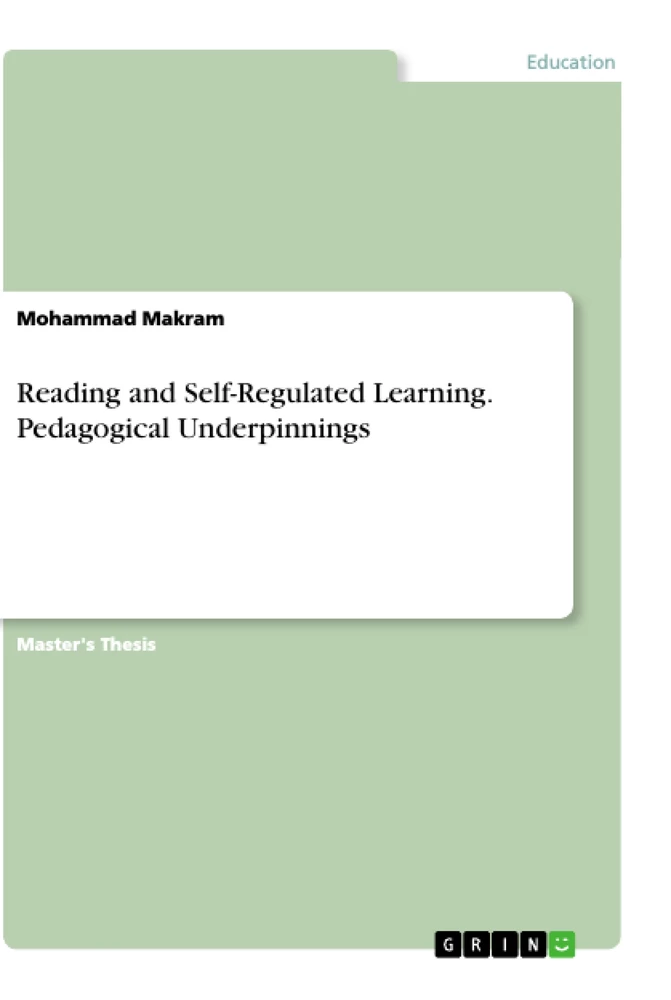
Table of Contents
1.1 Introduction
1.2 Background of the problem
1.3 Definition of terms
1.3.1 Self-regulated learning
1.3.2 Reading comprehension
1.4 Significance of the study
1.5 Objective of the study
1.6 Question of the study
1.7 Delimitations of the study
1.8 Design & Methodology
1.9 Procedures of the study
2.1 Self-regulated learning
2.1.1 Nature of self-regulated learning
2.1.2 Origins of self-regulated learning
2.1.3 Dimensions of self-regulated learning
2.1.4 Self-regulated learning strategies (SRLSs)
2.1.5 Characteristics of self-regulated learners
2.2 Reading Comprehension
2.2.1 What is reading?
2.2.2 Reading as an interactive process
2.2.3 Reading as a critical activity
2.2.4 Characteristics of effective readers
2.2.5 Purposes for reading
2.2.5.1 Why is setting a purpose for reading important?
2.2.6 Factors that affect reading
2.2.6.1 Reader-related factors
2.2.6.2 Text-related factors
2.2.6.3 Context-related factors
2.2.7 Effective reading instruction
2.2.8 Reading skills
2.2.8.1 Skimming
2.2.8.2 Scanning
2.2.8.3 Guessing/Deducing meaning from context
2.2.8.4 Drawing inferences
2.2.8.5 Summarization
2.2.8.6 Critical reading
2.2.8.7 Creative reading
2.3 Commentary
2.4 Pedagogical implications
2.4 Conclusion
3.1 Design of the study
3.2 Variables of the study
3.2.1 The independent variable: Self-regulated learning
3.2.2 The dependent variable: Reading comprehension
3.2.3 Control Variables
3.3 Group of the study
3.3.1 Piloting
3.3.2 Research group
3.4 Materials & Instruments of the study
3.4.1 The suggested self-regulated learning program
3.4.1.1 Objectives of the program
3.4.1.2 Framework of the program
3.4.1.3 Resources of the program
3.4.1.4 Structure of the program
3.4.1.5 Validity of the program
3.4.1.6 Piloting the program
3.4.2 The reading comprehension test
3.4.2.1 Test construction
3.4.2.2 Test question types
3.4.2.3 Test instructions
3.4.2.4 Test piloting
3.4.2.5 Test validity
3.4.2.6 Test reliability
3.4.2.7 Test easiness & difficulty indexes
3.4.2.8 Test discrimination index
3.4.2.9 Test time
3.4.2.10 Scoring the test (Rubric)
3.5 The structured interview
3.5.1 Objective of the interview
3.5.2 Description & Structure of the interview
3.5.3 Validity of the interview
3.5.4 Scoring the interview
3.6 Timetable of the experiment
3.7 Difficulties encountered during the study
4.1 Hypothesis I
4.2 Hypothesis II
4.3 Discussion
4.3.1 Analysis of quantitative data
4.3.2 Analysis of qualitative data (Student-interviewees' reflections)
5.1 Objective of the study
5.2 Question of the study
5.3 Hypotheses of the study
5.4 Design of the study
5.5 Instruments & Materials
5.6 Delimitations of the study
5.7 Main findings
5.8 Implications: Future research trajectories
5.9 Recommendations of the study
5.10 Suggestions for further research:
Research Objectives and Core Themes
The primary objective of this study is to investigate the efficacy of a self-regulated learning program on the reading comprehension proficiency of third-year English majors. The research seeks to determine whether explicitly teaching self-regulation strategies—such as goal-setting, self-monitoring, and cognitive organization—enhances students' ability to master complex reading comprehension skills compared to traditional pedagogical approaches.
- Impact of self-regulated learning on academic achievement.
- Cognitive and metacognitive strategies in reading comprehension.
- Role of student independence and motivation in language learning.
- Comparison of instructional methods in English as a Foreign Language (EFL) contexts.
- Integration of qualitative feedback to assess pedagogical interventions.
Extract from the Book
1.1 Introduction
Literacy is crucial for human life; it is the means whereby people can communicate and exchange information in different fields. A literate community is a dynamic community in which people have access to share knowledge, communicate effectively and indulge in different aspects of social dialogue. This way it is significant to learn the basic form of literacy, i.e. reading.
Reading, in this concern, is vital for engaging in the worldwide society of literacy and knowledge. That is why governments all over the world exert much effort on reading and literacy programs. For instance, Zimmerman (2012) pointed that poor reading skills or failure to keep on reading lead to failure in any academic pursuit. Furthermore, reading is unlimited to just alphabet learning or passing exams at school level, but it has to do with one’s daily needs. Such needs may range from simply reading a telephone number or scanning a sign for an important address to reading textbooks at college level.
Nevertheless, the domain of teaching reading still witnesses a wide range of problems that may range from text-related issues (such as readability), to teaching methods and students’ readiness and motivation for reading. Irujo (2016, 6) indicated that “reading comprehension instruction for English language learners (ELLs) needs to be modified to address their needs.” Additionally, August and Shanahan (2006) indicated that instruction in the key components of reading is necessary, but not sufficient. That is to say, teaching reading has to be more student-centered, taking into consideration students’ different reading abilities and interests, comprehension and individual abilities.
Summary of Chapters
1.1 Introduction: Provides the foundational rationale for the study, highlighting the importance of reading literacy and the necessity of self-regulation in the learning process.
1.2 Background of the problem: Analyzes previous studies and identifies gaps in reading instruction, underscoring the struggle of EFL learners with vocabulary and comprehension strategies.
2.1 Self-regulated learning: Establishes the theoretical framework by exploring the nature, dimensions, and origins of self-regulated learning theories.
2.2 Reading Comprehension: Examines the complexity of reading as an interactive, critical, and purposeful activity, categorizing key sub-skills required for effective reading.
3.1 Design of the study: Details the quasi-experimental methodology, including group selection, the implementation of the self-regulated program, and the usage of quantitative and qualitative instruments.
4.1 Hypothesis I: Presents the statistical analysis of the control and experimental groups' post-test results, evaluating the impact of the program on specific reading sub-skills.
5.1 Objective of the study: Summarizes the research aim, design, and major findings, offering recommendations for curriculum designers and future research.
Keywords
Self-regulated learning, reading comprehension, EFL learners, metacognitive strategies, cognitive strategies, language proficiency, pedagogical implications, student-centered instruction, literacy skills, quasi-experimental design, reading instruction, student motivation, critical reading, learning autonomy.
Frequently Asked Questions
What is the core focus of this research?
The research examines the effectiveness of using a self-regulated learning program to help third-year English majors improve their mastery of specific reading comprehension skills.
What are the primary fields of study addressed?
The work integrates educational psychology—specifically self-regulation theory—with language teaching methodologies and reading instruction in English as a Foreign Language (EFL) settings.
What is the main research question?
The study asks what effect a structured program based on self-regulated learning strategies has on the reading comprehension mastery of third-year EFL university students.
Which scientific method is utilized?
The researcher adopts a quasi-experimental research design, utilizing two groups (control and experimental) to compare the impact of traditional instruction versus self-regulated learning intervention.
What is addressed in the theoretical main section?
The main part provides a comprehensive literature review on the definitions, dimensions, and cyclic models of self-regulated learning, as well as an exploration of reading as an interactive, critical, and sub-skill-based process.
Which keywords best describe this academic work?
Core terms include Self-regulated learning, reading comprehension, EFL learners, metacognitive strategies, and academic achievement.
Why is self-regulation considered necessary for reading comprehension?
It is presented as a method to foster learner independence, allowing students to move beyond passive decoding toward active, goal-oriented mastery of study materials.
What unique insights does the study offer regarding the participant group?
The study highlights specific challenges faced by third-year English majors, such as misconceptions about research programs and a reliance on haphazard "guessing" instead of applying systematic reading strategies.
Ende der Leseprobe aus 94 Seiten
- nach oben
- Arbeit zitieren
- Mohammad Makram (Autor:in), 2019, Reading and Self-Regulated Learning. Pedagogical Underpinnings, München, Page::Imprint:: GRINVerlagOHG, https://www.diplomarbeiten24.de/document/470281

neugierig - aktuell - relevant
Entdecken Sie hilfreiche Tipps und Tricks rund ums Studium!

Entdecken Sie hilfreiche Tipps und Tricks rund ums Studium!
Ihre Hausarbeit / Abschlussarbeit:

- - Publikation als E-Book und Buch
- - Hohes Honorar auf die Verkäufe
- - Für Sie komplett kostenlos - mit ISBN
- - Es dauert nur 5 Minuten
- - Jede Arbeit findet Leser

- © GRIN Publishing GmbH.
- Alle Inhalte urheberrechtlich geschützt. Kopieren und verbreiten untersagt.
- info@grin.com
- AGB
- Open Publishing
Der GRIN Verlag hat sich seit 1998 auf die Veröffentlichung akademischer eBooks und Bücher spezialisiert. Der GRIN Verlag steht damit als erstes Unternehmen für User Generated Quality Content. Die Verlagsseiten GRIN.com, Hausarbeiten.de und Diplomarbeiten24 bieten für Hochschullehrer, Absolventen und Studenten die ideale Plattform, wissenschaftliche Texte wie Hausarbeiten, Referate, Bachelorarbeiten, Masterarbeiten, Diplomarbeiten, Dissertationen und wissenschaftliche Aufsätze einem breiten Publikum zu präsentieren.
Kostenfreie Veröffentlichung: Hausarbeit, Bachelorarbeit, Diplomarbeit, Dissertation, Masterarbeit, Interpretation oder Referat jetzt veröffentlichen!
Folgen Sie GRIN auf


- GRIN Verlag GmbH
-
- Nymphenburger Str. 86
- 80636
- Munich, Deutschland
- +49 89-550559-0
- +49 89-550559-10
- info@grin.com
-
