
präsentiert von

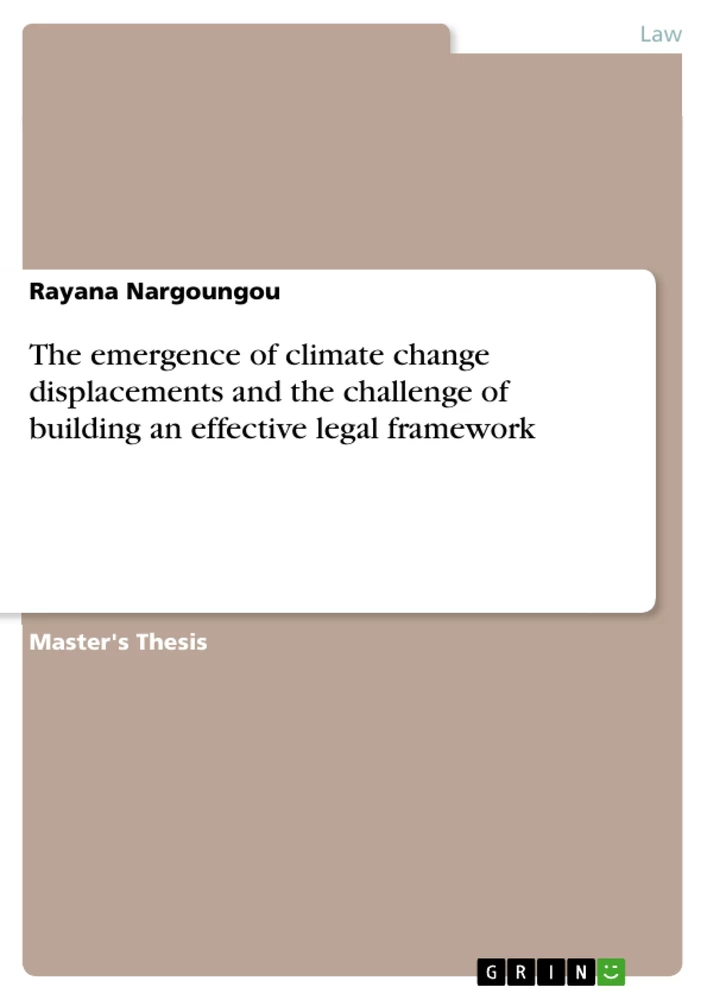
Table of Contents
Introduction
Title I: The climate change migrants
Title II-Climate change refugees and international law
Conclusion
Research Objectives & Core Themes
This thesis examines the complex interplay between climate change, environmental degradation, and human mobility, focusing on the legal vacuum surrounding climate-induced displacement. The research aims to evaluate the adequacy of current international frameworks, such as the 1951 Geneva Convention, in addressing the needs of those displaced by environmental factors, while exploring potential regional and legal alternatives to manage this emerging global crisis.
- Analysis of climate-driven migration patterns and environmental risk factors.
- Evaluation of current legal definitions and nomenclatures regarding "climate refugees."
- Assessment of the role of international and regional instruments like the Kampala Convention.
- Exploration of policy adaptations and proactive governance strategies for climate-induced displacement.
Excerpt from the Book
Section 2: How climate change became a driver for migration
As expounded earlier, migration is caused by several factors, which varies over time and according to the individuals, or groups.
The climate change appears to be an added factor to the already complex decision to migrate.
This section will aim to study how climate change directly and indirectly impacts the decision to migrate
The Foresight report of 2011 presents theories from studies made on displacements. It puts an accent on the fact that climate change became a non-insignificant trigger to migration, compared to the usual ones such as economic and political factors (inflation in food process, high exposure to armed conflicts risks etc....).
According to the report, the climate changes affect macro, meso and micro levels of displacement choices.
Summary of Chapters
Introduction: Outlines the urgent link between rapid climate change and mass human displacement, establishing the necessity for a new legal scholarship and protective framework.
Title I: The climate change migrants: Analyzes the socioeconomic and environmental drivers of migration, including global warming, sea-level rise, urban heat effects, and resource scarcity.
Title II-Climate change refugees and international law: Critically evaluates the inadequacy of the 1951 Refugee Convention and proposes alternative regional and legal approaches to protect displaced populations.
Conclusion: Synthesizes the need for proactive governance and regional cooperation to manage the imminent humanitarian crisis caused by climate-induced displacement.
Keywords
Climate change, human mobility, forced migration, environmental degradation, legal framework, climate refugees, internally displaced persons, Kampala Convention, global warming, sea level rise, international law, humanitarian aid, regional cooperation, resource scarcity, sustainable development.
Frequently Asked Questions
What is the core focus of this thesis?
The thesis focuses on the emergence of climate-induced displacement as a global challenge and the lack of an effective international legal framework to protect the people affected by these environmental changes.
What are the primary thematic areas covered?
The main themes include the environmental triggers of migration (such as sea-level rise and drought), the debate over defining "climate refugees," and the assessment of existing legal instruments like the Geneva Convention and the Kampala Convention.
What is the central research question?
The primary research question addresses how international law can adapt to recognize and manage the specific needs of individuals displaced by climate change, who do not currently fit the traditional definition of refugees.
Which scientific methods are utilized in this work?
The author utilizes a qualitative analytical method, synthesizing reports from international organizations like the World Bank and UNHCR, academic migration theories, and case studies to examine current legal frameworks.
What does the main body of the work address?
The main body examines the direct and indirect effects of environmental change on population movement, explores the complexities of legal terminology, and evaluates specific mechanisms for regional and international legal protection.
How can this work be characterized by keywords?
Key terms include climate change, forced migration, international legal frameworks, environmental refugees, and regional governance models like the Kampala Convention.
Why does the author argue that the current refugee definition is insufficient?
The author argues it is insufficient because the 1951 Geneva Convention requires proof of intentional persecution, whereas climate change is a non-intentional, multifaceted phenomenon affecting entire communities rather than specific social groups.
What is the significance of the "Kampala Convention" in this research?
The Kampala Convention is highlighted as a pioneering regional model that specifically addresses the protection of internally displaced persons (IDPs), offering a blueprint for managing displacement within national and regional borders.
What role does New Zealand play in the author's analysis of climate visas?
New Zealand is examined as a case study for progressive policy, specifically its efforts to reflect on official visa programs for climate-affected Pacific islanders, marking a shift toward anticipating humanitarian migration needs.
How does the author view the "security approach" to migration?
The author expresses concern that viewing climate migration primarily through a security lens leads to restrictive policies, such as border walls, rather than sustainable development and adaptation strategies.
Ende der Leseprobe aus 55 Seiten
- nach oben
- Arbeit zitieren
- Rayana Nargoungou (Autor:in), 2018, The emergence of climate change displacements and the challenge of building an effective legal framework, München, Page::Imprint:: GRINVerlagOHG, https://www.diplomarbeiten24.de/document/477216

neugierig - aktuell - relevant
Entdecken Sie hilfreiche Tipps und Tricks rund ums Studium!

Entdecken Sie hilfreiche Tipps und Tricks rund ums Studium!
Ihre Hausarbeit / Abschlussarbeit:

- - Publikation als E-Book und Buch
- - Hohes Honorar auf die Verkäufe
- - Für Sie komplett kostenlos - mit ISBN
- - Es dauert nur 5 Minuten
- - Jede Arbeit findet Leser

- © GRIN Publishing GmbH.
- Alle Inhalte urheberrechtlich geschützt. Kopieren und verbreiten untersagt.
- info@grin.com
- AGB
- Open Publishing
Der GRIN Verlag hat sich seit 1998 auf die Veröffentlichung akademischer eBooks und Bücher spezialisiert. Der GRIN Verlag steht damit als erstes Unternehmen für User Generated Quality Content. Die Verlagsseiten GRIN.com, Hausarbeiten.de und Diplomarbeiten24 bieten für Hochschullehrer, Absolventen und Studenten die ideale Plattform, wissenschaftliche Texte wie Hausarbeiten, Referate, Bachelorarbeiten, Masterarbeiten, Diplomarbeiten, Dissertationen und wissenschaftliche Aufsätze einem breiten Publikum zu präsentieren.
Kostenfreie Veröffentlichung: Hausarbeit, Bachelorarbeit, Diplomarbeit, Dissertation, Masterarbeit, Interpretation oder Referat jetzt veröffentlichen!
Folgen Sie GRIN auf


- GRIN Verlag GmbH
-
- Nymphenburger Str. 86
- 80636
- Munich, Deutschland
- +49 89-550559-0
- +49 89-550559-10
- info@grin.com
-
