
präsentiert von

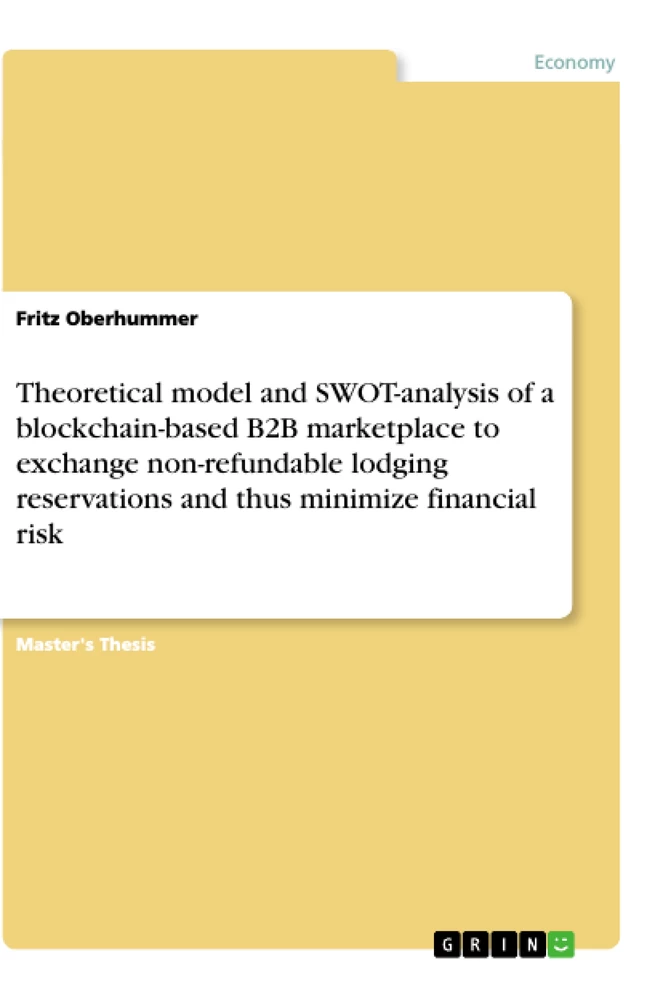
Table of Contents
Executive Summary
Introduction
1. Problem Definition
2. Objectives
3. Methodology
4. Main Part
1. Definitions and current overview
4.1.1 B2B Online Market Place
4.1.1.1 Definition B2B Online Marketplace
4.1.1.2 Key metrics
4.1.2 Overview of the travel industry
4.1.2.1 Types of travel companies
4.1.2.1.1 Online Travel Agents OTAs (B2C) and Search
4.1.2.1.2 Supplier (Airlines, rental car suppliers etc.)
4.1.2.1.3 Retail (content aggregators offline)
4.1.2.1.4 Travel Management Companies (TMC) and Business Travel
4.1.2.1.5 Technology providers and GDS
4.1.2.2 Billing models of the travel industry
4.1.2.2.1 Merchant vs Agency
4.1.2.2.2 Merchant of Record vs Customer Direct
4.1.2.3 Merchant model: industry standards on financial operations
4.1.2.3.1 “Booked” vs “Stayed” billing
4.1.2.3.2 Collateral
4.1.2.3.3 Reconciliation and write-offs
4.1.2.3.4 Service and support for multi-vendor environments (24/7, supplier relations, scalable backend systems)
4.1.3 Overview blockchain
4.1.3.1 Origins and general functionality (blockchain/Bitcoin)
4.1.3.2 Ethereum: Smart Contracts extension
2. Theoretical model of a B2B hotel reservations exchange
4.2.1 Market-place sizing
4.2.2 Prerequisites for marketplace participants
4.2.2.1 Business requirements
4.2.2.1.1 Pre-verification by Suppliers/Insurers
4.2.2.1.2 Business relationships to other marketplace participants
4.2.2.1.3 Escrow
4.2.2.2 Technology requirements
4.2.2.2.1 Source code
4.2.2.2.2 API interfaces/connectivity
4.2.2.2.3 Storage technology
4.2.2.2.4 Security systems (PCI DSS)
4.2.2.3 Operational setup
4.2.2.3.1 Initial setup
4.2.2.3.2 ICO and initial FO$ credit awards
4.2.2.3.3 Achieving “consensus” and master validation nodes
4.2.2.3.4 Adding/removing product and recording sales on the distributed ledger
3. SWOT-Analysis of marketplace
4.3.1 Strengths
4.3.1.1 Decentralization of transactions
4.3.1.2 Existing partner basis and industry knowledge
4.3.1.3 Additional income stream for the marketplace provider
4.3.1.4 Easier to enforce contract obligations (via Smart contracts)
4.3.1.5 Cost reduction of reconciliation/accounting procedures
4.3.1.6 Large-scale enterprise resources
4.3.2 Weaknesses
4.3.2.1 Blockchain scaling/speed limitations
4.3.2.2 Additional budget and needed resources
4.3.2.3 Duplicate bookings off the chain
4.3.2.4 Blockchain security risks
4.3.2.5 Escrow dependency
4.3.2.6 Operational risk and financial cost for switch over
4.3.3 Opportunities
4.3.3.1 USP for market place participants to increase customer retention/satisfaction
4.3.3.2 Currency fluctuation risk minimization
4.3.3.3 Future public open marketplace
4.3.4 Threats
4.3.4.1 Possible issues from legal regulations
4.3.4.1.1 Privacy data and General Data Protection Regulation (GDPR) of the EU
4.3.4.1.2 Packaging Directive
4.3.4.1.3 ICO regulative aspects
4.3.4.2 FO$-token exchange rate fluctuation
4.3.4.3 Visibility of sensitive financial information of competitors
4.3.4.4 Push-back from inventory suppliers
4.3.4.5 Adoption/knowledge on blockchain in travel industry
4.3.4.6 Competition: Alternative Open blockchains
5. Conclusion
5.1.1.1 Initial variant: Private Ledger (only limited partner base)
5.1.1.2 Extended variant: Multi-supply and public ledger model
5.1.1.3 Final conclusion
6. Appendices
1. ITM-Approach
6.1.1 General Economics
6.1.2 Strategic Management
6.1.3 Marketing
6.1.4 Financial Management
6.1.5 Human Resource Management
6.1.6 Business Law
6.1.7 Research Methods / Management Decision Making
6.1.8 Soft Skills / Leadership
Objectives and Research Themes
The primary objective of this thesis is to develop a theoretical framework for a blockchain-based B2B marketplace specifically designed for the exchange of non-refundable lodging reservations, with the goal of mitigating financial risks and resolving industry-wide frictions regarding cancellation fees and inventory management.
- Blockchain technology as a decentralized exchange layer for the travel industry.
- Technical and commercial requirements for a B2B reservation marketplace.
- Financial risk mitigation through smart contracts and escrow services.
- SWOT analysis of the proposed framework, covering internal strengths, weaknesses, and external opportunities and threats.
- Evaluation of regulatory and legal considerations, including GDPR compliance and ICO standards.
Excerpt from the Book
4.3.1.1 Decentralization of transactions
One of the main advantages of a distributed ledger is the decentralization which removes the dependency on a single, centralized database, a concept already being introduced in the pre-Internet age (McLeod and Heimbigner, 1980). The benefits here are moving away from one single point of failure and also creatomg less vulnerability against cyberattacks (Walport, 2015, p. 6). This then also greatly reduces the need for costly high-end firewalls and other protection measures which in turn creates savings in IT infrastructure.
Also, if there a multiple data participants there is a tendency that a centralized database might not be up-to-date, which out of the authors professional experience leads especially in the travel industry to issues when reconciling bookings with suppliers (more on this in point 4.3.1.5 “Cost reduction of reconciliation/accounting procedures”)
Summary of Chapters
Problem Definition: This chapter introduces the core challenge of the travel industry: the inability of companies to swap or re-sell non-refundable lodging reservations, leading to financial losses.
Objectives: The chapter defines the goal of creating a theoretical blockchain-based B2B marketplace to standardize the exchange of these reservations.
Methodology: The author outlines the research process, which includes data analysis of market volume, basic process diagramming, expert interviews, and a structured SWOT analysis.
Main Part: This section covers definitions of B2B marketplaces, an overview of the travel industry, blockchain technology basics including Smart Contracts, and the detailed theoretical model for the reservations exchange.
SWOT-Analysis of marketplace: This chapter evaluates the internal strengths and weaknesses of the proposed blockchain model and identifies external opportunities and threats.
Conclusion: The author summarizes the findings, suggesting an initial private ledger variant for a vetted group of partners before potentially expanding to an open public model.
Appendices: The appendix provides a detailed ITM-approach, applying economic, strategic, and management theories to the proposed blockchain solution.
Keywords
Blockchain, B2B Marketplace, Lodging Reservations, Smart Contracts, Travel Industry, Non-refundable, Ethereum, Financial Risk, Decentralization, SWOT Analysis, Cryptocurrency, FO$ Token, Distribution, Settlement, Reconciliation
Frequently Asked Questions
What is the core problem this thesis addresses?
The work focuses on the inefficiency and financial burden of non-refundable lodging reservations, which companies currently cannot easily swap or re-sell, resulting in wasted inventory and customer dissatisfaction.
What are the central thematic fields covered?
The thesis connects three primary fields: travel industry business processes, financial billing models (Merchant vs. Agency), and blockchain technology (specifically Ethereum and Smart Contracts).
What is the primary goal of the research?
The goal is to design a theoretical technical and commercial framework for a decentralized B2B marketplace that allows travel companies to trade lodging reservations securely.
Which scientific methodology is employed?
The research uses a deductive, mixed-method approach, combining secondary data analysis, market process investigation, expert feedback, and a structured SWOT analysis to validate the model.
What topics are discussed in the main part?
It provides an overview of existing travel industry structures, explains blockchain mechanisms, details the business and technical prerequisites for the marketplace, and conducts an in-depth SWOT analysis.
How is the proposed blockchain model characterized?
The model is characterized by its use of an Ethereum-based private ledger, the introduction of a custom cryptocurrency ("FO$"), and the application of Smart Contracts to automate transactions and enforcement.
Why is an escrow service considered vital for this marketplace?
Escrow services are essential to provide financial guarantees for transactions in major fiat currencies (USD, EUR, GBP), helping participants mitigate currency fluctuation risks and credit issues.
How does the author address the security risks of blockchain?
The author highlights risks such as 51% attacks, private key security, and vulnerabilities in Smart Contracts, recommending cold storage for funds and robust code-auditing practices to minimize exposure.
How is the legal environment regarding ICOs and GDPR treated?
The thesis discusses the complexity of EU GDPR data privacy requirements and the evolving regulatory landscape for Initial Coin Offerings (ICOs), noting that legal compliance is a critical hurdle for any public-facing token implementation.
Ende der Leseprobe aus 100 Seiten
- nach oben
- Arbeit zitieren
- Fritz Oberhummer (Autor:in), 2019, Theoretical model and SWOT-analysis of a blockchain-based B2B marketplace to exchange non-refundable lodging reservations and thus minimize financial risk, München, Page::Imprint:: GRINVerlagOHG, https://www.diplomarbeiten24.de/document/488811

neugierig - aktuell - relevant
Entdecken Sie hilfreiche Tipps und Tricks rund ums Studium!

Entdecken Sie hilfreiche Tipps und Tricks rund ums Studium!
Ihre Hausarbeit / Abschlussarbeit:

- - Publikation als E-Book und Buch
- - Hohes Honorar auf die Verkäufe
- - Für Sie komplett kostenlos - mit ISBN
- - Es dauert nur 5 Minuten
- - Jede Arbeit findet Leser

- © GRIN Publishing GmbH.
- Alle Inhalte urheberrechtlich geschützt. Kopieren und verbreiten untersagt.
- info@grin.com
- AGB
- Open Publishing
Der GRIN Verlag hat sich seit 1998 auf die Veröffentlichung akademischer eBooks und Bücher spezialisiert. Der GRIN Verlag steht damit als erstes Unternehmen für User Generated Quality Content. Die Verlagsseiten GRIN.com, Hausarbeiten.de und Diplomarbeiten24 bieten für Hochschullehrer, Absolventen und Studenten die ideale Plattform, wissenschaftliche Texte wie Hausarbeiten, Referate, Bachelorarbeiten, Masterarbeiten, Diplomarbeiten, Dissertationen und wissenschaftliche Aufsätze einem breiten Publikum zu präsentieren.
Kostenfreie Veröffentlichung: Hausarbeit, Bachelorarbeit, Diplomarbeit, Dissertation, Masterarbeit, Interpretation oder Referat jetzt veröffentlichen!
Folgen Sie GRIN auf


- GRIN Verlag GmbH
-
- Nymphenburger Str. 86
- 80636
- Munich, Deutschland
- +49 89-550559-0
- +49 89-550559-10
- info@grin.com
-
