
präsentiert von

Content
0 Summary
1 Introduction
1.1 Panic disorder: definitions and aetiology
1.2 Treatment options for panic disorder and therapy success
1.3 Cortisol stress response in panic disorder patients compared to healthy individuals as well as post-traumatic stress disorder and major depressive disorder patients
2 Aims
3 Methods
4 Study I: Effects of the cortisol stress response on the psychotherapy outcome for panic disorder patients
4.1 Abstract
4.2 Introduction
4.3 Methods
4.4 Results
4.5 Discussion
5 Study II: Cortisol stress response in post-traumatic stress disorder, panic disorder and major depressive disorder patients
5.1 Abstract
5.2 Introduction
5.3 Methods
5.4 Results
5.5 Discussion
6 Study III: Stress hormone response to the DEX-CRH test and its relation to psychotherapy outcome in panic disorder patients with and without agoraphobia
6.1 Abstract
6.2 Introduction
6.3 Methods
6.4 Results
6.5 Discussion
7 Discussion
7.1 Discussion of main findings
7.2 Implications for clinical practice
7.3 Implications for future research
7.4 Strengths and limitations
8 Conclusions
9 References
10 Appendix
10.1 Acknowledgements
10.2 Erklärung zu den Eigenanteilen an einzelnen Publikationen
10.3 Eigenständigkeitserklärung
Research Objectives & Topics
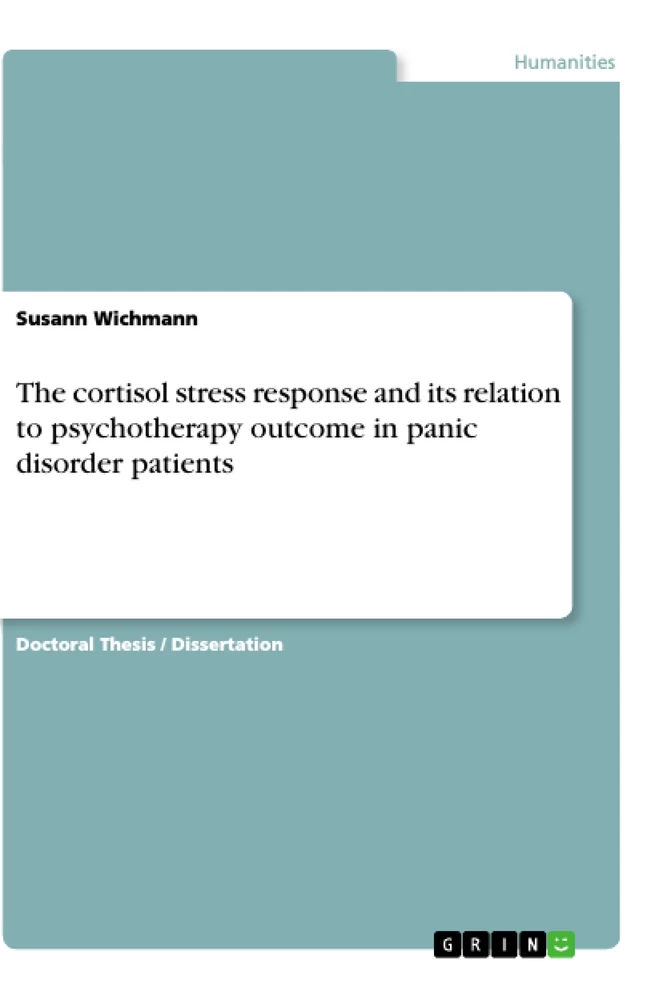
This thesis investigates the relationship between the hypothalamic-pituitary-adrenal (HPA)-axis mediated cortisol stress response and psychotherapy outcomes in patients with panic disorder (PD). It specifically explores whether the endocrine stress response can serve as a predictor for treatment success and compares these stress patterns across different diagnostic groups, including post-traumatic stress disorder (PTSD) and major depressive disorder (MDD).
- Cortisol stress reactivity in patients with panic disorder.
- Predictive value of endocrine markers for psychotherapy response.
- Comparative analysis of hormonal responses across PD, PTSD, and MDD.
- Efficacy of psychosocial (TSST) and hormonal (DEX-CRH) stress induction protocols.
- Integration of psycho-endocrine markers into clinical evaluation and decision-making.
Excerpt from the Book
4.2 Introduction
Panic disorder (PD) is a serious mental disorder associated with high levels of disability and impairment in the quality of life, next to depressive disorders (Wittchen & Jacobi, 2005). The most recent 12-month-prevalence of PD, with and without agoraphobia, in the German adult population was 2.0% (Jacobi et al., 2014). Patients with PD experience acute, stressful panic attacks as well as chronic stress due to being concerned about future panic attacks and their implications to health as well as changes in behaviour related to the panic attacks.
The hypothalamic-pituitary-adrenal (HPA)-axis is the body’s major endocrine stress system controlling responses to various stressors. In clinical psychological research, the activity of the HPA-axis has been investigated extensively in reference to the pathophysiology of panic attacks. The hypothalamus directs the secretion of the adrenocorticotropic hormone (ACTH) from the anterior pituitary, which in turn, stimulates the secretion of cortisol from the adrenal cortex. Under resting conditions, the ACTH and cortisol secretion follow a circadian rhythm as a function of light exposure to stress (Jung et al., 2010), caffeine (Lovallo et al., 2006), intense aerobic exercise (Fuqua & Rogol, 2013), and disrupted sleep (Leproult, 1997), among others. During acute stress, the diurnal hormone secretion is disrupted, which increased release of both cortisol and ACTH in healthy individuals (Tsigos & Chrousos, 2002).
Summary of Chapters
0 Summary: Provides an overview of the thesis, summarizing the background, methods, results, and conclusions regarding the cortisol stress response in PD patients.
1 Introduction: Discusses the definitions, aetiology, and treatment options for panic disorder, highlighting existing biological research on the HPA-axis.
2 Aims: Outlines the specific objectives of the thesis, focusing on improving knowledge of cortisol responses in PD and their relationship to therapy success.
3 Methods: Describes the study participants, the diagnostic evaluation process, and the application of psychosocial (TSST) and hormonal (DEX-CRH) stress tests.
4 Study I: Effects of the cortisol stress response on the psychotherapy outcome for panic disorder patients: Investigates the predictive relationship between cortisol reactivity to the TSST and psychotherapy outcome in PD patients.
5 Study II: Cortisol stress response in post-traumatic stress disorder, panic disorder and major depressive disorder patients: Compares HPA-axis functioning across different diagnostic patient groups using the TSST.
6 Study III: Stress hormone response to the DEX-CRH test and its relation to psychotherapy outcome in panic disorder patients with and without agoraphobia: Evaluates whether the response to the DEX-CRH test predicts psychotherapy success in PD patients.
7 Discussion: Synthesizes the main findings, discusses clinical implications, future research directions, and addresses the strengths and limitations of the work.
8 Conclusions: Offers a final perspective on the importance of HPA-axis responsivity as an additional tool for evaluating psychotherapy efficacy.
Keywords
Panic disorder, Cortisol, HPA-axis, Psychotherapy, Treatment outcome, TSST, DEX-CRH test, Post-traumatic stress disorder, Major depressive disorder, Stress response, Endocrine, Anxiety, Agoraphobia, Hypo-responsiveness, Biological markers.
Frequently Asked Questions
What is the primary focus of this research?
The research primarily investigates the hypothalamic-pituitary-adrenal (HPA)-axis, specifically the cortisol stress response, and its association with the success of cognitive behavioural psychotherapy in patients diagnosed with panic disorder.
Which patient groups are compared in this study?
The study compares patients with panic disorder (PD) to patients with post-traumatic stress disorder (PTSD), major depressive disorder (MDD), and healthy control individuals.
What is the main objective of the thesis?
The aim is to identify biological markers, specifically endocrine responses, that can predict psychotherapy outcomes, thereby helping clinicians adjust treatment strategies for patients who might not respond to standard interventions.
What scientific methods were used to induce stress?
Two primary methods were used: the Trier Social Stress Test (TSST) as a psychosocial stressor and the combined Dexamethasone Suppression/Corticotropin-releasing Hormone (DEX-CRH) test as a pharmacological/hormonal stressor.
What does the main part of the thesis cover?
The main part is divided into three studies that investigate the predictive relationship between cortisol response and therapy outcome (Study I and III) and a cross-sectional study comparing cortisol reactivity across different psychiatric diagnoses (Study II).
What are the characterizing keywords for this research?
The research is characterized by terms such as panic disorder, cortisol, HPA-axis, psychotherapy, treatment outcome, stress response, and transdiagnostic factors.
Did the researchers find that comorbid depression impacted the cortisol results?
The findings indicated that in the studied samples, comorbid depression did not significantly alter the primary hormonal stress response patterns observed in panic disorder patients.
What is the clinical significance of the dissociation between cortisol and ACTH?
The thesis provides evidence of a dissociation between cortisol and ACTH concentrations in PD and PTSD patients during stress, suggesting a dysfunction in the HPA-axis feedback regulation that may be relevant to the course and treatment of these disorders.
Ende der Leseprobe aus 128 Seiten
- nach oben
- Arbeit zitieren
- Susann Wichmann (Autor:in), 2018, The cortisol stress response and its relation to psychotherapy outcome in panic disorder patients, München, Page::Imprint:: GRINVerlagOHG, https://www.diplomarbeiten24.de/document/489362

neugierig - aktuell - relevant
Entdecken Sie hilfreiche Tipps und Tricks rund ums Studium!

Entdecken Sie hilfreiche Tipps und Tricks rund ums Studium!
Ihre Hausarbeit / Abschlussarbeit:

- - Publikation als E-Book und Buch
- - Hohes Honorar auf die Verkäufe
- - Für Sie komplett kostenlos - mit ISBN
- - Es dauert nur 5 Minuten
- - Jede Arbeit findet Leser

- © GRIN Publishing GmbH.
- Alle Inhalte urheberrechtlich geschützt. Kopieren und verbreiten untersagt.
- info@grin.com
- AGB
- Open Publishing
Der GRIN Verlag hat sich seit 1998 auf die Veröffentlichung akademischer eBooks und Bücher spezialisiert. Der GRIN Verlag steht damit als erstes Unternehmen für User Generated Quality Content. Die Verlagsseiten GRIN.com, Hausarbeiten.de und Diplomarbeiten24 bieten für Hochschullehrer, Absolventen und Studenten die ideale Plattform, wissenschaftliche Texte wie Hausarbeiten, Referate, Bachelorarbeiten, Masterarbeiten, Diplomarbeiten, Dissertationen und wissenschaftliche Aufsätze einem breiten Publikum zu präsentieren.
Kostenfreie Veröffentlichung: Hausarbeit, Bachelorarbeit, Diplomarbeit, Dissertation, Masterarbeit, Interpretation oder Referat jetzt veröffentlichen!
Folgen Sie GRIN auf


- GRIN Verlag GmbH
-
- Nymphenburger Str. 86
- 80636
- Munich, Deutschland
- +49 89-550559-0
- +49 89-550559-10
- info@grin.com
-
