
präsentiert von

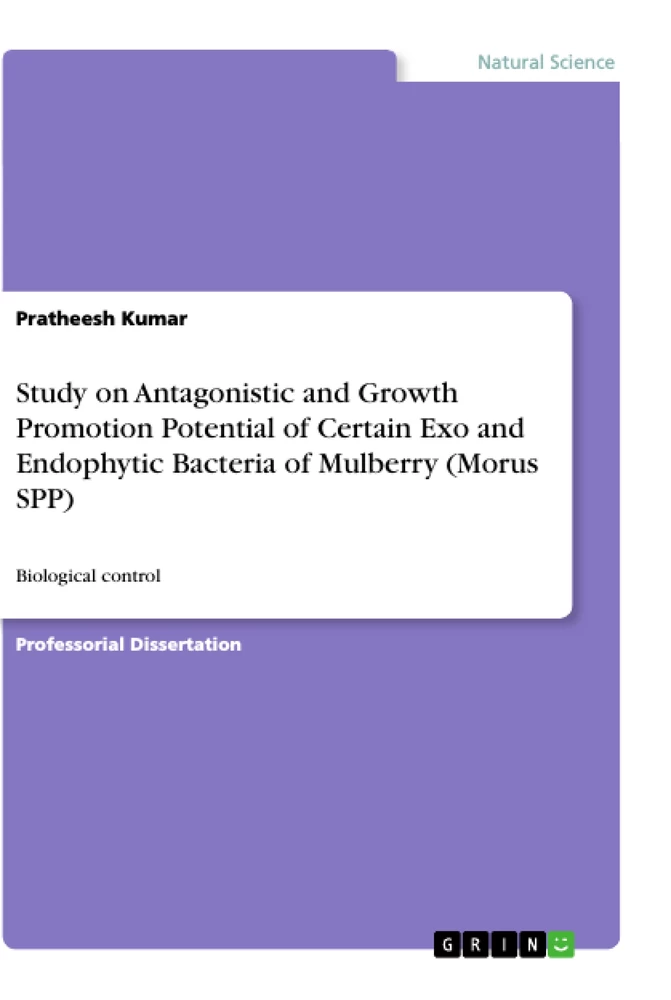
Table of Contents
1. INTRODUCTION
2. REVIEW OF LITERATURE
3. METERIALS AND METHODS
4. RESULTS
5. DISCUSSION
6. SUMMARY AND CONCLUSION
7. BIBLIOGRAPHY
Research Objectives and Themes
This study focuses on identifying and assessing the efficacy of antagonistic and plant growth-promoting bacteria isolated from the rhizosphere, phylloplane, and internal tissues of mulberry plants (Morus spp.) to develop biological control strategies against severe soil-borne pathogens, thereby reducing reliance on chemical fungicides in sericulture.
- Isolation and characterization of diverse bacterial communities from mulberry.
- Evaluation of bacterial antagonistic potential against major phytopathogens like Fusarium and Rhizoctonia.
- Assessment of bio-priming effects on seed germination and early seedling vigor.
- Investigation into sustainable, eco-friendly alternatives for disease management in mulberry cultivation.
Excerpt from the Book
MATERIALS AND METHODS
Samples were collected from the experimental mulberry garden of Central Sericultural Research &Training Institute, Mysore. Soil samples were collected by digging to a depth of 1-2 feet near the roots of mulberry plants grown in the experimental plots. The soil adhered to root was separated and transferred to separate clean polythene bags and carried to laboratory. The soil samples were then spread and air dried. The dried soil samples were powdered and sieved to get the fine powder of the soil and stored in separate polythene bags and labeled. Healthy mulberry leaves were collected in sterilized polythene bags from the mulberry gardens of Central Sericultural Research &Training Institute, Mysore. Mulberry plants were randomly selected from a healthy plantation and the plants were uprooted manually and washed under running tap water. Bits of 3cm length were excised using flame sterilized secateurs from 3cm above and below the soil line and from the main branch and all the samples were washed and then blotted using blotting paper. Leaves and fruits were collected in sterilised polythene bags.
Summary of Chapters
INTRODUCTION: Provides an overview of the significance of sericulture in India and the critical need to address mulberry diseases that negatively impact silk production and quality.
REVIEW OF LITERATURE: Examines existing research on plant growth-promoting rhizobacteria (PGPR), phylloplane microbes, and endophytes as biological control agents for managing soil-borne pathogens.
METERIALS AND METHODS: Details the procedures for sample collection, isolation, purification, and the specific experimental protocols used to test antagonism and seed biopriming.
RESULTS: Presents the experimental data on the antagonistic potential of various bacterial isolates against fungal pathogens and their influence on the growth metrics of mulberry seedlings.
DISCUSSION: Interprets the findings by comparing them with prior studies, emphasizing the potential of isolated strains as eco-friendly tools for sustainable disease management.
SUMMARY AND CONCLUSION: Recaps the primary findings of the study and concludes that specific bacterial isolates offer promising results for enhancing mulberry health and productivity.
BIBLIOGRAPHY: Lists the academic references and sources cited throughout the dissertation.
Keywords
Mulberry, Sericulture, Rhizobacteria, Phylloplane, Endophytic bacteria, Biological control, Fusarium solani, Rhizoctonia bataticola, Bio-priming, Seed germination, Vigour index, Plant growth promotion, Sustainable agriculture, Pathogen suppression, Microbial ecology.
Frequently Asked Questions
What is the core focus of this research?
The research explores the potential of using naturally occurring bacteria—specifically from the rhizosphere, phylloplane, and internal tissues of mulberry plants—as biological control agents to suppress soil-borne pathogens and promote plant growth.
What are the primary areas investigated?
The study centers on the isolation, identification, and functional assessment of bacteria capable of inhibiting fungal growth and improving seedling vigor in mulberry.
What is the ultimate goal of this work?
The primary aim is to establish sustainable, eco-friendly alternatives to chemical fungicides in sericulture to prevent crop loss and maintain leaf quality.
Which scientific methodology was utilized?
The researchers employed isolation techniques, dual culture tests for antagonistic activity, and bio-priming of seeds to measure germination rates, root-shoot development, and overall vigor index, followed by ANOVA for statistical validation.
What is covered in the main body of the text?
The main body details the methodology for bacterial extraction, presents extensive experimental results in table format regarding pathogen suppression and growth enhancement, and discusses the implications for mulberry disease management.
Which keywords define this dissertation?
Key terms include mulberry, endophytes, biological control, Fusarium solani, and plant growth-promoting rhizobacteria (PGPR).
How were the bacterial isolates categorized for testing?
Isolates were categorized based on their habitat of origin—rhizosphere (soil near roots), phylloplane (leaf surface), and endophytes (internal tissues of leaves, roots, fruits, and shoots).
What role does bio-priming play in this study?
Bio-priming is used to treat mulberry seeds with beneficial bacterial solutions prior to planting, aimed at enhancing germination percentages and initial seedling growth parameters.
What specific pathogens were addressed?
The study tested antagonism against major mulberry pathogens including Fusarium solani, Fusarium oxysporum, Botryodiplodia theobromae, and Rhizoctonia bataticola.
What are the implications for farmers?
The study suggests that identifying and applying specific effective bacterial strains can lead to better crop yields, reduced reliance on hazardous chemicals, and improved economic outcomes for sericulturists.
Ende der Leseprobe aus 86 Seiten
- nach oben
- Arbeit zitieren
- Pratheesh Kumar (Autor:in), 2018, Study on Antagonistic and Growth Promotion Potential of Certain Exo and Endophytic Bacteria of Mulberry (Morus SPP), München, Page::Imprint:: GRINVerlagOHG, https://www.diplomarbeiten24.de/document/490001

neugierig - aktuell - relevant
Entdecken Sie hilfreiche Tipps und Tricks rund ums Studium!

Entdecken Sie hilfreiche Tipps und Tricks rund ums Studium!
Ihre Hausarbeit / Abschlussarbeit:

- - Publikation als E-Book und Buch
- - Hohes Honorar auf die Verkäufe
- - Für Sie komplett kostenlos - mit ISBN
- - Es dauert nur 5 Minuten
- - Jede Arbeit findet Leser

- © GRIN Publishing GmbH.
- Alle Inhalte urheberrechtlich geschützt. Kopieren und verbreiten untersagt.
- info@grin.com
- AGB
- Open Publishing
Der GRIN Verlag hat sich seit 1998 auf die Veröffentlichung akademischer eBooks und Bücher spezialisiert. Der GRIN Verlag steht damit als erstes Unternehmen für User Generated Quality Content. Die Verlagsseiten GRIN.com, Hausarbeiten.de und Diplomarbeiten24 bieten für Hochschullehrer, Absolventen und Studenten die ideale Plattform, wissenschaftliche Texte wie Hausarbeiten, Referate, Bachelorarbeiten, Masterarbeiten, Diplomarbeiten, Dissertationen und wissenschaftliche Aufsätze einem breiten Publikum zu präsentieren.
Kostenfreie Veröffentlichung: Hausarbeit, Bachelorarbeit, Diplomarbeit, Dissertation, Masterarbeit, Interpretation oder Referat jetzt veröffentlichen!
Folgen Sie GRIN auf


- GRIN Verlag GmbH
-
- Nymphenburger Str. 86
- 80636
- Munich, Deutschland
- +49 89-550559-0
- +49 89-550559-10
- info@grin.com
-
