
präsentiert von

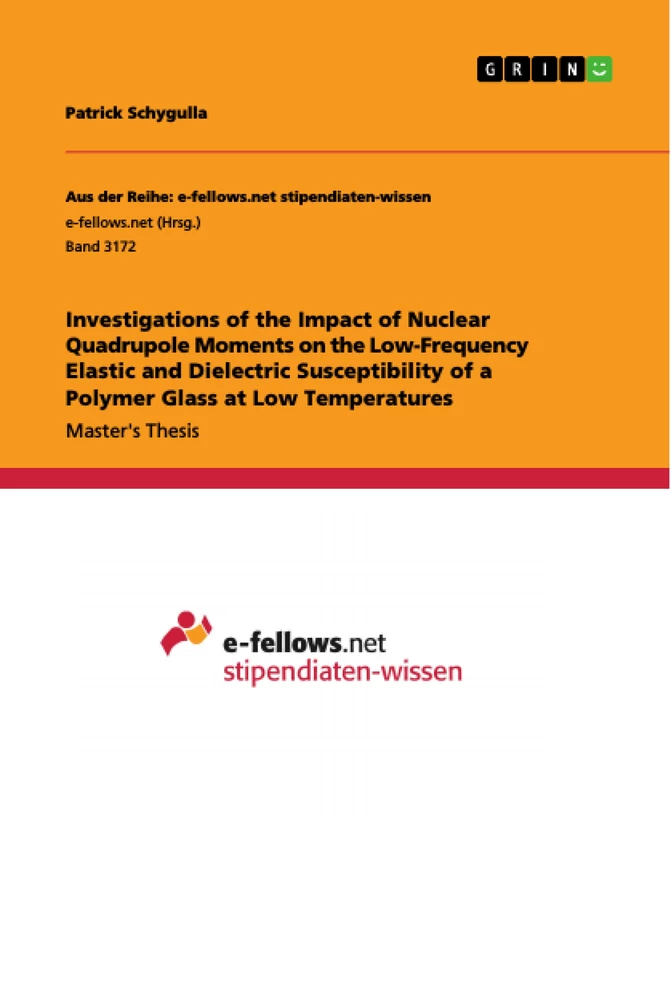
Table of Contents
1 Introduction and Motivation
2 Theoretical Background
2.1 Low-Temperature Dynamics in Glasses
2.1.1 Glass Formation and Thermal Properties
2.1.2 Structure of Amorphous Materials
2.1.3 Energy States in a Double Well Potential
2.1.4 The Standard Tunnelling Model
2.1.5 Frequency Response of Amorphous Samples
2.2 Nuclear Quadrupole Moments
2.2.1 Nuclear Quadrupole Resonance
2.2.2 Resonant Susceptibility
2.2.3 Relaxation Mechanisms
3 Experimental Methods
3.1 Working at Low Temperatures
3.1.1 Cooling Methods
3.1.2 Thermometry
3.2 Polymer Glass FR-122P
3.2.1 Chemical Structure
3.2.2 Sample Production
3.2.3 Material Choice
3.3 Acoustic Measurements
3.3.1 Double Paddle Oscillator
3.3.2 Measurement Strategy
3.3.3 Probing the Nuclear Bath
3.4 Dielectric Measurements
4 Results and Analysis
4.1 Preparatory Measurements
4.1.1 High Temperatures
4.1.2 Background
4.1.3 Voltage Scaling
4.1.4 Thermalisation
4.2 Complex Acoustic and Dielectric Susceptibilities
4.2.1 Temperature Overview
4.2.2 Acoustic Measurements
4.2.3 Dielectric Measurements
4.3 Numerical Calculations
4.3.1 Standard Tunnelling Model
4.3.2 Resonant Susceptibility
4.3.3 Additional Relaxation Rate
4.4 Impact of RF Bias
5 Discussion
5.1 Validity of Data
5.2 Conclusion
5.2.1 Interpretation of Results
5.2.2 Comparison to Related Work
5.3 Outlook
6 Summary
Research Objectives and Core Themes
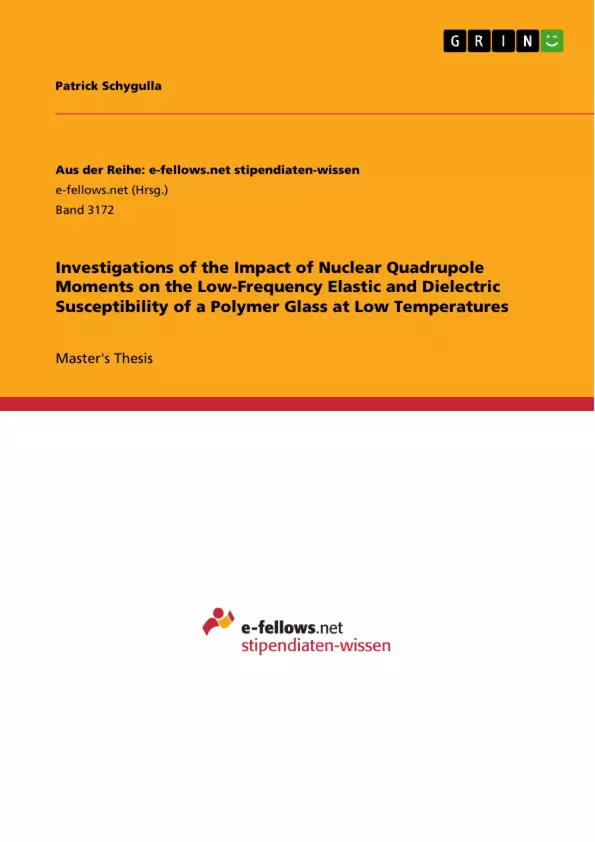
This thesis investigates the impact of nuclear quadrupole moments (NQM) on the low-frequency elastic and dielectric properties of the polymer glass FR-122P at temperatures ranging from 7 mK to 600 mK. The research aims to determine whether observed deviations from the Standard Tunnelling Model (STM) arise primarily from an additional relaxation mechanism between NQM and atomic tunnelling systems or from modifications to the tunnelling system distribution function.
- Characterization of low-temperature dynamics in glasses and the role of atomic tunnelling systems.
- Theoretical and experimental study of nuclear quadrupole moments and their interaction with tunnelling degrees of freedom.
- Development and validation of a novel experimental module to selectively drive nuclear quadrupole transitions via RF bias.
- Comparative analysis of acoustic and dielectric susceptibility measurements against numerical simulations based on the STM and its extensions.
Excerpt from the Book
1. Introduction and Motivation
Glasses have since long attracted special interest among humans thanks to some of their interesting and useful properties, for instance their transparency which enabled their usage as window panes along with traces of metallic admixtures providing colour. This fact is also what gave glass its name which is derived from the Germanic word glasa meaning "shimmering" or "shining". The existence of glass precedes human history, though, for early glass samples on Earth originate from volcanic eruptions. Upon sufficiently fast cooling below the glass transition temperature hot lava forms an amorphous solid, or in other words a glass, called obsidian. Another possibility for natural glass production are volcanic lightnings caused by friction between ash particles which melt in the course of a flash. Under certain cooling conditions they can form glass spheres that allow scientists to study eruption parameters at a safe distance [Ber17].
While the variety of glasses is as wide as their application spectrum, ranging from storing liquids over glass fibres to optical devices, the common and defining trait is their amorphous structure in contrast to crystals. The latter are characterised by a well defined crystal lattice that determines order and symmetry of the crystal by setting the position of every atom of the solid once a single atomic position is fixed. The former do not exhibit such a long range order. Rather, in glasses both the distances and bonding angles between neighbouring atoms are not discrete but show a distribution resulting in structural disorder.
Summary of Chapters
1 Introduction and Motivation: Summarizes the history of glass research and identifies the research gap regarding the impact of nuclear quadrupole moments on the low-temperature physics of amorphous systems.
2 Theoretical Background: Provides the theoretical foundation, detailing the Standard Tunnelling Model and the theory of nuclear quadrupole moments and their interactions.
3 Experimental Methods: Describes the cooling techniques, the fabrication of the FR-122P samples, the acoustic measurements using a double paddle oscillator, and the design of the novel RF bias module.
4 Results and Analysis: Presents the experimental findings for acoustic and dielectric measurements and compares them to numerical simulations of the STM and its proposed extensions.
5 Discussion: Evaluates the validity of the obtained data, interprets the results within the context of previous research, and offers an outlook on future investigations.
6 Summary: Concludes the thesis by summarizing the experimental approach and the core findings regarding the role of NQM in the relaxation processes of polymer glasses.
Keywords
Polymer glass, FR-122P, low-temperature physics, nuclear quadrupole moments, NQM, Standard Tunnelling Model, STM, elastic susceptibility, dielectric susceptibility, atomic tunnelling systems, relaxation mechanisms, double paddle oscillator, acoustic measurements, cryogenics.
Frequently Asked Questions
What is the primary focus of this master's thesis?
The thesis focuses on examining how nuclear quadrupole moments (NQM) affect the low-frequency elastic and dielectric properties of the polymer glass FR-122P at temperatures below 1 Kelvin.
What are the central themes discussed in this work?
The work covers the structural properties of glasses, the Standard Tunnelling Model, the theoretical physics of nuclear quadrupole moments, and advanced low-temperature measurement techniques.
What is the main research question?
The research investigates whether the observed anomalies in the dielectric and acoustic properties of NQM-containing glasses are caused by an additional relaxation pathway between NQM and tunnelling systems or by structural changes (a pseudogap) in the tunnelling system distribution.
Which experimental methods were employed?
The research used low-frequency acoustic measurements via a custom-fabricated double paddle oscillator (DPO) and dielectric susceptibility measurements in a capacitance bridge, both conducted in a 3He/4He dilution cryostat.
What does the main part of the thesis cover?
The main part encompasses the theoretical derivation of tunnelling interactions, the experimental characterization of the FR-122P polymer, the fabrication of the DPO, and the development of an RF bias module for nuclear quadrupole transition driving.
Which keywords best characterize the work?
Key terms include Polymer glass, FR-122P, nuclear quadrupole moments (NQM), Standard Tunnelling Model (STM), and low-temperature acoustics.
What makes the material FR-122P particularly suitable for this study?
FR-122P contains bromine atoms with a large, well-defined nuclear quadrupole moment. Furthermore, the bromine atoms are covalently bonded to carbon, providing a uniform chemical and electrical environment, which simplifies the interpretation of the quadrupole splitting.
Did the RF bias module succeed in isolating NQM effects?
While the module allowed for RF excitation, it was determined that the observed changes in susceptibility were predominantly due to thermal heating caused by eddy currents in the gold-coated surface of the DPO, setting an upper limit on the method's sensitivity for detecting NQM transitions.
Ende der Leseprobe aus 118 Seiten
- nach oben
- Arbeit zitieren
- Patrick Schygulla (Autor:in), 2018, Investigations of the Impact of Nuclear Quadrupole Moments on the Low-Frequency Elastic and Dielectric Susceptibility of a Polymer Glass at Low Temperatures, München, Page::Imprint:: GRINVerlagOHG, https://www.diplomarbeiten24.de/document/491538

neugierig - aktuell - relevant
Entdecken Sie hilfreiche Tipps und Tricks rund ums Studium!

Entdecken Sie hilfreiche Tipps und Tricks rund ums Studium!
Ihre Hausarbeit / Abschlussarbeit:

- - Publikation als E-Book und Buch
- - Hohes Honorar auf die Verkäufe
- - Für Sie komplett kostenlos - mit ISBN
- - Es dauert nur 5 Minuten
- - Jede Arbeit findet Leser

- © GRIN Publishing GmbH.
- Alle Inhalte urheberrechtlich geschützt. Kopieren und verbreiten untersagt.
- info@grin.com
- AGB
- Open Publishing
Der GRIN Verlag hat sich seit 1998 auf die Veröffentlichung akademischer eBooks und Bücher spezialisiert. Der GRIN Verlag steht damit als erstes Unternehmen für User Generated Quality Content. Die Verlagsseiten GRIN.com, Hausarbeiten.de und Diplomarbeiten24 bieten für Hochschullehrer, Absolventen und Studenten die ideale Plattform, wissenschaftliche Texte wie Hausarbeiten, Referate, Bachelorarbeiten, Masterarbeiten, Diplomarbeiten, Dissertationen und wissenschaftliche Aufsätze einem breiten Publikum zu präsentieren.
Kostenfreie Veröffentlichung: Hausarbeit, Bachelorarbeit, Diplomarbeit, Dissertation, Masterarbeit, Interpretation oder Referat jetzt veröffentlichen!
Folgen Sie GRIN auf


- GRIN Verlag GmbH
-
- Nymphenburger Str. 86
- 80636
- Munich, Deutschland
- +49 89-550559-0
- +49 89-550559-10
- info@grin.com
-
