
präsentiert von

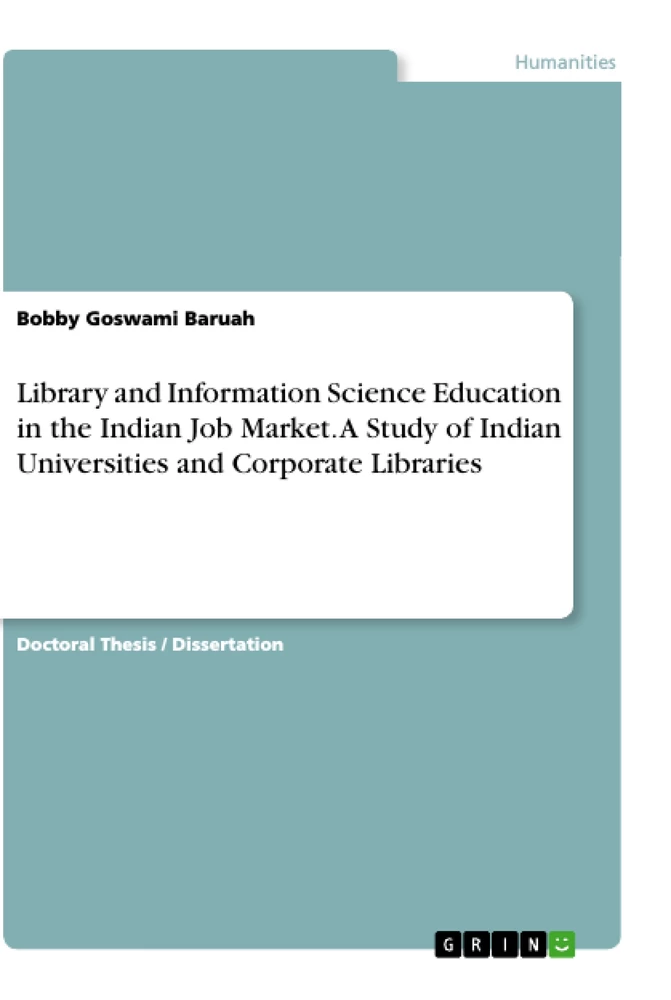
Table of Contents
CHAPTER 1 INTRODUCTION
1.1 Statement of the Problem
1.2 Significance of the Study
1.3 Definition of Operative Concepts
1.3.1 Relevance
1.3.2 Library and Information Science Profession
1.3.3 Library and Information Science Education
1.3.4 Library and Information Science Curriculum
1.3.5 Job Market for Library and Information Science Professionals
1.3.6 University Libraries
1.3.7 Corporate Libraries
1.3.8 Course Content and Course Title
1.3.9 Broad Subject Category
1.3.10 Syllabuses
1.3.11 Job Specification, Job Description and Job Requirement
1.3.12 Job Designation/Job Title
1.4 Changes in Library and Information Science Curricula over the Years
1.5 Organisation of Chapters
CHAPTER 2 LITERATURE REVIEW LIRARY AND INFORMATION SCIENCE EDUCATION AND JOB MARKET
2.1 Historical Development of Library and Information Science
2.2 Emergence of Library and Information Science as an Academic Discipline
2.3 Library and Information Science Education in India in Paradigm Shifts
2.4 Library and Information Science Faculty and Professional Development
2.5 Historical Development of Library and Information Science Education in India
2.6 Current Use of Information And Communication Technology in Different Libraries in India
2.7 Present Status of Library and Information Science Education in India
2.8 Importance of Curricula and Curricula Design
2.8.1 Conceptual Definition of Curriculum in Library and Information Science
2.8.2 Library and Information Science Curricula
2.8.3 Contribution of Other National Level Professional Associations and Organisations
2.8.4 Changes in Library and Information Science Curricula in India
2.9 Job Market for Library and Information Science Professionals
2.10 Job Market in University Libraries
2.11 Scope of Job Market in University Libraries
2.12 Job Market in Corporate Libraries
2.13 Scope of Job Market in Corporate Libraries
2.14 Job Descriptions in Library and Information Science Professional
2.15 Job Requirement
2.16 Job Requirement in Library and Information Science Professional
2.17 Job Requirement for Academic Libraries
2.18 Job Requirement for Corporate Libraries
2.19 Observation and Inferences
CHAPTER 3 LITERATURE REVIEW: CONTENT ANALYSIS
3.1 Content Analysis as a Research Method
3.2 Content Analysis as Quantitative And Qualitative Research
3.3 Conducting a Content analysis
3.3.1 Analyzing the Data
3.3.2 Coding Data
3.3.3 Coding Units
3.3.4 Reliability
3.3.5 Computer Programmes in Support of Qualitative Content Analysis
3.4 Frequency and Word Count
3.5 Use of Content Analysis in Library and Information Science
3.5.1 Content Analysis of Job Descriptions in Library and Information Science
3.5.2 Content Analysis of Job Requirement in Library and Information Science
3.5.3 Content Analysis of Library and Information Science Curriculum
CHAPTER 4 RESEARCH DESIGN AND METHODOLOGY
4.1 Scope of the Study
4.2 Objectives of the Study
4.3 Hypothesis to be Tested
4.4 Research Design
4.5 Data Collection and Sample Size
4.6 Methods Used for the Study
4.6.1 Content Analysis
4.6.2 Content Extraction
4.6.3 Classification Tools Used
4.6.4 Statistical Tools Used
4.6.5 Cluster Methods Used in the Study
4.7 Data Analysis
4.8 Limitations of the study
CHAPTER 5 DATA ANALYSIS AND INTERPRETATION
5.1 Curriculums of Post Graduate in Library and Information Science in the Universities
5.1.1. Universities with Higher Percentage of ICT based Course Contents in the Curriculums
5.1.2 Universities with Higher Percentages of Non ICT based Course Contents in the Curriculums
5.2. Subject Analysis of Course Contents in Library and Information Science Curriculums
5.2.1 ICT Based Course Contents in Library and Information Science Curriculums
5.2.2 Non ICT Based Course Contents in Library and Information Science Curriculums
5.3 Job Designations of Library and Information Science Professionals and their Job Requirements
5.3.1. Job Requirements Performed by Library and Information Science Professionals
5.3.2 Cluster Analysis of the Job Requirements
5.3.3 Results and Discussion
5.4 Job Descriptions of Library and Information Science Professionals in University Libraries and Corporate Libraries in India
5.4.1 Subject Categories Analysis of Library and Information Science Job Requirements under University and Corporate Setup
5.4.2 Comparison of Library and Information Science Curriculums and Job Requirements
5.4.3 Non Matching Broad Subject Categories of Job Requirements and Course Contents
5.4.4 Discussion
5.5 Model Curriculum Designed in the Light of Job Requirements of the Job Market in Library and Information Science
5.6 Hypothesis Testing
CHAPTER 6 FINDINGS, SUGGESTIONS AND CONCLUSIONS
6.1. Findings
6.1.1. Core Findings Based on Objectives of the Study
6.1.2. Hypotheses Findings
6.2 Suggestions and Conclusions
6.3 Model Curriculum Design
6.3.1 Formation of Papers (Course Title)
6.3.2 Course structure
Research Objectives and Focus Areas
The primary aim of this research is to evaluate the relevance and responsiveness of current postgraduate Library and Information Science (LIS) curricula in Indian universities to the evolving requirements of the modern job market. The study investigates the alignment between academic course content and professional job specifications, particularly within university and corporate library sectors, to propose a standardized, market-oriented model curriculum.
- Content analysis of LIS postgraduate curricula across 55 Indian universities.
- Examination of job requirements and designations within university and corporate library sectors.
- Identification of gaps between academic training and practical professional demands.
- Comparative analysis of ICT-based and non-ICT-based course components.
- Development of a model LIS curriculum based on identified market needs and employer expectations.
Excerpt from the Book
1.3.1 Relevance
Yerodia (1981), define relevance as “coherence between the content of education and the socio-cultural environment in which it takes place”. According to Alaezi (1988), relevance means that, all stakeholders share a common purpose and work together in solving problems brought about by changes in environmental demands. It is noteworthy, that relevance has many dimensions in time, context and situation. What is relevant today may not be relevant tomorrow. According to Minishi (2007), the education and training of library and information science professionals has to be such that it empowers them to unleash their potential as they endeavor to offer relevant and efficient services within the current levels of technological sophistication. In the study, relevance is used to denote the existing curriculums relevancies in the light of the demands of the rising job market. The variables in course contents in a curriculum such as theory and practice affect curriculum relevance. The relevance of curriculums is measured against appropriateness and compatibility of the course contents with the changing professional requirements in the field of works specifically university and corporate library job requirements. Significantly, how relevant are the course contents to the job requirements have been widely dealt within the body of the research.
Summary of Chapters
CHAPTER 1 INTRODUCTION: Outlines the concern regarding the responsiveness of LIS education to job market requirements in India and introduces the study's scope, objectives, and operational definitions.
CHAPTER 2 LITERATURE REVIEW LIRARY AND INFORMATION SCIENCE EDUCATION AND JOB MARKET: Provides a comprehensive historical and thematic review of LIS education, curricular evolution, and the changing professional demands in university and corporate library sectors.
CHAPTER 3 LITERATURE REVIEW: CONTENT ANALYSIS: Explores the theoretical framework and application of content analysis as a research methodology for examining curriculum and job requirement data.
CHAPTER 4 RESEARCH DESIGN AND METHODOLOGY: Details the research design, data collection methods, sampling criteria, and analytical tools used to investigate the correspondence between academic curricula and market needs.
CHAPTER 5 DATA ANALYSIS AND INTERPRETATION: Presents the statistical and comparative analysis of curricula against job requirements, identifying key mismatches and gaps in current LIS education.
CHAPTER 6 FINDINGS, SUGGESTIONS AND CONCLUSIONS: Summarizes the study’s core findings, discusses hypotheses, and offers recommendations for developing a standardized, demand-driven model curriculum.
Keywords
Library and Information Science, LIS Education, Curriculum Design, Job Market, ICT, University Libraries, Corporate Libraries, Content Analysis, Competencies, Professional Development, Job Descriptions, Information Technology, Higher Education, Curriculum Standardization, India.
Frequently Asked Questions
What is the core focus of this research?
The work examines whether the current postgraduate Library and Information Science (LIS) curricula in Indian universities meet the actual skill and competency requirements demanded by the modern job market in academic and corporate libraries.
What are the central themes of the study?
Key themes include the impact of Information and Communication Technology (ICT) on LIS professional roles, the misalignment between university syllabi and employer needs, and the transition from traditional library science to a more modern information-management focus.
What is the primary objective of this study?
The primary goal is to identify discrepancies between taught curriculum content and industry requirements to establish a standardized, modernized model curriculum that ensures LIS graduates are job-ready.
Which research methodology is applied?
The study primarily utilizes content analysis to systematically evaluate course syllabi and job advertisements, supported by statistical tests and cluster analysis (using software like UCINET) to map relationships between job designations and professional requirements.
What does the book cover in its main sections?
The main part provides an extensive historical review, an evaluation of current curriculum structures, an analysis of job-market demands in both university and corporate settings, and statistical comparisons regarding the "relevance gap" of current education.
Which keywords best describe the work?
The work is centered around Library and Information Science (LIS) education, curriculum development, job market relevance, ICT competencies, and content analysis in the context of Indian higher education.
How do university and corporate libraries differ in their requirements?
Corporate libraries prioritize specialized knowledge management, technical innovation, and agility in a business environment, whereas university libraries often focus on standard automation, collection management, and research support; however, the study finds corporate requirements are increasingly pushing for more futuristic and technological skill sets.
What is the significance of the "Model Curriculum" proposed?
The proposed model curriculum serves as a blueprint for Indian LIS schools to re-engineer their programs, integrating core traditional skills with advanced technological competencies to bridge the gap between academic instruction and industry reality.
Ende der Leseprobe aus 288 Seiten
- nach oben
- Arbeit zitieren
- Bobby Goswami Baruah (Autor:in), 2014, Library and Information Science Education in the Indian Job Market. A Study of Indian Universities and Corporate Libraries, München, Page::Imprint:: GRINVerlagOHG, https://www.diplomarbeiten24.de/document/491737

neugierig - aktuell - relevant
Entdecken Sie hilfreiche Tipps und Tricks rund ums Studium!

Entdecken Sie hilfreiche Tipps und Tricks rund ums Studium!
Ihre Hausarbeit / Abschlussarbeit:

- - Publikation als E-Book und Buch
- - Hohes Honorar auf die Verkäufe
- - Für Sie komplett kostenlos - mit ISBN
- - Es dauert nur 5 Minuten
- - Jede Arbeit findet Leser

- © GRIN Publishing GmbH.
- Alle Inhalte urheberrechtlich geschützt. Kopieren und verbreiten untersagt.
- info@grin.com
- AGB
- Open Publishing
Der GRIN Verlag hat sich seit 1998 auf die Veröffentlichung akademischer eBooks und Bücher spezialisiert. Der GRIN Verlag steht damit als erstes Unternehmen für User Generated Quality Content. Die Verlagsseiten GRIN.com, Hausarbeiten.de und Diplomarbeiten24 bieten für Hochschullehrer, Absolventen und Studenten die ideale Plattform, wissenschaftliche Texte wie Hausarbeiten, Referate, Bachelorarbeiten, Masterarbeiten, Diplomarbeiten, Dissertationen und wissenschaftliche Aufsätze einem breiten Publikum zu präsentieren.
Kostenfreie Veröffentlichung: Hausarbeit, Bachelorarbeit, Diplomarbeit, Dissertation, Masterarbeit, Interpretation oder Referat jetzt veröffentlichen!
Folgen Sie GRIN auf


- GRIN Verlag GmbH
-
- Nymphenburger Str. 86
- 80636
- Munich, Deutschland
- +49 89-550559-0
- +49 89-550559-10
- info@grin.com
-
