
präsentiert von

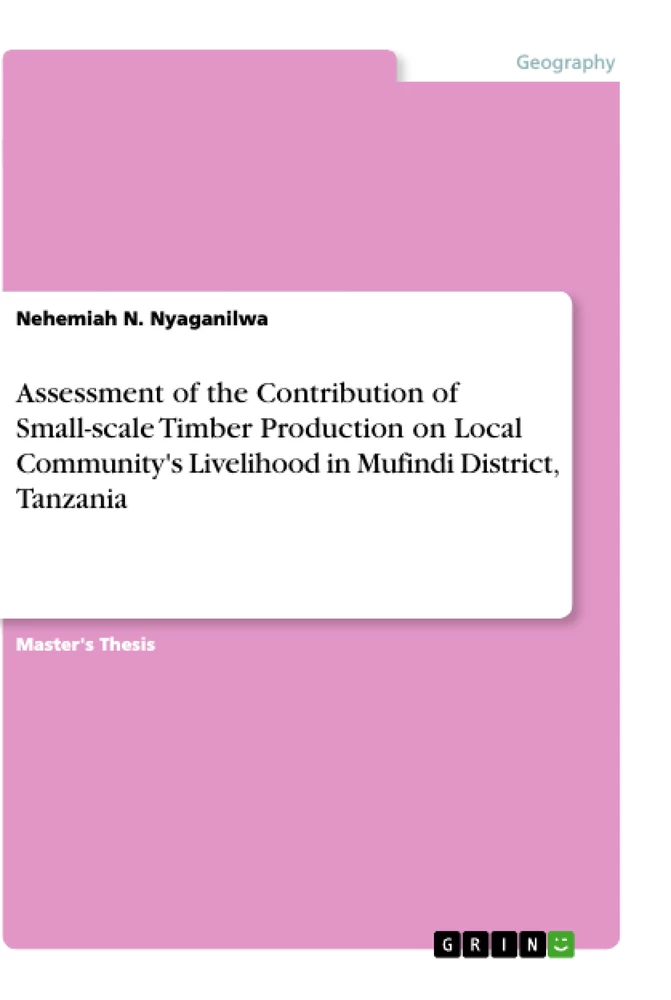
Table of Contents
CHAPTER ONE: INTRODUCTION
1.1 Background of the Study
1.2 Statement of the Research Problem
1.3 Objectives of the Study
1.3.1 The General Objective
1.3.2 Specific Objectives
1.4 Research Questions
1.5 Significance of the Study
1.6 Limitation of the study
1.7 Structure of the Dissertation
CHAPTER TWO: LITERATURE REVIEW
2.1 Definition of key Terms
2.1.1 Timber Production
2.1.2 Small scale Timber Production
2.1.3 Livelihood
2.2 Empirical Literature Review
2.2.1 The Practices of Small scale Timber Production
2.2.1.1 Land Size
2.2.1.2 Harvesting Timber
2.2.1.3 Marketing Timber from Small scale Producers
2.2.2 Role of Small scale Timber Production on Poverty Reduction
2.2.2.1 Poverty Reduction Strategies in Tanzania
2.2.3 Timber Production and Food Security
2.2.4 Small scale Timber Production and Employment Creation
2.2.5 Timber Production and Social, Economic and Human aspects of Livelihood
2.3 Conceptual Framework
2.3.1 Land
2.3.2 Financial Capital
2.3.3 Infrastructure
2.3.4 Policy and Strategies
2.3.5 Livelihood Outcomes
2.4 Research Gap
CHAPTER THREE: METHODOLOGY
3.1 Introduction
3.2 Study Area
3.2.1 Location
3.2.2 Economic Activities in the Study Area
3.3 Research Design
3.4 Sampling Design
3.4.1 Sampling Frame
3.4.2 Determination of Sample Size
3.4.3 Sampling Procedures
3.5 Data Collection Techniques
3.5.1 Structured Questionnaire Interviews
3.5.2 Field Observation
3.5.3 In-depth Interview
3.5.4 Documentary Review
3.6 Data Analysis
3.7 Data Presentation
CHAPTER FOUR: STUDY FINDINGS AND DISCUSSION
4.1 Introduction
4.2 Demographic Characteristics of Respondents
4.2.1 Age of the Respondents
4.2.2 Sex of the Respondents
4.2.3 Ethnical Representations of the Respondents
4.2.4 Education Level of the Respondents
4.2.5 Main Occupations
4.3 Practices of Small scale Timber Production
4.3.1 Land Ownership
4.3.2 Land Acquisition
4.3.3 Timeframe of the Land Ownership and Practices
4.3.4 Species of Tree for Timber Production
4.3.5 The Number of Trees in a Plot
4.3.6 The First Harvest Time
4.3.7 Amount of Harvest
4.3.8 The Form of Timber Sold
4.3.9 Methods Used in Sawing Timber
4.3.10 Timber Selling Means
4.3.11 Timber Customers
4.3.12 Access to Customers
4.3.13 Price Determination
4.3.14 NGOs Support
4.4 The Role of Small scale Timber Production in Income and Employment Generation and Ensuring Food Security
4.4.1 Small scale Timber Production and Income
4.4.1.1 Annual Average Income
4.4.1.2 Other Sources of Income apart from Small Scale Timber Production
4.4.1.3 Possession of Physical Assets
4.4.2 Timber Production and Food Security
4.4.2.1 Uses of Income from Timber
4.4.3 Source of Employment
4.4.3.1 Opportunities of Small scale Timber Production
4.5 Potential for More Gains from Small Scale Timber Production
4.5.1 Challenges that small scale timber producers face
4.5.2 Measures to Improve Livelihoods of Small scale Timber Producers
4.6 Chapter Summary
CHAPTER FIVE: SUMMARY, CONCLUSION AND RECOMMENDATIONS
5.1 Introduction
5.2 Summary of the Major Findings
5.3 Conclusion
5.4 Recommendations
Research Objectives and Themes
The primary objective of this research is to evaluate how small-scale timber production impacts the livelihoods of local communities in the Mufindi District of Tanzania. The study explores the socio-economic effects, including income generation, food security, and employment opportunities, while identifying challenges and potential improvements for small-scale producers.
- Practices and methodologies of small-scale timber production
- Economic contributions to household income and poverty reduction
- Role of timber production in employment and food security
- Challenges, including infrastructure, marketing, and institutional support
- Strategies for enhancing future gains and sustainable livelihoods
Excerpt from the Book
4.3.5 The Number of Trees in a Plot
The area under forest plantations in Tanzania is estimated to be about 250,000 ha. Out of which 40,000 are owned privately and 80,000, by the government (Ngaga 1998). When asked about the number of trees, each respondent had in his/her respective plots majority of the small-scale timber producers, (59%) had more than 1000 tress in a plot (Table 4.6), others included 14% less than 500 tree in a plot and 27% between 500 and 1000 trees in a plot. One key informant said, “In one hectare, a required number of trees are 600 when spaced scientifically.”
Summary of Chapters
CHAPTER ONE: INTRODUCTION: This chapter introduces the study, outlines the background of small-scale timber production globally and locally, and defines the research problem, objectives, and significance.
CHAPTER TWO: LITERATURE REVIEW: This chapter provides an overview of existing theories and empirical studies regarding timber production, livelihood assets, and the relationship between forestry and poverty reduction.
CHAPTER THREE: METHODOLOGY: This chapter describes the research design, study area (Mufindi District), sampling techniques, data collection methods, and the analytical approach used to evaluate findings.
CHAPTER FOUR: STUDY FINDINGS AND DISCUSSION: This chapter presents the empirical data collected from the field, covering demographic characteristics, production practices, income roles, and challenges faced by local timber producers.
CHAPTER FIVE: SUMMARY, CONCLUSION AND RECOMMENDATIONS: This chapter synthesizes the major findings, draws final conclusions, and offers policy recommendations to support small-scale timber producers.
Keywords
Small-scale timber production, Livelihoods, Mufindi District, Tanzania, Forestry, Poverty reduction, Income generation, Food security, Sustainable management, Smallholder agriculture, Timber marketing, Rural development, Infrastructure, Tree plantations, Socio-economic analysis.
Frequently Asked Questions
What is the core focus of this research?
The study assesses the contribution of small-scale timber production to the improvement of local community livelihoods in the Mufindi District of Tanzania.
What are the primary themes covered in the book?
Key themes include timber production practices, income and employment generation, food security, challenges like poor infrastructure, and strategies for economic empowerment.
What is the main research objective?
The main objective is to evaluate how small-scale timber production affects local livelihoods and to identify ways to increase benefits for small-scale producers.
Which methodology was employed for this study?
The research used a cross-sectional mixed-methods design, involving household questionnaires, field observations, in-depth interviews, and a review of relevant documents.
What does the main body of the work discuss?
The main body details demographic characteristics of respondents, the physical practices of timber production (land size, tree species, harvesting methods), and the economic outcomes of these activities.
Which keywords characterize this work?
Core keywords include small-scale timber production, livelihoods, Mufindi District, rural poverty reduction, and socio-economic development.
Why is Pinus patula preferred by farmers in Mufindi?
Farmers prefer Pinus patula because it does not deplete soil nutrients as severely as Eucalyptus and allows for the cultivation of agricultural crops after harvesting.
What are the major challenges faced by small-scale producers?
Key challenges identified include poor road infrastructure, lack of government and NGO support, limited market access, lack of technical knowledge, and the risks posed by fire outbreaks.
How does the study suggest improving the situation for timber producers?
The study recommends improved infrastructure, better access to loans, technical education on sustainable tree spacing, and the formation of collective organizations for marketing.
Ende der Leseprobe aus 103 Seiten
- nach oben
- Arbeit zitieren
- Nehemiah N. Nyaganilwa (Autor:in), 2019, Assessment of the Contribution of Small-scale Timber Production on Local Community's Livelihood in Mufindi District, Tanzania, München, Page::Imprint:: GRINVerlagOHG, https://www.diplomarbeiten24.de/document/492141

neugierig - aktuell - relevant
Entdecken Sie hilfreiche Tipps und Tricks rund ums Studium!

Entdecken Sie hilfreiche Tipps und Tricks rund ums Studium!
Ihre Hausarbeit / Abschlussarbeit:

- - Publikation als E-Book und Buch
- - Hohes Honorar auf die Verkäufe
- - Für Sie komplett kostenlos - mit ISBN
- - Es dauert nur 5 Minuten
- - Jede Arbeit findet Leser

- © GRIN Publishing GmbH.
- Alle Inhalte urheberrechtlich geschützt. Kopieren und verbreiten untersagt.
- info@grin.com
- AGB
- Open Publishing
Der GRIN Verlag hat sich seit 1998 auf die Veröffentlichung akademischer eBooks und Bücher spezialisiert. Der GRIN Verlag steht damit als erstes Unternehmen für User Generated Quality Content. Die Verlagsseiten GRIN.com, Hausarbeiten.de und Diplomarbeiten24 bieten für Hochschullehrer, Absolventen und Studenten die ideale Plattform, wissenschaftliche Texte wie Hausarbeiten, Referate, Bachelorarbeiten, Masterarbeiten, Diplomarbeiten, Dissertationen und wissenschaftliche Aufsätze einem breiten Publikum zu präsentieren.
Kostenfreie Veröffentlichung: Hausarbeit, Bachelorarbeit, Diplomarbeit, Dissertation, Masterarbeit, Interpretation oder Referat jetzt veröffentlichen!
Folgen Sie GRIN auf


- GRIN Verlag GmbH
-
- Nymphenburger Str. 86
- 80636
- Munich, Deutschland
- +49 89-550559-0
- +49 89-550559-10
- info@grin.com
-
