
präsentiert von

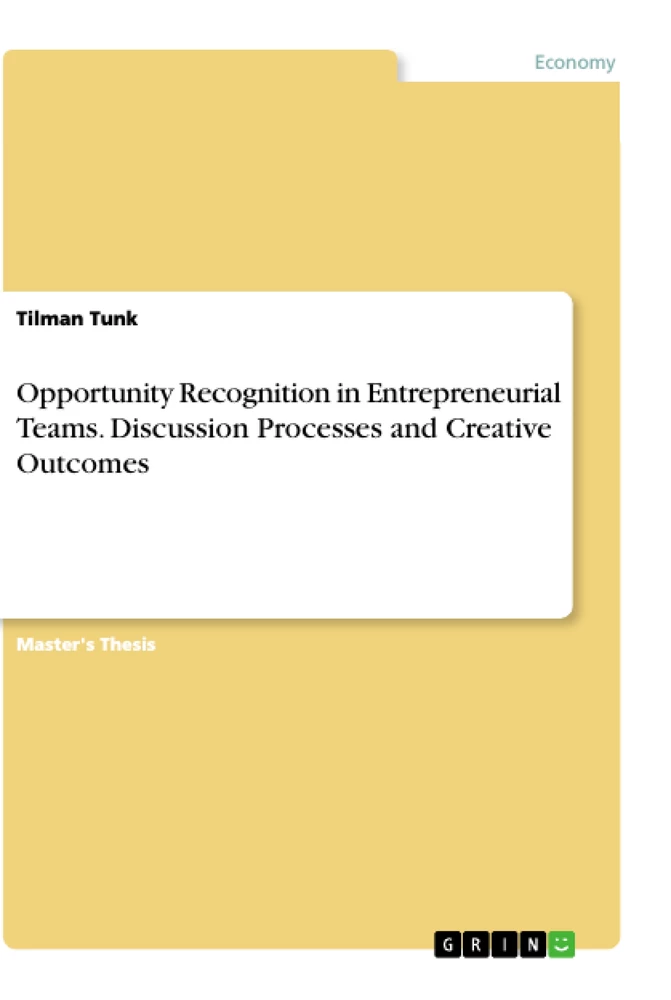
Table of Contents
1 Introduction
2 Literature Review
2.1 Product-Oriented Perspective on Team Creativity
2.2 Entrepreneurial Team Cognition
2.2.1 Framework
2.2.2 Team Creative Cognition as an Emergent State
2.2.3 Inputs on Team Creative Cognition
2.2.4 Mediators on Team Creative Cognition
2.2.5 Opportunity Recognition as the Output of Team Creative Cognition
2.2.6 Recognition of Original and Feasible Opportunities
2.3 Conceptualization of Idea-Generation
2.4 Research Hypotheses – How to Generate Novel and Feasible Ideas?
3 Research Operationalization and Methodology
3.1 Participants and Experiment Procedure
3.2 Measurement
3.2.1 Data Collection and Analytic Strategy
3.2.2 Coding the Idea-Generation Process
3.2.3 Opportunity Originality and Feasibility Rating
3.2.4 Calculations
4 Results
4.1 Summary Statistics
4.2 Correlation of Discussion Phases and Opportunity Recognition
5 Discussion
5.1 Idea-Generation Processes and Creative Opportunities
5.2 Conceptual and Empirical Limitations
5.3 Implications for Further Research
6 Conclusion
Research Objectives and Themes
This thesis investigates how entrepreneurial team cognition (ETC) and team discussion processes influence the quality of recognized business opportunities. The primary research goal is to understand how different team interaction patterns, specifically divergent and convergent thinking phases, shape the originality and feasibility of generated ideas.
- Role of team creative cognition in opportunity recognition
- Impact of convergent and divergent thinking on idea quality
- Operationalization of team idea-generation through process phases
- Influence of taskwork mediators on team decision outcomes
- Measurement of originality and feasibility in entrepreneurial settings
Excerpt from the Book
Opportunity Recognition as the Output of Team Creative Cognition
A particular type of an outcome that has been proved to be valuable in considering team effectiveness is given by the team’s production of a high-quality product. That might occur in a physical product, a plan, or in a decision (Hackman, 1987). Within the outcome perspective, entrepreneurial team creativity arises out of capacity of entrepreneurial teams in utilizing relevant cognitive frameworks, “linking dots” between apparently unrelated events or market trends, and identifying patterns in these links subsequently (de Mol et al., 2015).
Opportunity recognition is a cognitive process that is strongly influenced by team cognition in this context. Baron and Ensley (2006) define opportunity recognition as the identification of meaningful patterns in complex series of events or trends. Opportunity recognition is based on the prototype theory (Hahn & Chatter, 1997; Whittleasa, 1997). This theory implies that through experience, people derive prototypes. Cognitive schemata, where the most typical member of a certain category is conditioned, serve as instances for storage. Existing prototype models within those categories play an important role in perception of new events or objects and in determination of connections between them. Such prototypes serve as templates through assisting the individual who possess them. Furthermore, they help to become aware of those events and to perceive recognizable, meaningful patterns within the connections (Baron & Ensley, 2006). Rephrased, it is a search for matching between perceived and already stored events and objects.
Building on this, a certain opportunity may be identified. An opportunity is defined “as an idea that may have value after further investments of resources” (Kornish & Ulrich, 2011, p. 107). For instance, an opportunity in the agriculture sector could be given by the legal clearance to grow a new variety of plant or to spring into action in the field of biogas plants. Summarizing these preliminary theories, for entrepreneurs an idea is the possibility of a new profitable business venture (Baron & Ensley, 2006). This implies, that an idea is a subjective perception that an opportunity exists.
Summary of Chapters
1 Introduction: Introduces the research context of opportunity recognition in entrepreneurial teams and defines the scope of investigating the cognitive underpinning of this process.
2 Literature Review: Provides a theoretical foundation covering team creativity, the concept of Entrepreneurial Team Cognition (ETC), and the operationalization of idea-generation.
3 Research Operationalization and Methodology: Details the quantitative experiment involving 116 teams and explains the measurement of process phases, originality, and feasibility.
4 Results: Presents the descriptive statistics and the correlation analysis between team discussion phases and the quality of recognized opportunities.
5 Discussion: Analyzes the findings regarding the impact of divergent and convergent thinking, addresses research limitations, and suggests paths for future inquiry.
6 Conclusion: Synthesizes the main findings and highlights the importance of process understanding in assisting entrepreneurs to achieve their goals.
Keywords
Entrepreneurial Team Cognition, Opportunity Recognition, Team Creativity, Divergent Thinking, Convergent Thinking, Idea-Generation, Feasibility, Originality, Taskwork, Innovation Tournaments, Team Processes, Cognition, Brainstorming, Entrepreneurship, Cognitive Schemata
Frequently Asked Questions
What is the core focus of this research?
The work focuses on how entrepreneurial team cognition and team discussion processes, characterized by convergent and divergent thinking, shape the recognition and quality of business opportunities.
What are the central thematic fields?
The central themes include team creative cognition, the product-oriented perspective on creativity, the stages of the idea-generation process, and the measurement of opportunity originality and feasibility.
What is the primary research goal?
The goal is to determine how specific team interaction patterns influence the novelty and utility of business ideas generated during the opportunity recognition process.
Which scientific methodology is employed?
The study uses a quantitative experimental approach, analyzing approximately 60 hours of recorded interactions from 116 entrepreneurial teams using Spearman's rank correlation.
What is addressed in the main body?
The main body examines the theoretical framework of Entrepreneurial Team Cognition (ETC), operationalizes idea-generation phases, and tests hypotheses regarding the influence of specific thinking processes on idea outcomes.
Which keywords best characterize this research?
Key terms include Entrepreneurial Team Cognition, Opportunity Recognition, Team Creativity, Divergent Thinking, and Convergent Thinking.
How does divergent thinking affect the originality of ideas?
The research indicates that a stronger focus on divergent thinking during the idea-generation process leads to more original idea sets and helps in recognizing highly novel opportunities.
What role does convergent thinking play in generating feasible ideas?
Convergent thinking phases, such as reading and task structuring, are positively associated with the feasibility of the idea sets and the final selected opportunities.
Does team size impact the outcome?
The study finds that larger team sizes correlate with more feasible solutions and an increase in the number of ideas generated during the process.
What is the significance of the "hidden profile" in this context?
The research discusses how information shared at the beginning of a process is more likely to influence group decisions, illustrating why managing information flow is critical for entrepreneurial teams.
Ende der Leseprobe aus 83 Seiten
- nach oben
- Arbeit zitieren
- Tilman Tunk (Autor:in), 2017, Opportunity Recognition in Entrepreneurial Teams. Discussion Processes and Creative Outcomes, München, Page::Imprint:: GRINVerlagOHG, https://www.diplomarbeiten24.de/document/493467

neugierig - aktuell - relevant
Entdecken Sie hilfreiche Tipps und Tricks rund ums Studium!

Entdecken Sie hilfreiche Tipps und Tricks rund ums Studium!
Ihre Hausarbeit / Abschlussarbeit:

- - Publikation als E-Book und Buch
- - Hohes Honorar auf die Verkäufe
- - Für Sie komplett kostenlos - mit ISBN
- - Es dauert nur 5 Minuten
- - Jede Arbeit findet Leser

- © GRIN Publishing GmbH.
- Alle Inhalte urheberrechtlich geschützt. Kopieren und verbreiten untersagt.
- info@grin.com
- AGB
- Open Publishing
Der GRIN Verlag hat sich seit 1998 auf die Veröffentlichung akademischer eBooks und Bücher spezialisiert. Der GRIN Verlag steht damit als erstes Unternehmen für User Generated Quality Content. Die Verlagsseiten GRIN.com, Hausarbeiten.de und Diplomarbeiten24 bieten für Hochschullehrer, Absolventen und Studenten die ideale Plattform, wissenschaftliche Texte wie Hausarbeiten, Referate, Bachelorarbeiten, Masterarbeiten, Diplomarbeiten, Dissertationen und wissenschaftliche Aufsätze einem breiten Publikum zu präsentieren.
Kostenfreie Veröffentlichung: Hausarbeit, Bachelorarbeit, Diplomarbeit, Dissertation, Masterarbeit, Interpretation oder Referat jetzt veröffentlichen!
Folgen Sie GRIN auf


- GRIN Verlag GmbH
-
- Nymphenburger Str. 86
- 80636
- Munich, Deutschland
- +49 89-550559-0
- +49 89-550559-10
- info@grin.com
-
