
präsentiert von

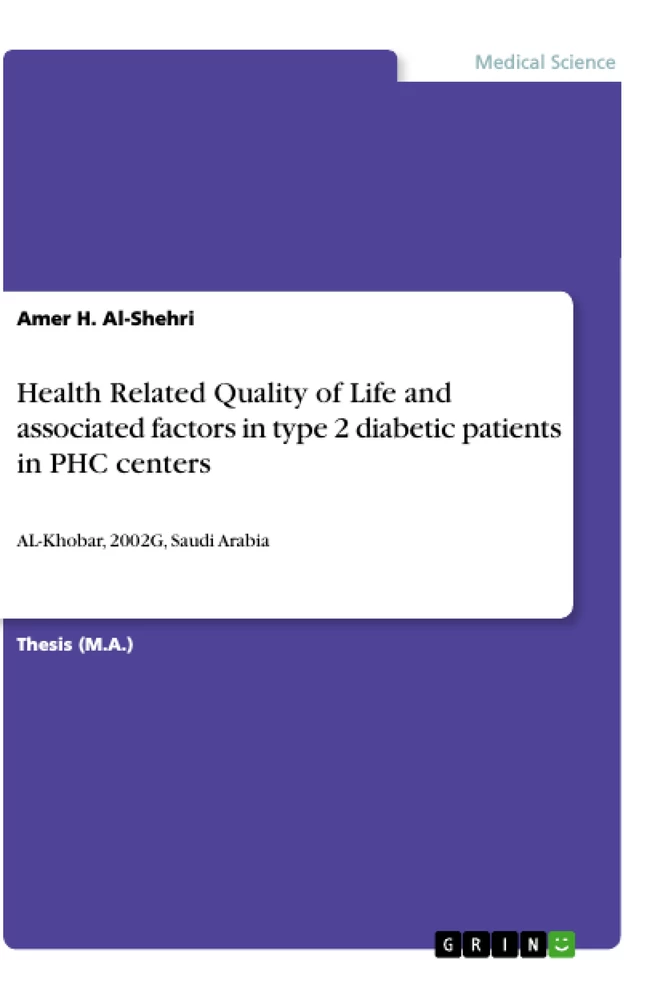
Table of Contents
Chapter 1 Introduction, Rationale and Objectives
1.1 Introduction
1.2 Statement of the Problem
1.3 Rationale
1.4 Research Hypothesis
1.5 Aim
1.6 Specific Objectives
Chapter 2 Literature Review
2.1 What is diabetes?
2.1.1 There are two types of diabetes mellitus:
2.1.2 Management of DM:
2.1.3 Diet:
2.1.4 Drug treatment of DM:
2.1.5 Complications of DM:
2.2 Magnitude of the problem:
2.2.1 Diabetes prevalence worldwide:
2.2.2 Type 2 Diabetes Prevalence in Saudi Arabia:
2.3 Health Related Quality of life (HRQOL):
2.3.1 HRQOL Goals :
2.3.2 Effects of DM on HRQOL:
2.3.3 HRQOL in diabetes mellitus:
2.3.4 Why HRQOL is important in diabetes:
2.4 HRQOL studies in type 2 diabetes and Factors Affecting Quality of life in Diabetes
2.4.1 Exercise consultation and HRQOL in Diabetes:
2.4.2 Diet and HRQOL:
2.4.3 Regular follow-up of type 2 diabetes and HRQOL:
2.4.4 Treatment Programs and Education:
2.4.5 Glycemic Control :
2.4.6 Income and HRQOL:
2.4.7 Depression:
2.4.8 Burden of Symptoms:
2.4.9 Insulin use and presence of complications:
2.4.10 Weight Loss :
2.4.11 Erectile Dysfunction:
2.4.12 Presence of Hypertension or other disease:
2.4.13 Age and oral hypoglycemic agents:
2.4.14 Diabetes Screening:
2.4.15 Knowledge:
2.4.16 Coping Behavior:
2.4.17 Educational Level:
2.4.18 Gender:
2.4.19 Self-Monitoring of Blood Glucose (SMBG):
2.4.20 Obesity:
2.5 The concept of measuring health outcome:
2.5.1 SF-36 HRQOL Measure:
2.5.2 The SF-12 HRQOL measure:
2.5.2.1 Reliability of SF-12:
2.5.2.2 Validity:
2.6 Review of studies using SF-12 in Diabetes and HRQOL
2.6.1- Nichols et al(69) carried out a study to determine "the characteristics that influence glycemic control among insulin-using adults with type 2 diabetes".
2.6.2- Collins et al(70) conducted a study to examine HRQOL and factors associated with it in men with chronic prostatitis using general and condition-specific instruments . A total number of 278 men with chronic prostatitis were recruited from six clinical research centers across the United States and Canada. SF-12 and the National institutes of the health chronic prostatitis symptom index (NIH-CPS1) were used for data collection.
2.6.3- Brown et al(71) conducted a study in Los Angeles, USA, to "evaluate the relationship between sociodemographic characteristics and quality of care for Medicare beneficiaries with diabetes in managed care".
2.6.4-Paul et al(72) carried out a study in USA , to "explore the impact of depressive symptoms in PHC patients with diabetes on diabetes self-care and adherence to medication regimens".
2.6.5-Wells and Sherbourne(73), conducted a study in USA to compare health utility (mean the preference of the patient for a particular health outcome), which is an important outcome for medical cost-effectiveness studies, with
2.6.6-Siddique et al(74) , conducted a study in USA, to describe the HRQOL of diabetics with and without motility-related upper gastrointestinal symptoms(UGS) compared to individuals without diabetes.
Chapter 3 Methodology
3.1 Study Type
3.2 Study Area
3.3 study population
3.4 Sampling technique
3.4.1 Sample Size:
3.4.2 Study sample:
3.5 Selection Criteria of diabetic Patients and controls
3.5.1 Inclusion criteria:
3.5.2 Exclusion criteria:
3.5.3 Control Group:
3.6 Interviewers
3.6.1 Selection of the Interviewers:
3.6.2 Interviewers Training:
3.7 Pilot study
3.8 Methods used for data collection
3.8.1 The questionnaire:
3.8.2 Demographic and clinical variables studied. These included:
3.8.3 The SF-12:
3.8.4 Definition of variables:
3.8.5 The scoring system used for analysis of SF-12 questionnaire:
3.8.6 The SF-12 validity:
3.9 Reliability of the Interviewers
3.9.1 Reliability of the SF-12:
3.9.2 Internal Consistency:
3.10 Patient Interviews
3.11 Interviews of Controls
3.12 Data Processing and Analysis
3.13 Ethical Considerations
3.14 Limitations of the Study
Chapter 4 Results
4.1 sample size and response rate
4.2 Demographic and social characteristics of cases and controls
4.3 Clinical characteristics of the cases
4.4 Total HRQOL
4.4.1 Logistic regression for PCS scores:
4.4.2 Logistic regression for MCS scores:
4.5 Quality of Life Measures
4.5.1 Cases and controls:
4.6 Multiple Linear Regression to predict HRQOL from SF-12
4.6.1 Multiple Regression model for PCS:
4.6.2 Multiple Linear regression for MCS:
4.7 Demographic and clinical characteristics of controlled and uncontrolled patients
Chapter 5 Discussion
5.1 Sociodemographic characteristics of Cases and Controls
5.2 Clinical Characteristics of Cases and Controls
5.3 Clinical Characteristics of Cases
5.4 HRQOL
5.4.1 Total HRQOL:
5.4.2 HRQOL in Cases and Controls:
5.4.3 HRQOL in males and females:
5.4.4 HRQOL in controlled and uncontrolled diabetics:
5.5 Factors affecting HRQOL
5.5.1 Factors affecting PCS:
5.5.2 Factors Affecting MCS:
5.5.3 Oral hypoglycemic drugs, blood glucose monitoring and HRQOL:
5.6 Demographic Characteristics of Controlled and Uncontrolled diabetic Patients
5.6.1 Social and family characteristics:
5.6.2 Clinical Characteristics of controlled and uncontrolled diabetics:
5.7 Factors that predict poor metabolic control
5.8 Factors that affect HRQOL in type 2 diabetes
CHAPTER 6 CONCLUSIONS AND RECOMMENDATIONS
6.1 CONCLUSIONS
6.2 RECOMMENDATIONS
Research Objectives and Core Topics
The primary aim of this study is to assess the Health Related Quality of Life (HRQOL) among patients with type 2 diabetes residing in the Al-Khobar area, Saudi Arabia, and to identify the factors influencing these outcomes, while comparing differences between controlled and uncontrolled diabetic patients.
- Measurement and assessment of HRQOL in type 2 diabetic patients using the SF-12 instrument.
- Comparison of HRQOL scores between diabetic patients and matched non-diabetic controls.
- Identification of sociodemographic and clinical factors affecting HRQOL.
- Evaluation of the impact of metabolic control levels (controlled vs. uncontrolled) on patient well-being.
- Validation of the Arabic version of the SF-12 questionnaire for use in a local clinical setting.
Book Excerpt
2.3.2 Effects of DM on HRQOL:
The diabetes can negatively affect the physical well-being in three major ways. The most potent factor (the first) is the development of long-term complications. There is likely to be a significant drop in perceived quality of life. The patient may now be unable or less able to work, to complete household tasks.(36)
The second factor is short-term complications. Chronically elevated blood glucose levels may lead to increased fatigue, sleep problems, more frequent infections, and other associated problems.(36)
The third major factor “concerns physical symptoms and lifestyle changes resulting from the demands of the diabetes regimen”. Unpleasant side effects of the medications such as lypohypertrophy from repeated insulin injections are also important.(36)
2- Effects of diabetes on the psychological(mental) functioning :
The demands of diabetes care can have a large impact on mood, both short-term and long-term. The diabetics may also feel hopeless about the possibility of avoiding long-term complications.(36) “In addition, chronically elevated blood glucose levels may lead to persistent fatigue, which can exacerbate the depressed mood”. Similarly, frequent hypoglycemic episodes can be exhausting. Facing the disease of diabetes with its complications and management will lead usually to prolonged feeling of helplessness and emotional distress. No one seems to understand the patient feeling so this causes an emotional distress in diabetes related social situations.(36)
Summary of Chapters
Chapter 1 Introduction, Rationale and Objectives: Discusses the rising prevalence of type 2 diabetes in Saudi Arabia and the importance of monitoring HRQOL as a primary health outcome.
Chapter 2 Literature Review: Provides an overview of diabetes management, the significance of HRQOL, and existing studies utilizing the SF-12 or SF-36 to measure outcomes in diabetic populations.
Chapter 3 Methodology: Describes the case-control study design conducted in PHC centers, including participant selection, the use of the SF-12, and the statistical methods employed.
Chapter 4 Results: Details the demographic profiles, clinical characteristics, and the statistical analysis of HRQOL scores, highlighting the impact of factors like gender and complications.
Chapter 5 Discussion: Analyzes the study findings in relation to existing international literature and explores the implications of various factors on metabolic control and HRQOL.
CHAPTER 6 CONCLUSIONS AND RECOMMENDATIONS: Summarizes the key findings and provides actionable recommendations for healthcare providers to improve patient education and follow-up care.
Keywords
Type 2 Diabetes, Health Related Quality of Life, HRQOL, SF-12, Saudi Arabia, Metabolic Control, Primary Health Care, Diabetic Complications, Patient Education, Chronic Disease, Physical Function, Mental Health, Clinical Outcomes, Glycemic Control, Socioeconomic Status
Frequently Asked Questions
What is the central focus of this research?
This research focuses on evaluating the Health Related Quality of Life (HRQOL) of patients with type 2 diabetes in Al-Khobar, Saudi Arabia, and investigating how various factors affect their physical and mental well-being.
What are the primary themes addressed?
The work covers diabetes prevalence, the impact of complications, the role of metabolic control, patient self-management, and the validation of HRQOL assessment tools.
What is the core research goal?
The primary goal is to determine the HRQOL of type 2 diabetic patients compared to controls and to identify the specific factors that lead to lower quality of life scores in this patient group.
Which scientific methodology is employed?
The study utilizes a cross-sectional case-control design, involving structured interviews with 216 diabetic patients and 216 matched controls using the SF-12 health survey.
What does the main body of the work cover?
The main sections include an extensive literature review, detailed methodology, results of statistical regressions, and a thorough discussion on how factors like age, gender, obesity, and diabetes complications impact health outcomes.
Which keywords best characterize this work?
Key terms include Type 2 Diabetes, HRQOL, SF-12, metabolic control, patient education, Saudi Arabia, and chronic disease management.
How does gender impact the study findings?
The study found that females generally reported lower HRQOL scores compared to males, and this difference was linked to higher rates of obesity and increased frequency of hospital visits among female patients.
What is the significance of the "controlled" vs. "uncontrolled" diabetes distinction?
The study demonstrates that patients with uncontrolled fasting blood sugar levels suffer from significantly impaired HRQOL compared to those who maintain better control, underscoring the need for improved metabolic management.
Why is the Arabic version of the SF-12 considered important in this study?
The validation of the Arabic SF-12 is crucial as it provides a standardized, reliable tool for assessing the health status of Arabic-speaking diabetic patients in local primary care settings.
Ende der Leseprobe aus 111 Seiten
- nach oben
- Arbeit zitieren
- Amer H. Al-Shehri (Autor:in), 2002, Health Related Quality of Life and associated factors in type 2 diabetic patients in PHC centers, München, Page::Imprint:: GRINVerlagOHG, https://www.diplomarbeiten24.de/document/494273

neugierig - aktuell - relevant
Entdecken Sie hilfreiche Tipps und Tricks rund ums Studium!

Entdecken Sie hilfreiche Tipps und Tricks rund ums Studium!
Ihre Hausarbeit / Abschlussarbeit:

- - Publikation als E-Book und Buch
- - Hohes Honorar auf die Verkäufe
- - Für Sie komplett kostenlos - mit ISBN
- - Es dauert nur 5 Minuten
- - Jede Arbeit findet Leser

- © GRIN Publishing GmbH.
- Alle Inhalte urheberrechtlich geschützt. Kopieren und verbreiten untersagt.
- info@grin.com
- AGB
- Open Publishing
Der GRIN Verlag hat sich seit 1998 auf die Veröffentlichung akademischer eBooks und Bücher spezialisiert. Der GRIN Verlag steht damit als erstes Unternehmen für User Generated Quality Content. Die Verlagsseiten GRIN.com, Hausarbeiten.de und Diplomarbeiten24 bieten für Hochschullehrer, Absolventen und Studenten die ideale Plattform, wissenschaftliche Texte wie Hausarbeiten, Referate, Bachelorarbeiten, Masterarbeiten, Diplomarbeiten, Dissertationen und wissenschaftliche Aufsätze einem breiten Publikum zu präsentieren.
Kostenfreie Veröffentlichung: Hausarbeit, Bachelorarbeit, Diplomarbeit, Dissertation, Masterarbeit, Interpretation oder Referat jetzt veröffentlichen!
Folgen Sie GRIN auf


- GRIN Verlag GmbH
-
- Nymphenburger Str. 86
- 80636
- Munich, Deutschland
- +49 89-550559-0
- +49 89-550559-10
- info@grin.com
-
