
präsentiert von

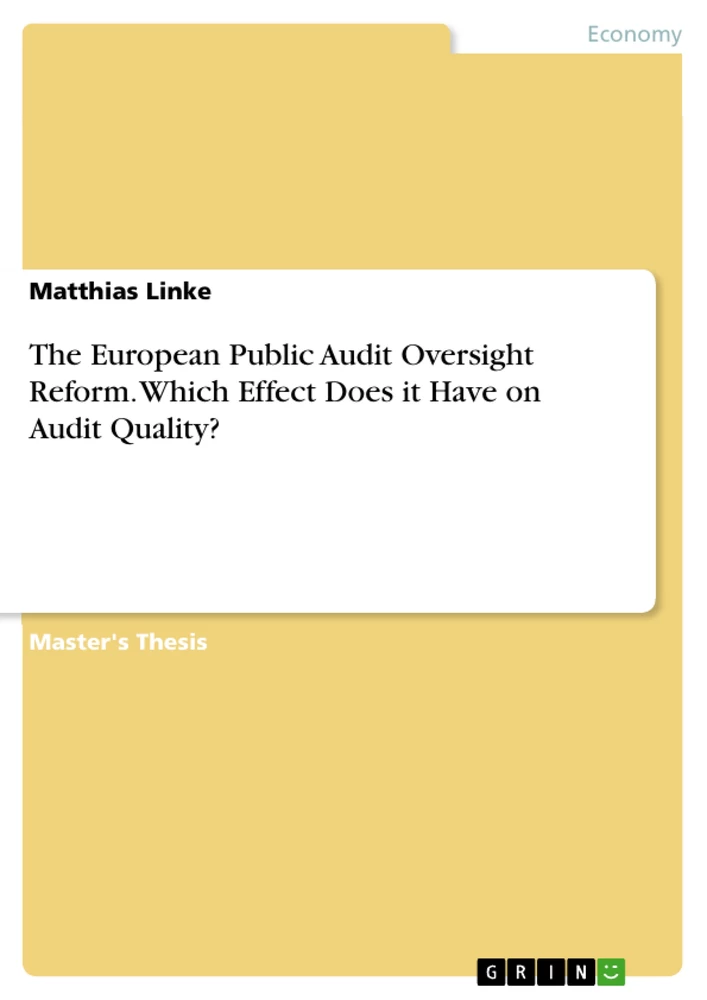
Table of Contents
I. INTRODUCTION
II. BACKGROUND
THE PIONEER – PUBLIC AUDIT OVERSIGHT IN THE U.S.
THE FOLLOWER – PUBLIC AUDIT OVERSIGHT IN THE EU
THE VOLUNTEERS – PUBLIC AUDIT OVERSIGHT AT AN INTERNATIONAL LEVEL
THE INTENTION – ENHANCEMENT OF AUDIT QUALITY
AUDIT QUALITY
LINKING PUBLIC AUDIT OVERSIGHT TO AUDIT QUALITY
III. LITERATURE REVIEW AND DEVELOPMENT OF HYPOTHESES
RESEARCH ON SELF-REGULATED PEER REVIEWS
RESEARCH ON INDEPENDENT INSPECTIONS
IV. DATA AND RESEARCH METHOD
SAMPLE AND DESCRIPTIVE STATISTICS
EMPIRICAL MODEL
THE MODIFIED JONES MODEL
ABNORMAL WORKING CAPITAL ACCRUALS
DEPENDENT VARIABLE
INDEPENDENT VARIABLES
CONTROL VARIABLES
V. EMPIRICAL RESULTS
VI. SENSITIVITY TEST
VII. ROBUSTNESS TEST
VIII. CONCLUSION
IX. REFERENCES
X. Appendix
Research Objectives and Key Topics
This study investigates the impact of the European public audit oversight reform, specifically Directive 2006/43/EC, on audit quality, measured through earnings management. It further examines whether the choice of different national public oversight models—full-time inspection versus a peer review system—leads to variations in audit quality across European jurisdictions.
- Impact of the European regulatory reform on audit quality.
- Comparison of full-time inspection models versus modified peer review models.
- Analysis of discretionary accruals and earnings management as proxies for audit quality.
- The relationship between public audit oversight and investor confidence.
- Cross-jurisdictional analysis of audit oversight effectiveness within the EU.
Excerpt from the Book
THE PIONEER – PUBLIC AUDIT OVERSIGHT IN THE U.S.
The downfall of influential publicly traded companies such as Enron and WorldCom led to extreme losses among investors and damaged the confidence in the audit profession in a severe way. As a consequence, auditors were publicly pilloried and faced severe hostilities. Just before the breakdown in December 2001, Enron was named “Americas Most Innovative Company” for six consecutive years (Forbes, 2012), whereas WorldCom’s filing for Chapter 11 bankruptcy protection in July 2002 was the largest such filing in U.S. history at the time.
In order to prevent comparable misbehavior and to regulate financial practice and corporate governance, the U.S. Congress issued the Sarbanes-Oxley Act of 2002. Named after Senator Paul Sarbanes and Representative Michael Oxley, SOX is arranged into eleven titles. Besides pervasive changes in guidelines regarding auditor independence, corporate responsibility and financial disclosure, the Act implemented the PCAOB as an independent third party performing oversight over the audits of public entities. The PCAOB replaced the AICPA that was implemented in the 1970s. Under the former self-regulated process public accounting firms engaged other firms to study and report on quality control policies and procedures and to assess to what extent the firm’s audit practice is consistent with its own system of quality control. Although requiring peer reviews was an important signal, a frequent criticism is that the reviewed firm could choose the firm that would perform the peer review (Hilary and Lennox, 2005), resulting in a small number of firms actually receiving unfavorable opinions. Opponents argued that firms often entered into ‘You scratch my neck; I’ll scratch yours’ relationships (Louwers et al., 2013).
Summary of Chapters
I. INTRODUCTION: Outlines the research motivation regarding public audit oversight, the U.S. regulatory transition following accounting scandals, and the research questions concerning the European context.
II. BACKGROUND: Provides a historical overview of public audit oversight evolution, contrasting U.S. and European approaches and defining the dual oversight models implemented in the EU.
III. LITERATURE REVIEW AND DEVELOPMENT OF HYPOTHESES: Synthesizes existing research on self-regulated peer reviews and independent inspections, leading to the formulation of two primary research hypotheses.
IV. DATA AND RESEARCH METHOD: Details the sample selection criteria, the construction of empirical models using discretionary and working capital accruals, and the identification of control variables.
V. EMPIRICAL RESULTS: Presents the statistical findings regarding the shift in earnings management levels pre- and post-reform and compares the effectiveness of different oversight models.
VI. SENSITIVITY TEST: Evaluates the robustness of the empirical findings by analyzing the influence of specific country data on the overall results.
VII. ROBUSTNESS TEST: Implements alternative models (Dechow and Dichev) to verify the consistency of the initial results regarding audit quality improvement.
VIII. CONCLUSION: Summarizes the study’s findings, acknowledging the complexities of regulatory impact and suggesting directions for future research.
Keywords
audit quality, public audit oversight, earnings management, discretionary accruals, Directive 2006/43/EC, SOX, PCAOB, peer review, full-time inspection, financial reporting, corporate governance, investor confidence, audit reform, accrual quality, financial markets
Frequently Asked Questions
What is the primary focus of this research paper?
The paper examines whether the European public audit oversight reform, initiated by Directive 2006/43/EC, has successfully improved audit quality by reducing earnings management practices among firms in the European Union.
Which central themes are explored in this work?
The work centers on the transition from self-regulatory to independent public oversight, the efficacy of different inspection models (full-time versus peer review), and the resulting impact on the reliability of financial disclosures.
What is the core research question?
The research asks if the European regulatory reform led to a significant decrease in abnormal accruals and whether the choice of a specific national oversight model correlates with higher audit quality.
Which scientific methods are applied?
The author uses empirical quantitative methods, specifically the Modified Jones Model and the Dechow and Dichev model, to calculate abnormal accruals as proxies for earnings management and audit quality.
What does the main body address?
The main body reviews the historical context of audit scandals, synthesizes literature on peer reviews versus independent inspections, details the research design and sample selection, and presents the results of regression analyses testing the defined hypotheses.
Which keywords define this work?
Key terms include audit quality, public audit oversight, earnings management, discretionary accruals, and the specific European and U.S. regulatory frameworks discussed.
Why were France and Slovakia excluded from the sample?
They were excluded because they implemented a hybrid approach (a combination of both oversight models), which hindered the comparative analysis between the two specific models identified in the research design.
What is the significance of the year 2006 in this study?
The year 2006 is treated as a transition year because it marks the establishment of Directive 2006/43/EC, representing a period where both pre-reform and post-reform managerial behaviors were observed.
How is audit quality proxied?
Audit quality is proxied by the level of earnings management, specifically through the absolute values of modified Jones model discretionary accruals and abnormal working capital accruals.
Ende der Leseprobe aus 57 Seiten
- nach oben
- Arbeit zitieren
- Matthias Linke (Autor:in), 2015, The European Public Audit Oversight Reform. Which Effect Does it Have on Audit Quality?, München, Page::Imprint:: GRINVerlagOHG, https://www.diplomarbeiten24.de/document/495142

neugierig - aktuell - relevant
Entdecken Sie hilfreiche Tipps und Tricks rund ums Studium!

Entdecken Sie hilfreiche Tipps und Tricks rund ums Studium!
Ihre Hausarbeit / Abschlussarbeit:

- - Publikation als E-Book und Buch
- - Hohes Honorar auf die Verkäufe
- - Für Sie komplett kostenlos - mit ISBN
- - Es dauert nur 5 Minuten
- - Jede Arbeit findet Leser

- © GRIN Publishing GmbH.
- Alle Inhalte urheberrechtlich geschützt. Kopieren und verbreiten untersagt.
- info@grin.com
- AGB
- Open Publishing
Der GRIN Verlag hat sich seit 1998 auf die Veröffentlichung akademischer eBooks und Bücher spezialisiert. Der GRIN Verlag steht damit als erstes Unternehmen für User Generated Quality Content. Die Verlagsseiten GRIN.com, Hausarbeiten.de und Diplomarbeiten24 bieten für Hochschullehrer, Absolventen und Studenten die ideale Plattform, wissenschaftliche Texte wie Hausarbeiten, Referate, Bachelorarbeiten, Masterarbeiten, Diplomarbeiten, Dissertationen und wissenschaftliche Aufsätze einem breiten Publikum zu präsentieren.
Kostenfreie Veröffentlichung: Hausarbeit, Bachelorarbeit, Diplomarbeit, Dissertation, Masterarbeit, Interpretation oder Referat jetzt veröffentlichen!
Folgen Sie GRIN auf


- GRIN Verlag GmbH
-
- Nymphenburger Str. 86
- 80636
- Munich, Deutschland
- +49 89-550559-0
- +49 89-550559-10
- info@grin.com
-
