
präsentiert von

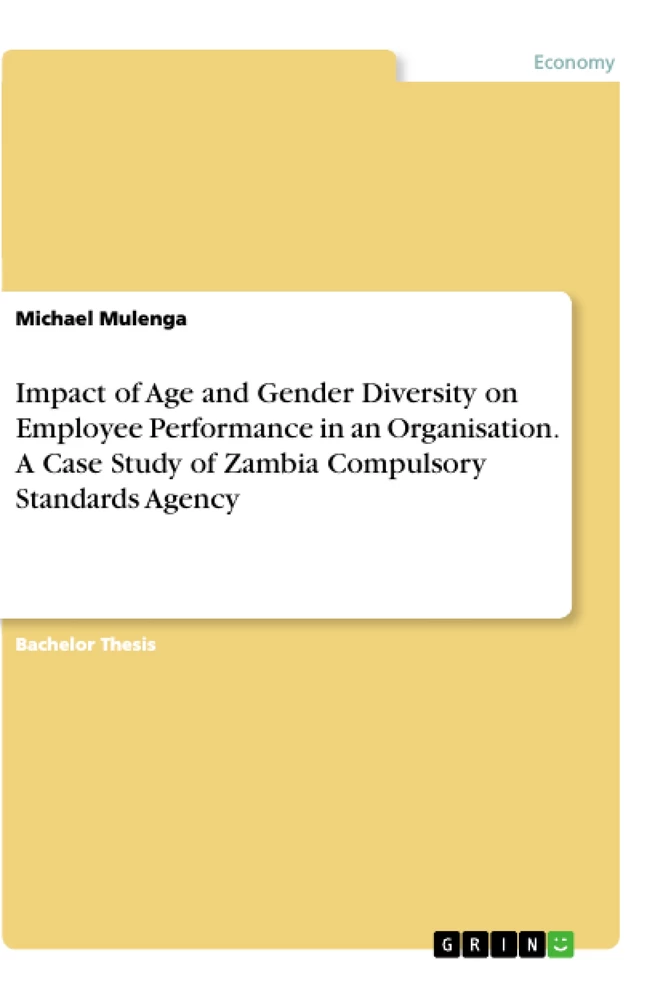
Table of Contents
Chapter One Introduction
1.1 Background to the Study
1.2 Statement of the Problem
1.3 Objectives of the Study
1.3.1 Main Objective
1.3.2 Specific Objectives
1.4 Research Questions
1.5 Research Hypotheses
1.6 Significance of the Study
1.7 Delimitations and Assumptions
1.8 Definition of Key Terms
1.9 Organisation of the study Report
Chapter Two Literature Review
2.1 Introduction
2.2 Impact of Age Diversity on Employee Performance
2.3 Impact of Gender Diversity on Employee Performance
2.4 Extent of Workforce Diversity Influence on Organisational Performance
2.5 Empirical Review of Gender Diversity in Zambia
2.6 Theoretical Framework
2.6.1 Information-Processing and Decision-Making Theory
2.6.2 Similarity-Attraction Theory
2.7 Conceptual Framework
2.8 Chapter Summary
Chapter Three Research Methodology
3.1 Introduction
3.2 Research Design
3.3 Location and Profile of Study Institution
3.4 Target Population
3.5 Sampling Strategy and Sample Size
3.6 Research Instrument
3.7 Data Collection Method
3.8 Data Analysis Procedure
3.9 Limitations of the Study
3.10 Research Ethics
3.11 Chapter Summary
Chapter Four Data Presentation and Interpretation
4.1 Introduction
4.2 Background Characteristics of Respondents
4.2.1 Age distribution of respondents
4.2.2 Gender distribution of respondents
4.2.3 Educational background of respondents
4.2.4 Distribution of respondents by employment status
4.2.5 Distribution of Respondents by Status or Position in the Organisation
4.2.6 Length of Service
4.3 Impact of Age Diversity on Employee Performance
4.4 Effects of Gender Diversity on Employee Performance in an Organisation
4.5 Extent of Workforce Diversity Influences on Organisational Performance
4.6 In-depth Interview: Results
4.7 Intervening Variables
4.8 Chapter Summary
Chapter Five Discussion of Findings and Analysis
5.1 Introduction
5.2 Impact of Age Diversity on Employee Performance
5.3 Impact of Gender Diversity on Employee Performance
5.4 Impact of Workforce Diversity on Employee Performance
5.5 Intervening Variables
5.6 Chapter Summary
Chapter Six Conclusion and Recommendations
6.1 Introduction
6.2 Conclusion
6.3 Recommendations
6.4 Suggestions for Future Research
Research Objectives and Key Topics
The primary objective of this study is to assess the impact of age and gender diversity on employee performance within the Zambia Compulsory Standards Agency (ZCSA), aiming to determine how diverse workforce compositions influence organisational efficiency and effectiveness.
- Impact of age diversity on employee performance
- Impact of gender diversity on employee performance
- Workforce diversity influence on organisational performance
- The role of intervening variables like corporate culture and business strategy
Excerpt from the Book
1.1 Background to the Study
Human capital is the organisation’s resource that cannot be duplicated by other organisations. The human capital comes from a pool of workforce that brings diverse skills, backgrounds and experiences all of which contribute to the success of an organisation. For organisations to attract a broader talent pool of employees, it needs to embrace an organisational culture of workforce diversity. This will lead to an enhanced corporate reputation and strengthened cultural values. According to Childs (2005), workforce diversity is a global workplace and marketplace phenomenon. Therefore, any business that intends to be successful must have a borderless view and an underlying commitment to ensuring that age and gender diversity are part of its day-to-day business conduct. Workforce diversity includes, but is not limited to: age, ethnicity, ancestry, gender, physical abilities/qualities, race, sexual orientation, educational background, geographical location, income, marital status, military experience, religious beliefs, parental status, and work experience (Srivastava and Agarwal, 2012).
In 1991, Zambia enacted a new set of laws, which sought to break the culture of gender bias at the work place in public sector in order to institutionalise professionalism and positive diversity attributes in these organisations. However, the report published by Mensi-Klarbach et al. (2013) shows that despite the adoption of the legislation by public institutions, the impact of the diversity programs at the organisation level still needed to be identified since these programs are executed deliberately by human resource managers, and may have varied adaptations and unintended consequences.
Summary of Chapters
Chapter One Introduction: This chapter provides the foundation for the study by outlining the background, problem statement, objectives, and research questions regarding workforce diversity at ZCSA.
Chapter Two Literature Review: This section reviews existing literature on age and gender diversity, covering theoretical frameworks such as information-processing and similarity-attraction theory.
Chapter Three Research Methodology: This chapter describes the research design, target population, sampling strategies, and data collection methods employed for the study at ZCSA.
Chapter Four Data Presentation and Interpretation: This chapter presents the raw findings of the study through descriptive statistics and interprets them in the context of the research objectives.
Chapter Five Discussion of Findings and Analysis: This chapter analyzes the empirical findings and discusses them in relation to the reviewed literature to assess whether the objectives were met.
Chapter Six Conclusion and Recommendations: This chapter concludes the research based on the findings and provides strategic recommendations for ZCSA and suggestions for further academic research.
Keywords
Workforce Diversity, Employee Performance, Age Diversity, Gender Diversity, Human Capital, Organisational Performance, ZCSA, Zambia, Corporate Culture, Business Strategy, Talent Management, Professionalism, Workplace Inclusion, Labour Turnover, Employee Satisfaction.
Frequently Asked Questions
What is the primary focus of this research?
The research focuses on investigating how age and gender diversity affect the performance of employees at the Zambia Compulsory Standards Agency (ZCSA).
What are the central thematic areas of the study?
The study centers on the impact of age and gender heterogeneity on work performance, team effectiveness, and organisational outcomes.
What is the main research objective?
The main objective is to determine and evaluate the impact of age and gender diversity on employee and organisational performance.
Which methodology was used in this research?
The study adopted a descriptive research design, utilizing stratified random sampling to survey 103 employees, with data collected via questionnaires and interviews.
What topics are discussed in the main body?
The main body covers the theoretical background of workforce diversity, empirical reviews, data presentation and interpretation, and a discussion of findings compared to established literature.
Which keywords define this work?
Key terms include Workforce Diversity, Employee Performance, Age Diversity, Gender Diversity, Organisational Performance, and Human Capital.
How does age diversity affect the team environment at ZCSA?
The findings indicate that age diversity generally contributes positively to team success, with older employees providing mentoring and younger employees contributing technical expertise.
What was the conclusion regarding gender diversity?
The study concludes that gender diversity is a vital factor for organisational performance, promoting inclusive environments and better decision-making processes.
Ende der Leseprobe aus 88 Seiten
- nach oben
- Arbeit zitieren
- Michael Mulenga (Autor:in), 2019, Impact of Age and Gender Diversity on Employee Performance in an Organisation. A Case Study of Zambia Compulsory Standards Agency, München, Page::Imprint:: GRINVerlagOHG, https://www.diplomarbeiten24.de/document/495281

neugierig - aktuell - relevant
Entdecken Sie hilfreiche Tipps und Tricks rund ums Studium!

Entdecken Sie hilfreiche Tipps und Tricks rund ums Studium!
Ihre Hausarbeit / Abschlussarbeit:

- - Publikation als E-Book und Buch
- - Hohes Honorar auf die Verkäufe
- - Für Sie komplett kostenlos - mit ISBN
- - Es dauert nur 5 Minuten
- - Jede Arbeit findet Leser

- © GRIN Publishing GmbH.
- Alle Inhalte urheberrechtlich geschützt. Kopieren und verbreiten untersagt.
- info@grin.com
- AGB
- Open Publishing
Der GRIN Verlag hat sich seit 1998 auf die Veröffentlichung akademischer eBooks und Bücher spezialisiert. Der GRIN Verlag steht damit als erstes Unternehmen für User Generated Quality Content. Die Verlagsseiten GRIN.com, Hausarbeiten.de und Diplomarbeiten24 bieten für Hochschullehrer, Absolventen und Studenten die ideale Plattform, wissenschaftliche Texte wie Hausarbeiten, Referate, Bachelorarbeiten, Masterarbeiten, Diplomarbeiten, Dissertationen und wissenschaftliche Aufsätze einem breiten Publikum zu präsentieren.
Kostenfreie Veröffentlichung: Hausarbeit, Bachelorarbeit, Diplomarbeit, Dissertation, Masterarbeit, Interpretation oder Referat jetzt veröffentlichen!
Folgen Sie GRIN auf


- GRIN Verlag GmbH
-
- Nymphenburger Str. 86
- 80636
- Munich, Deutschland
- +49 89-550559-0
- +49 89-550559-10
- info@grin.com
-
