
präsentiert von

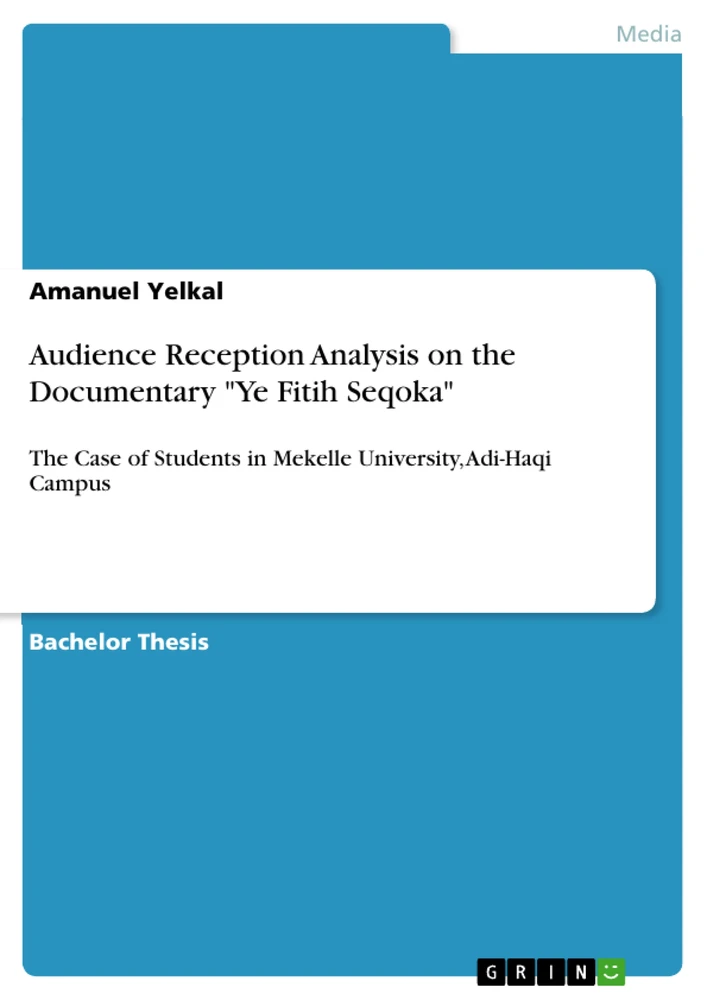
Table of Contents
1. Introduction
1.1. Background of the study
1.2. Statement of the Problem
1.3. Objectives the study
1.3.1 General objective
1.3.2 Specific objectives
1.4. Research questions
1.5. Significance of the study
1.6. Scope of the study
1.7. Limitations of the study
2. Literature Review
2.1. Audience Research
2.2.1. Theories of Active audience
2.2.2.2 Reception Theory
2.2.2.3 Encoding/Decoding
2.3. Representation of media
2.4. Documentary
2.4.1. Ethiopian Television (ETV) Documentaries
2.5.1. Role of media in Ethiopia
2.6. Human Right in Ethiopian Media
2.7 Conclusion
3. Research Methodology
3.1. Introduction
3.1. Study Area
3.2. Sampling method
3.2.1 Sample size
3.3. Methods of data collection
3.3.1 Interview
3.3.3 Focus group discussion (FGD)
3.3 Methods of data analysis
4. Data Presentation and Analysis
4. Analysis of Discussants’ and Interviewees’
4.1 Interpretation of the message of “Yefitih Seqoka” Documentary film
4.1.1 Understanding of the Documentary film Title “yefith seqoka”
4.1.2 Understanding the message of “Yefith Seqoka” documentary film
4.2. Representation of Subjects in “Yefith Seqoqa” Documentary Film
4.3. The documentary from Journalistic view
5. Conclusion and Recommendations
5.1 Conclusion
5.2. Recommendations
Research Objectives and Core Themes
The primary objective of this research is to analyze how students at Mekelle University, Adi-Haqi campus, interpret the messages and representations conveyed by the documentary "Ye Fitih Seqoka." The study seeks to understand audience reactions, the influence of sociocultural contexts on interpretation, and the journalistic validity of the film.
- Audience reception and interpretation of politically sensitive media content.
- The role of media in shaping ethnic perceptions and social cohesion.
- Evaluation of documentary filmmaking through journalistic values and ethical standards.
- The impact of media framing on audience safety perceptions and social security.
- The influence of personal background and social positioning on meaning construction (Encoding/Decoding).
Excerpt from the Book
4.1.1 Understanding of the Documentary film Title “yefith seqoka”
Titles of media productions are like a summary of its whole content with a few words. Understanding the title of media outlets therefore helps the audience not only to decide whether to start watching or not, and also it helps the audience to understand the content and message of the media production. In this manner the focus group discussion (FGD) were begins by asking the informants to reflect on how they understood the documentary film’s title: “Yefith seqoka”.
Almost all participants (15) of the three FGDs expressed their views differently with their own understandings. For example the below mentioned participants have expressed their views in the following way:
FGD 1 (5): the title “yefith seqoqa” as the words itself describes, it exactly show the presented sufferings in the documentary. I wonder how they manage to combine these two words, it’s very descriptive.
FGD 3 (5): when I firstly saw the title I thought it only talks about justice system. But after I start watching the documentary and as a law school student I started understanding its manner. Justice is the only thing that matters, so the title describes the documentary well.
FGD 1 (1): for me the title was presentiment and uncomfortable. Even when I keep watching the documentary that harrowing feeling keeps growing. I found the title as something disutility.
FGD 2 (4): Days ago before the transmission of the documentary on social media I have seen a statement that says “there will be a documentary that narrates about violation of human right coming soon” so it was not difficult for me to understand the title when I saw it first. I understood the title “yefith seqoqa” not only as a violation of justice but as an infraction of humanity.
Summary of Chapters
1. Introduction: This chapter provides the background on media influence, outlines the problem regarding state-controlled media, and establishes the research objectives and questions.
2. Literature Review: This section covers theoretical foundations including audience research, reception theory, media representation, and the historical role of media in Ethiopia.
3. Research Methodology: This chapter details the qualitative approach used, including focus group discussions and in-depth interviews as the primary data collection methods.
4. Data Presentation and Analysis: This chapter analyzes the participants' interpretations of the documentary's title, its messages, the representation of ethnic subjects, and an evaluation from a journalistic perspective.
5. Conclusion and Recommendations: This chapter summarizes the study findings, noting the negative perception of the documentary among the audience and providing recommendations for future media practices.
Keywords
Audience Reception Analysis, Documentary Film, Media Representation, Ye Fitih Seqoka, Encoding/Decoding, Media Ethics, Ethiopian Television, Journalism, Social Cohesion, Ethnic Representation, Political Communication, Qualitative Research, Human Rights, Media Credibility, Public Perception.
Frequently Asked Questions
What is the core focus of this research?
The study investigates the audience reception of the documentary "Ye Fitih Seqoka" among students at Mekelle University, specifically examining how they interpret the film's message and its portrayal of ethnic groups.
What are the central themes discussed in the work?
Key themes include the power of media framing, the impact of political agendas on documentary production, the role of audience background in decoding messages, and the ethical implications of media representations in the Ethiopian context.
What is the primary research goal?
The goal is to assess how specific audiences interpret and react to the documentary, focusing on their understanding of the message, their reaction to representations of subjects, and the factors influencing their perceptions.
Which scientific method is utilized?
The study employs a qualitative research method, utilizing focus group discussions with students and semi-structured interviews with lecturers of journalism and communication.
What is analyzed in the main body of the work?
The main body examines audience feedback on the documentary’s title, their emotional and cognitive reactions, their perspectives on ethnic representations, and a professional evaluation of the film’s adherence to journalistic standards.
Which keywords best characterize the study?
Relevant keywords include Audience Reception, Media Representation, Documentary, Journalism, Political Communication, and Ethnic Representation.
How did the participants feel about the documentary's title?
The majority of participants found the title "Yefith Seqoka" to be highly descriptive and directly related to the documentary's content, though some felt it failed to capture the broader political nuances of the issues presented.
Did the participants find the documentary credible?
The participants were largely skeptical of the documentary's credibility, describing it as one-sided and questioning the selection of interviewees, which they felt were politically motivated rather than objective.
Ende der Leseprobe aus 49 Seiten
- nach oben
- Arbeit zitieren
- Amanuel Yelkal (Autor:in), 2019, Audience Reception Analysis on the Documentary "Ye Fitih Seqoka", München, Page::Imprint:: GRINVerlagOHG, https://www.diplomarbeiten24.de/document/495897

neugierig - aktuell - relevant
Entdecken Sie hilfreiche Tipps und Tricks rund ums Studium!

Entdecken Sie hilfreiche Tipps und Tricks rund ums Studium!
Ihre Hausarbeit / Abschlussarbeit:

- - Publikation als E-Book und Buch
- - Hohes Honorar auf die Verkäufe
- - Für Sie komplett kostenlos - mit ISBN
- - Es dauert nur 5 Minuten
- - Jede Arbeit findet Leser

- © GRIN Publishing GmbH.
- Alle Inhalte urheberrechtlich geschützt. Kopieren und verbreiten untersagt.
- info@grin.com
- AGB
- Open Publishing
Der GRIN Verlag hat sich seit 1998 auf die Veröffentlichung akademischer eBooks und Bücher spezialisiert. Der GRIN Verlag steht damit als erstes Unternehmen für User Generated Quality Content. Die Verlagsseiten GRIN.com, Hausarbeiten.de und Diplomarbeiten24 bieten für Hochschullehrer, Absolventen und Studenten die ideale Plattform, wissenschaftliche Texte wie Hausarbeiten, Referate, Bachelorarbeiten, Masterarbeiten, Diplomarbeiten, Dissertationen und wissenschaftliche Aufsätze einem breiten Publikum zu präsentieren.
Kostenfreie Veröffentlichung: Hausarbeit, Bachelorarbeit, Diplomarbeit, Dissertation, Masterarbeit, Interpretation oder Referat jetzt veröffentlichen!
Folgen Sie GRIN auf


- GRIN Verlag GmbH
-
- Nymphenburger Str. 86
- 80636
- Munich, Deutschland
- +49 89-550559-0
- +49 89-550559-10
- info@grin.com
-
