
präsentiert von

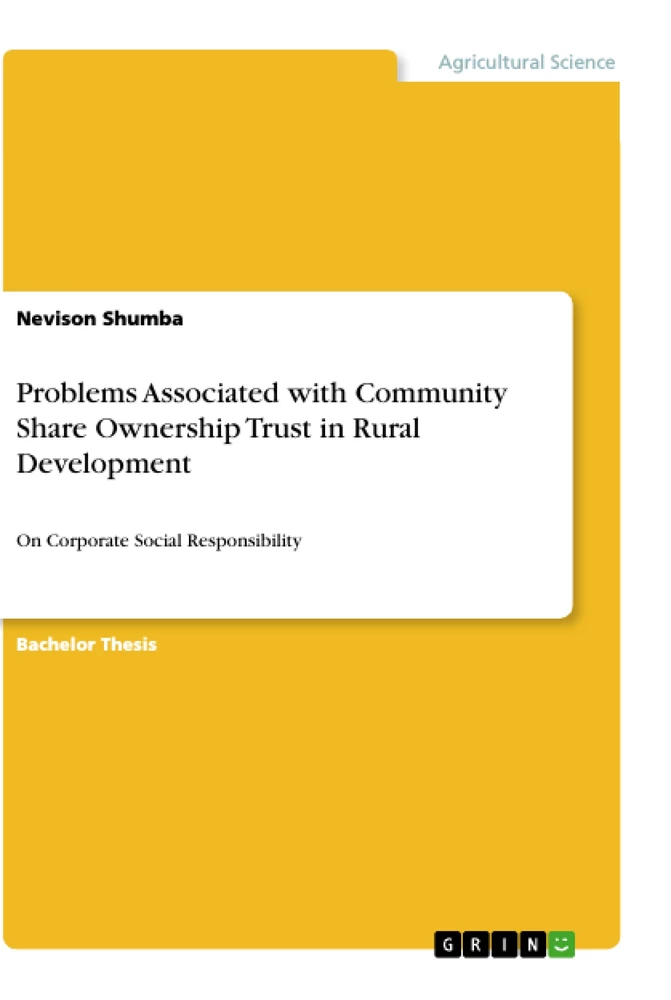
Table of Contents
CHAPTER ONE
1.0 INTRODUCTION
1.1 Background
1.2 Problem Statement
1.3 Purpose of the study
1.4 Research Questions
1.5 Objectives of the study
1.6 Significance of the Study
1.7 Delimitation of the study
1.8 Assumptions of the study
1.9 Limitations of the Study
1.10 Definition of terms
1.11 Summary
CHAPTER TWO
2.0 LITERATURE REVIEW
2.1. Introduction
2.2 Overview
2.3 Participatory theoretical framework (Bottom-up approach)
2.4 Common Good Capitals
2.5. Regulations and structures
2.6 The extent of community participation
2.7 Strength and limitations of CSOT
2.8 Expectations of communities on CSOT
2.9 Summary
CHAPTER THREE
3.0 RESEARCH METHODOLOGY
3.1 Introduction
3.2 Research Design
3.3 Population
3.4 Sample and Sampling Procedures
3.5 Research Instruments
3.5.1 The questionnaire
3.5.2 Interviews
3.6 Pilot Study
3.7 Data Collection Procedures
3.8 Data Presentation and Analysis
3.9 Summary
CHAPTER FOUR
4.0 DATA PRESENTATION AND ANALYSIS OF DATA
4.1 Introduction
4.2 Characteristics Of Respondents
4.3 Regulations and structures governing CSOT
4.4 Extent of participation
4.5 Strengths and limitations
4.6 Community Expectations on CSOT
4.7 Review of CSOT documents (Secondary Data)
4.8 Summary
CHAPTER FIVE
5.0 SUMMARY, CONCLUSIONS AND RECOMMENDATIONS
5.1 Introduction
5.2 Summary
5.2.1. Objectives of the study
5.2.2 Review of literature
5.2.3 Research Design and Methodology.
5.3 Findings and Conclusions
5.4 Recommendations
Study Objectives and Research Themes
The research investigates the problems associated with the implementation of Community Share Ownership Trusts (CSOT) in rural development, specifically focusing on the Mazvihwa area in Zvishavane, Zimbabwe. The study seeks to examine existing regulations, structures, and the extent of community participation, while identifying core limitations and strengths of the approach in addressing rural development needs.
- Examination of regulatory and structural frameworks for CSOT operations.
- Analysis of community participation levels in CSOT-led development projects.
- Identification of operational and administrative limitations and strengths.
- Evaluation of community expectations regarding socioeconomic empowerment.
Excerpt from the Book
1.1 Background
Community Share Ownership Trusts (CSOT) is an emerging concept in Zimbabwe meant to economically empower rural communities. In development, economic empowerment is a means and an end in itself.
Unequal distribution of economic resources amongst the black majority and white minority was a legacy of the colonial regime. The legacy entrenched poverty in rural communities and wealth was concentrated in the urban areas. Allied to this is the urban biased development to the detriment of the rural communities exhibited by under-development of rural communities and exploitation. According to Golfillan (2009) the socio-economic disparities existing between the rural and urban communities can only be bridged by active participation of rural communities in development initiatives. Community Share Ownership Trust is a strategy used by the Zimbabwean government to empower rural communities to propel their development. Community Share Ownership Trust is based on the concept of Corporate Social Responsibility whereby corporate are obliged to plough back to the communities. Under the guise of corporate social responsibility the firms or companies would occasionally offer donations to communities to meet their needs. However, these donations many times were falling far below the needs of the communities or were far-short the damage caused by the firms (Golfillan, 2009). In addition to that there is no legal framework in Zimbabwe that binds firms to comply with their social responsibility. This saw most of the firms flouting their social responsibility policy. This necessitated the formation of community share ownership trusts or schemes. This innovation has a legal binding on the compliance by firms.
Summary of Chapters
CHAPTER ONE: Provides the background information, research problem, objectives, and significance of the study on CSOT.
CHAPTER TWO: Reviews literature on participatory development frameworks, common good capitals, and the history and challenges of CSOT.
CHAPTER THREE: Outlines the research methodology, including the descriptive survey design, sampling procedures, and research instruments used.
CHAPTER FOUR: Presents and analyzes the collected data regarding CSOT structures, community participation, and operational challenges.
CHAPTER FIVE: Summarizes the major research findings, draws conclusions, and provides policy recommendations.
Keywords
Community Share Ownership Trust, CSOT, rural development, economic empowerment, Zimbabwe, Mazvihwa, community participation, corporate social responsibility, sustainable development, socioeconomic, infrastructure, policy, Zvishavane, stakeholders, administrative challenges.
Frequently Asked Questions
What is the core focus of this research?
The research addresses the administrative and operational problems linked to the implementation of Community Share Ownership Trusts (CSOT) in rural Zimbabwe, using the Mazvihwa area as a case study.
Which thematic areas are central to this work?
The key themes include the legal and structural frameworks of CSOT, the degree of genuine community participation, the influence of elite capture on project distribution, and the gap between community expectations and current project outcomes.
What is the primary objective of this study?
The primary goal is to examine how CSOT regulations operate, establish the actual level of local community participation, identify current institutional strengths and limitations, and capture the community's developmental expectations.
What scientific methods were employed?
The study adopted a qualitative descriptive survey approach, utilizing questionnaires and semi-structured interviews with community members and key informants to gather primary data.
What topics are discussed in the main body of the work?
The work covers theoretical frameworks of participation, the history of corporate social responsibility, analysis of legislative instruments like the Indigenization and Economic Empowerment Act, and the practical challenges of resource and benefit management in rural areas.
Which keywords define this research?
The study is characterized by terms such as community economic empowerment, rural development, social responsibility, participation, and trust-based management.
How does the study address the issue of elite capture in the Mazvihwa area?
The study highlights concerns that CSOT benefits are often concentrated where influential figures reside, and that community involvement is frequently limited to legitimizing top-down decisions rather than meaningful policy participation.
What is the author's main recommendation for improving CSOT efficacy?
The author recommends amending current legislation to ensure greater transparency, rotational management, and mandatory stakeholder consultation to hold executive committees accountable to the local population.
Ende der Leseprobe aus 97 Seiten
- nach oben
- Arbeit zitieren
- Nevison Shumba (Autor:in), 2013, Problems Associated with Community Share Ownership Trust in Rural Development, München, Page::Imprint:: GRINVerlagOHG, https://www.diplomarbeiten24.de/document/496048

neugierig - aktuell - relevant
Entdecken Sie hilfreiche Tipps und Tricks rund ums Studium!

Entdecken Sie hilfreiche Tipps und Tricks rund ums Studium!
Ihre Hausarbeit / Abschlussarbeit:

- - Publikation als E-Book und Buch
- - Hohes Honorar auf die Verkäufe
- - Für Sie komplett kostenlos - mit ISBN
- - Es dauert nur 5 Minuten
- - Jede Arbeit findet Leser

- © GRIN Publishing GmbH.
- Alle Inhalte urheberrechtlich geschützt. Kopieren und verbreiten untersagt.
- info@grin.com
- AGB
- Open Publishing
Der GRIN Verlag hat sich seit 1998 auf die Veröffentlichung akademischer eBooks und Bücher spezialisiert. Der GRIN Verlag steht damit als erstes Unternehmen für User Generated Quality Content. Die Verlagsseiten GRIN.com, Hausarbeiten.de und Diplomarbeiten24 bieten für Hochschullehrer, Absolventen und Studenten die ideale Plattform, wissenschaftliche Texte wie Hausarbeiten, Referate, Bachelorarbeiten, Masterarbeiten, Diplomarbeiten, Dissertationen und wissenschaftliche Aufsätze einem breiten Publikum zu präsentieren.
Kostenfreie Veröffentlichung: Hausarbeit, Bachelorarbeit, Diplomarbeit, Dissertation, Masterarbeit, Interpretation oder Referat jetzt veröffentlichen!
Folgen Sie GRIN auf


- GRIN Verlag GmbH
-
- Nymphenburger Str. 86
- 80636
- Munich, Deutschland
- +49 89-550559-0
- +49 89-550559-10
- info@grin.com
-
