
präsentiert von

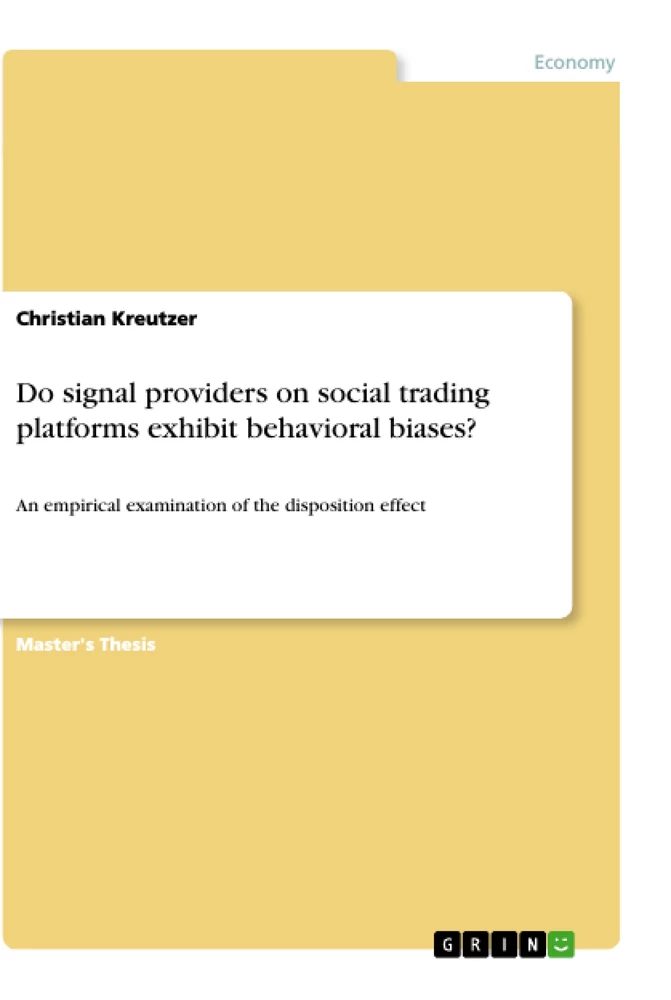
Table of Content
1. Introduction
2. Literature Review
2.1 Review on the Disposition Effect
2.1.1 The Four Key Elements of the Disposition Effect
2.1.2 Cognitive Dissonance
2.1.3 What Factors influence the Disposition Effect?
2.2 Review on the Home Bias
3. Social Trading
4. Methodology and Empirical Results
4.1 Disposition Effect
4.1.1 Hypotheses
4.1.2 Data and Empirical Approach
4.1.3 Empirical Results
4.1.4 Odean Method
4.2 Home Bias
4.2.1 Hypothesis
4.2.2 Data and Empirical Approach
4.2.3 Empirical Results
5. Limitations and Further Research
6. Conclusion
Research Objectives and Thematic Focus
This thesis examines the impact of varying degrees of transparency on the trading behavior of signal providers on the social trading platform Wikifolio, specifically focusing on the disposition effect and the home bias.
- Analysis of how transparency mitigates behavioral biases in social trading environments.
- Empirical investigation of the disposition effect regarding gain and loss realization behaviors.
- Examination of home bias tendencies in portfolio construction under different transparency stages.
- Evaluation of trader compensation models and their influence on risk-taking and behavioral biases.
- Assessment of the role of platform-specific metrics like AUM, Sharpe ratio, and ranking in trading decisions.
Excerpt from the Book
2.1.1 The Four Key Elements of the Disposition Effect
The disposition effect is a behavioral bias that has been widely analyzed by researchers during the last three decades. It describes the effect, that investors often tend to sell assets that have gained in value, while holding losing assets for longer periods. The term “disposition effect” which is named by Shefrin and Statman (1985) consists of four key elements: prospect theory, mental accounting, regret aversion, and self-control. These will be briefly discussed in the following.
In 1979 Kahneman and Tversky published an article, in which they explained their “prospect theory” for decision under uncertainty. The theory describes the decision processes in two stages, an editing phase and a subsequent phase of evaluation. During the editing phase the subjects start by defining a reference point as mental starting point for the following evaluation. They asses possible actions or prospects against this reference point. Subjects then decide which outcomes they consider equivalent, define outcomes greater than the reference point as gains and outcomes smaller than the reference point as losses. In the evaluation phase subjects dedicate a specific utility, based on the outcome and the occurrence probability, and then choose the alternative with the highest utility.
When people have to choose between risky prospects, they often act risk averse when the possible outcome is framed as gains and risk seeking if the outcome is framed as losses. This phenomenon in prospect theory is defined as the “Reflection Effect”. Additionally, the well-known “Endowment Effect” can be also explained by the choice of reference point. The endowment effect is the hypothesis that people ascribe more value to things just because they own them. Owners incorporate the item into their status quo and therefore choose a reference point including the item. Buyers will set their willingness to pay lower and choose a reference point without the item. Buying will be interpreted as positive prospect and selling as a negative prospect.
Summary of Chapters
1. Introduction: Outlines the research focus on transparency and its effects on the disposition effect and home bias within the context of social trading.
2. Literature Review: Provides a theoretical foundation covering prospect theory, cognitive dissonance, and established findings on the disposition effect and home bias.
3. Social Trading: Introduces the social trading industry, the Wikifolio platform mechanics, and the role of transparency stages in delegated portfolio management.
4. Methodology and Empirical Results: Details the empirical panel data regression approach and the Odean method, presenting findings on how transparency influences trading outcomes.
5. Limitations and Further Research: Discusses constraints in data accessibility and sample size, suggesting directions for future research regarding trader attributes and broader platform analysis.
6. Conclusion: Summarizes the thesis findings, confirming that transparency influences holding times but also revealing complex interactions with trader reputation concerns.
Keywords
Social Trading, Transparency, Disposition Effect, Home Bias, Wikifolio, Prospect Theory, Behavioral Finance, Portfolio Management, Regression Analysis, Odean Method, Investment Behavior, Investor Psychology, Financial Technology, Asset Under Management, Sharpe Ratio
Frequently Asked Questions
What is the core subject of this thesis?
The thesis investigates whether increased transparency on social trading platforms helps mitigate common behavioral biases, specifically the disposition effect and home bias, among signal providers.
What are the primary thematic areas explored?
The work covers behavioral finance theory, the mechanics of social trading platforms (specifically Wikifolio), the impact of visibility on trading decisions, and empirical methods to detect biases.
What is the primary research question?
The research asks if permanent, visible performance statistics can mitigate the extent to which traders hold losing stocks too long and sell profitable ones too soon, as well as their preference for domestic stocks.
Which scientific methodology is utilized?
The study employs a panel data analysis using fixed and random effects models to test hypotheses, complemented by the Odean method for robustness checks on a sub-sample of traders.
What does the main body cover?
It provides a literature review on behavioral biases, explains the evolution of Wikifolio portfolios, details the data acquisition and variable construction, and reports findings from statistical regressions.
Which keywords best characterize this work?
Key terms include Social Trading, Disposition Effect, Home Bias, Transparency, Behavioral Finance, and Panel Data Regression.
How does transparency specifically affect the disposition effect according to the author?
The author suggests that while transparency encourages traders to hold gains longer, it may inadvertently increase the holding time for losses, as traders fear realizing a loss that would be visible in their public track record.
What is the significance of the "investable phase" for the study?
The investable phase represents the highest level of transparency on the platform, allowing for a direct comparison with the "test phase" to evaluate how full public exposure changes trading behavior.
Ende der Leseprobe aus 69 Seiten
- nach oben
- Arbeit zitieren
- Christian Kreutzer (Autor:in), 2018, Do signal providers on social trading platforms exhibit behavioral biases?, München, Page::Imprint:: GRINVerlagOHG, https://www.diplomarbeiten24.de/document/496076

neugierig - aktuell - relevant
Entdecken Sie hilfreiche Tipps und Tricks rund ums Studium!

Entdecken Sie hilfreiche Tipps und Tricks rund ums Studium!
Ihre Hausarbeit / Abschlussarbeit:

- - Publikation als E-Book und Buch
- - Hohes Honorar auf die Verkäufe
- - Für Sie komplett kostenlos - mit ISBN
- - Es dauert nur 5 Minuten
- - Jede Arbeit findet Leser

- © GRIN Publishing GmbH.
- Alle Inhalte urheberrechtlich geschützt. Kopieren und verbreiten untersagt.
- info@grin.com
- AGB
- Open Publishing
Der GRIN Verlag hat sich seit 1998 auf die Veröffentlichung akademischer eBooks und Bücher spezialisiert. Der GRIN Verlag steht damit als erstes Unternehmen für User Generated Quality Content. Die Verlagsseiten GRIN.com, Hausarbeiten.de und Diplomarbeiten24 bieten für Hochschullehrer, Absolventen und Studenten die ideale Plattform, wissenschaftliche Texte wie Hausarbeiten, Referate, Bachelorarbeiten, Masterarbeiten, Diplomarbeiten, Dissertationen und wissenschaftliche Aufsätze einem breiten Publikum zu präsentieren.
Kostenfreie Veröffentlichung: Hausarbeit, Bachelorarbeit, Diplomarbeit, Dissertation, Masterarbeit, Interpretation oder Referat jetzt veröffentlichen!
Folgen Sie GRIN auf


- GRIN Verlag GmbH
-
- Nymphenburger Str. 86
- 80636
- Munich, Deutschland
- +49 89-550559-0
- +49 89-550559-10
- info@grin.com
-
