
präsentiert von

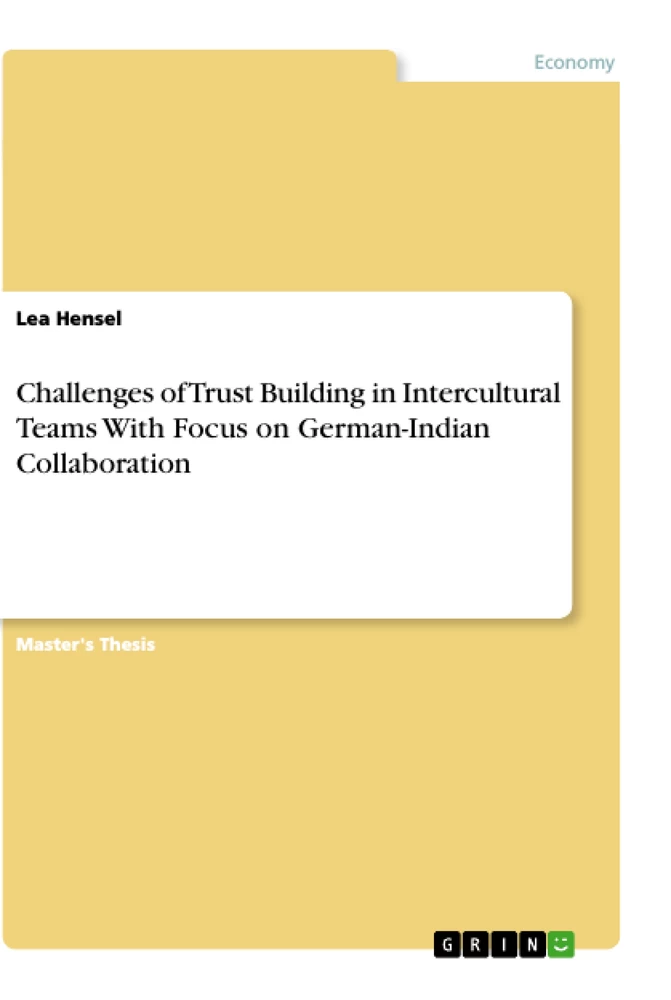
Table of Contents
1. Introduction
1.1 Introduction and Problem Definition
1.2 Motivation and Objective
1.3 Methodology and Structure
2. Explanation of Terms
2.1 Trust
2.2 Culture
3. Theoretical Background on trust in intercultural collaboration
3.1 Fundamental aspects of intercultural influences on trust
3.2 Trust misunderstanding
4. Theoretical framework to describe the Indian business culture
5. Business Culture in India
5.1 History and background about business in India
5.2 Leadership
5.3 Relationships
5.4 Communication
5.6 Tradition
5.7 Ethical Values in Business
6. Empirical Part: The Study
6.1 Research Design
6.1.1 Research Issue and Objective
6.1.2 Critical Incident Methodology
6.1.3 Critical reflection of the methodology
6.2 Sampling and conducting the study
6.2.1 Selection criteria and process for study participants
6.2.2 Planning and conducting the interviews
6.3 Data Collection Methodology
6.3.1 Recruitment of interview partner and interview procedure
6.3.2 Specification of sampling and data material
6.3.3 Representativeness of the sampling
6.4 Evaluation Methodology
7. Results and Discussion
6.5 Short discussion of the German business culture
6.6 Definition of trust factors and overview
6.7 Detailed discussion of the trust factors identified
6.7.1 Interpersonal Relationship
6.7.2 Hierarchy
6.7.3 Fair Play
6.7.4 Handling of Agreements and Tasks
6.7.5 Communication
6.7.6 Environment
8. Recommendations for action
9. Conclusion
10. Bibliography
Objectives and Key Themes
This master thesis aims to analyze the challenges of trust building in German-Indian business collaborations by identifying specific trust factors derived from literature and empirical research. The central research question explores how cultural differences influence the development, maintenance, or loss of trust between German managers and their Indian counterparts, ultimately providing actionable recommendations to prevent cultural misunderstandings.
- Analysis of the trust-building process in intercultural teams.
- Identification of 22 specific trust factors relevant to German-Indian collaborations.
- Exploration of how cultural standards and values influence trust factor diagnosis and weighting.
- Application of the Critical Incident Technique (CIT) for qualitative empirical investigation.
- Development of practical strategies for German managers to navigate and manage cultural differences effectively.
Auszug aus dem Buch
7.4.1.1 Private Relationship
The situations reported by the interview partners support the importance of building a private relationship analyzed in the literature review (Chapter 5.1.3). In literature, it is stated that job-related decisions are influenced by interpersonal considerations rather than by task demands in India (Kanungo & Mendinca, 1994).
The trust factor is described differently by the interview partners. 9 of the interview partners describe the importance of sharing personal things in conversations about families, values, sport or politics (ID-01.33, 02.14, 07.30, 10.52, 14.04, 14.33, 14.49, 21.54, 41.54). One of the interview partner describes the building of a private relationship during a weekly meeting: "also da kann man nicht direkt zum Thema kommen, man muss schon versuchen auch wirklich da die Person besser kennenzulernen und dann auch fragen: wie geht es dem Kind und ist es dann diese Woche endlich in der Schule geblieben?" (ID-14.04).
Another interview partner reports how talking about private things turned his relationship to one of his business partner: "Wir haben uns da ausgetauscht, jeder hat dem anderen zugehört und ich glaube das war eine ganz gute Basis, um einfach mal auf Ground Zero zu kommen, also von einer sehr komplexen Situation, die einfach geschäftlich auch sehr vorbesetzt war konnte man durch die Normalität des Gespräches das Ganze wieder auf den Boden bringen." (ID-14.49).
Another aspect a few of the interview partners mention is ‘auch mal abends was zu machen’ (ID-16.24) or in general sharing experiences and activities. Sharing experiences and activities welds together as one of the interview partner describes: "dann waren das irgendwie 43 Leute hinterher die da waren. Wir haben gottseidank die Teppiche da raus, die sind morgens bis um 5 Uhr bei uns geblieben und das war eine tolle Stimmung und das hat so viel Zusammenhalt gebracht, da reden die heute noch drüber." (ID-54.37).
Summary of Chapters
1. Introduction: Presents the research topic, problem definition, and the motivation for examining trust in German-Indian professional relationships.
2. Explanation of Terms: Defines core constructs of trust and culture based on relevant literature and theoretical models.
3. Theoretical Background on trust in intercultural collaboration: Discusses trust building as a challenging process in intercultural teams and examines the causes of trust misunderstandings.
4. Theoretical framework to describe the Indian business culture: Introduces cultural frameworks (Hofstede, GLOBE, Schwartz) used to analyze Indian business context.
5. Business Culture in India: Analyzes Indian business culture, focusing on history, leadership, relationships, communication, traditions, and ethical values.
6. Empirical Part: The Study: Details the research design using the Critical Incident Technique (CIT), sampling strategy, data collection, and evaluation methodology.
7. Results and Discussion: Analyzes findings from qualitative interviews, comparing them with literature and defining 22 critical trust factors.
8. Recommendations for action: Offers practical guidance for managers to improve trust building and handle cultural differences in German-Indian collaborations.
9. Conclusion: Summarizes research findings and highlights the necessity of cultural sensitivity and profound trust assessment in successful international business.
10. Bibliography: Lists all academic sources and literature cited in the thesis.
Key Keywords
Trust building, Intercultural collaboration, German-Indian business relations, Critical Incident Technique, Cultural differences, Trust factors, Trust misunderstanding, Leadership styles, Business culture, Interpersonal relationships, Communication style, Ethical values, Compliance, Qualitative content analysis, Management strategies.
Frequently Asked Questions
What is the core focus of this research?
The research focuses on the trust-building process between German managers and their Indian counterparts, specifically analyzing how cultural differences affect these professional relationships.
What are the primary thematic areas explored?
The work explores themes such as leadership, interpersonal relationships, communication styles, organizational hierarchy, tradition, and ethical values within the context of Indian business.
What is the primary research question?
The main question is whether cultural differences influence the development of trust in German-Indian collaborations and, if so, in what specific ways this occurs.
Which methodology was chosen for the empirical part?
The research employs the Critical Incident Technique (CIT), utilizing qualitative interviews with 15 experienced German managers to gather insights into specific situations involving trust development and loss.
What key insights are presented in the main chapters?
The main chapters provide a comprehensive analysis of the Indian business environment, identify 22 specific trust factors, and discuss the critical role of interpersonal relationships and hierarchical structures in trust formation.
Which keywords characterize this thesis?
Key terms include Trust building, Intercultural collaboration, German-Indian business relations, Critical Incident Technique, Cultural differences, and Business ethics.
Why is a private relationship considered essential in India?
The research indicates that in India, job-related decisions and trust are heavily influenced by interpersonal considerations. Building a private, social relationship is seen as a necessary foundation for professional cooperation and closing business deals.
How does the concept of "facework" influence trust?
Facework involves assisting others in maintaining their social identity. Misunderstandings often arise when German managers, focused on direct task-orientation, unintentionally cause Indian partners to lose face, which can severely damage the trust relationship.
What role does corruption play in the research?
The thesis identifies "Corruption/Betrayal" as a critical trust factor. It explores how complex bureaucracy and slow approval processes in India lead some to engage in corrupt practices, which German managers must navigate while maintaining compliance.
Ende der Leseprobe aus 178 Seiten
- nach oben
- Arbeit zitieren
- Lea Hensel (Autor:in), 2019, Challenges of Trust Building in Intercultural Teams With Focus on German-Indian Collaboration, München, Page::Imprint:: GRINVerlagOHG, https://www.diplomarbeiten24.de/document/496169

neugierig - aktuell - relevant
Entdecken Sie hilfreiche Tipps und Tricks rund ums Studium!

Entdecken Sie hilfreiche Tipps und Tricks rund ums Studium!
Ihre Hausarbeit / Abschlussarbeit:

- - Publikation als E-Book und Buch
- - Hohes Honorar auf die Verkäufe
- - Für Sie komplett kostenlos - mit ISBN
- - Es dauert nur 5 Minuten
- - Jede Arbeit findet Leser

- © GRIN Publishing GmbH.
- Alle Inhalte urheberrechtlich geschützt. Kopieren und verbreiten untersagt.
- info@grin.com
- AGB
- Open Publishing
Der GRIN Verlag hat sich seit 1998 auf die Veröffentlichung akademischer eBooks und Bücher spezialisiert. Der GRIN Verlag steht damit als erstes Unternehmen für User Generated Quality Content. Die Verlagsseiten GRIN.com, Hausarbeiten.de und Diplomarbeiten24 bieten für Hochschullehrer, Absolventen und Studenten die ideale Plattform, wissenschaftliche Texte wie Hausarbeiten, Referate, Bachelorarbeiten, Masterarbeiten, Diplomarbeiten, Dissertationen und wissenschaftliche Aufsätze einem breiten Publikum zu präsentieren.
Kostenfreie Veröffentlichung: Hausarbeit, Bachelorarbeit, Diplomarbeit, Dissertation, Masterarbeit, Interpretation oder Referat jetzt veröffentlichen!
Folgen Sie GRIN auf


- GRIN Verlag GmbH
-
- Nymphenburger Str. 86
- 80636
- Munich, Deutschland
- +49 89-550559-0
- +49 89-550559-10
- info@grin.com
-
