
präsentiert von

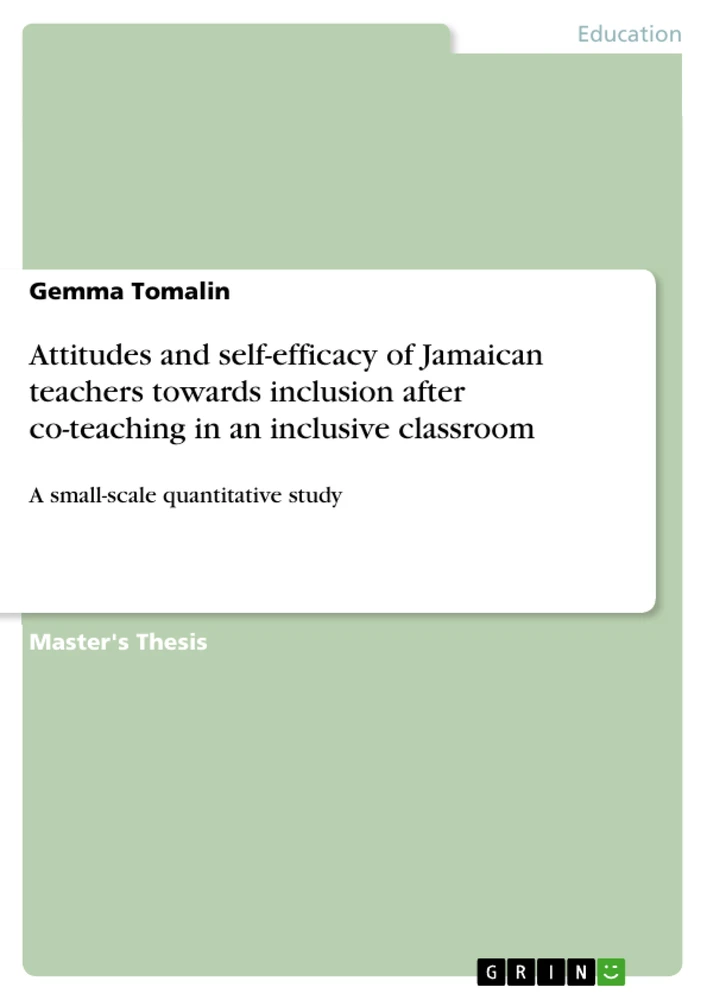
Table of Contents
Abstract
Acknowledgements
Chapter 1 Introduction
Chapter 2 Literature Review
2.0. Introduction
2.1. Attitudes towards inclusion and integration
2.2. Experience of and Exposure to Inclusive Classrooms and SWSN
2.3. Teacher Self‐efficacy in Inclusive Teaching
2.4. Co‐Teaching
2.5. Conclusion
Chapter 3 Methodology
3.0. Introduction
3.1 Sampling
3.2 Training
3.3 Procedures
3.4 Instruments
3.5 Threats to Validity
Chapter 4: Data Analysis and Results and Discussion
4.0 Introduction
4.1 Descriptive Results
4.2 Hypothesis Testing
4.3 Inferential Analysis
4.4 Implementation
Chapter 5 Conclusion, Recommendations and Limitations
5.0. Conclusion
5.1 Limitations and Recommendations
References
Objectives & Topics
This study aims to investigate the impact of a two-week co-teaching training program on Jamaican teachers' attitudes toward inclusion and their self-efficacy in inclusive teaching methods, addressing the gap between theoretical training and practical classroom application.
- Differences in attitudes and self-efficacy regarding inclusive education before and after training.
- The effectiveness of hands-on, co-teaching training compared to traditional lecture-style instruction.
- The influence of prior experience with students with special needs (SWSN) on training outcomes.
- The potential for training to predict successful implementation of inclusive techniques in mainstream classrooms.
Excerpt from the Book
Chapter 1 Introduction
This study is asking what are the differences in attitudes and self-efficacy in Jamaican teachers towards inclusion after co-teaching in an inclusive classroom? A small-scale quantitative study seeking to add insight to the current lack of facilitation of inclusion across Jamaican schools.
Jamaica tends to be a fairly hostile environment for Persons with Disabilities (PWD) or Students with Special Needs (SWSN), having very little provision or adaptations for these members of society or any other vulnerable people. The term inclusion can be used for both aspects, social and educational in Jamaica, but for the purposes of this study inclusion means education for all children especially for children with disabilities, through values, attitudes and belief systems; Through physical, meaningful and environmental dimensions of access to childhood education programmes, activities and skills training services that result in contributing to society (Anderson, 2019). The facilitation of educational inclusion across schools in Jamaica is still at a basic stage even though the Ministry of Education has had this inclusive mission statement published on their website since 2005,
“Providing quality care and education for all children in an innovative, inclusive and enabling environment” (MoE, n.d).
Summary of Chapters
Chapter 1 Introduction: This chapter outlines the research problem regarding the lack of inclusive education in Jamaica and states the research questions concerning teacher attitudes and self-efficacy.
Chapter 2 Literature Review: The review examines existing research on inclusive education, teacher attitudes, self-efficacy, and the role of co-teaching as an effective pedagogical intervention.
Chapter 3 Methodology: This chapter details the quantitative study design, including the participant sampling, the two-week co-teaching training intervention, and the instruments used for data collection.
Chapter 4: Data Analysis and Results and Discussion: This section presents the statistical analysis of the pre- and post-training questionnaire data and discusses the impact of the training on teacher performance.
Chapter 5 Conclusion, Recommendations and Limitations: This chapter summarizes the study's findings, provides recommendations for educational policy, and acknowledges the study's limitations regarding sample size.
Keywords
Inclusion, Jamaica, Teacher Self-efficacy, Attitudes, Co-teaching, Special Needs, SWSN, Inclusive Education, Teacher Training, Practicum, Quantitative Study, Classroom Management, Educational Reform, Mentorship, Teaching Practice.
Frequently Asked Questions
What is the fundamental focus of this study?
The study focuses on assessing how a two-week co-teaching training program influences the attitudes and self-efficacy of Jamaican teachers regarding the inclusion of students with special needs in mainstream classrooms.
What are the primary themes addressed?
Key themes include the impact of practical training on teaching beliefs, the role of co-teaching in reducing the theory-to-practice gap, and the current state of inclusive education in Jamaica.
What is the research goal?
The goal is to determine if hands-on experience in an inclusive classroom can improve teachers' perceived readiness and ability to implement inclusive practices.
Which methodology was employed?
The study used a quantitative approach, utilizing pre- and post-training self-rating questionnaires and paired sample t-tests to evaluate changes in attitudes and self-efficacy.
What does the main body of the work cover?
The main body reviews the literature on inclusion, explains the training procedures and survey instruments, and presents statistical analyses of data collected from participating teachers.
Which keywords define this work?
The work is defined by terms like inclusion, teacher self-efficacy, co-teaching, Jamaican schools, and inclusive practices.
Did previous teaching experience influence the results?
The study found that while attitudes improved significantly across the board, teachers without prior experience with special needs showed a larger positive difference in attitude scores compared to those who had prior experience.
Is the training perceived as successful for implementation?
Yes, follow-up questionnaires indicated that all participating teachers were implementing inclusive techniques, materials, and lesson plans in their own classrooms after completing the training.
Ende der Leseprobe aus 51 Seiten
- nach oben
- Arbeit zitieren
- Gemma Tomalin (Autor:in), 2019, Attitudes and self-efficacy of Jamaican teachers towards inclusion after co-teaching in an inclusive classroom, München, Page::Imprint:: GRINVerlagOHG, https://www.diplomarbeiten24.de/document/496541

neugierig - aktuell - relevant
Entdecken Sie hilfreiche Tipps und Tricks rund ums Studium!

Entdecken Sie hilfreiche Tipps und Tricks rund ums Studium!
Ihre Hausarbeit / Abschlussarbeit:

- - Publikation als E-Book und Buch
- - Hohes Honorar auf die Verkäufe
- - Für Sie komplett kostenlos - mit ISBN
- - Es dauert nur 5 Minuten
- - Jede Arbeit findet Leser

- © GRIN Publishing GmbH.
- Alle Inhalte urheberrechtlich geschützt. Kopieren und verbreiten untersagt.
- info@grin.com
- AGB
- Open Publishing
Der GRIN Verlag hat sich seit 1998 auf die Veröffentlichung akademischer eBooks und Bücher spezialisiert. Der GRIN Verlag steht damit als erstes Unternehmen für User Generated Quality Content. Die Verlagsseiten GRIN.com, Hausarbeiten.de und Diplomarbeiten24 bieten für Hochschullehrer, Absolventen und Studenten die ideale Plattform, wissenschaftliche Texte wie Hausarbeiten, Referate, Bachelorarbeiten, Masterarbeiten, Diplomarbeiten, Dissertationen und wissenschaftliche Aufsätze einem breiten Publikum zu präsentieren.
Kostenfreie Veröffentlichung: Hausarbeit, Bachelorarbeit, Diplomarbeit, Dissertation, Masterarbeit, Interpretation oder Referat jetzt veröffentlichen!
Folgen Sie GRIN auf


- GRIN Verlag GmbH
-
- Nymphenburger Str. 86
- 80636
- Munich, Deutschland
- +49 89-550559-0
- +49 89-550559-10
- info@grin.com
-
