
präsentiert von

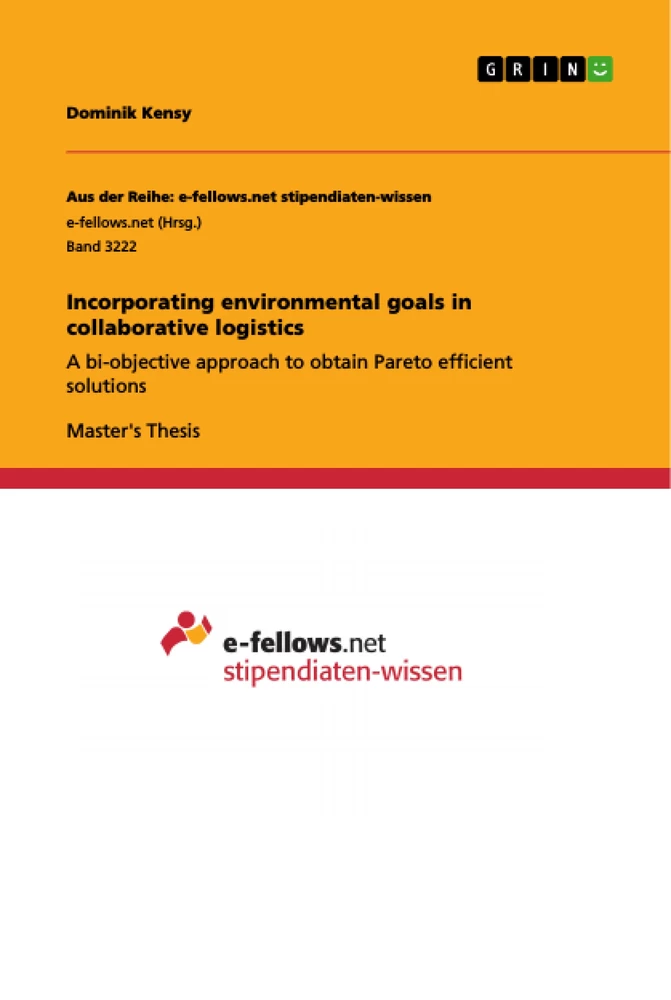
Table of Contents
1. Introduction
2. Literature review
3. Greenhouse gas-emissions and the environment
3.1 The greenhouse effect
3.2 EU-legislations on GHG-emissions
3.3 Calculating CO2-emissions
4. A Green Vehicle Routing Problem
4.1 A green multi-depot vehicle routing problem with time windows
4.2 Constructive heuristic
5. Cooperative Game Theory
5.1 The core
5.2 Cost allocation methods
5.2.1 Shapley value
5.2.2 Nucleolus
5.2.3 Equal Profit Method
5.2.4 Volume-based allocation
5.2.5 Star method
5.2.6 Weighted Star method
6. Multi-objective horizontal collaboration in logistics
6.1 Horizontal collaboration
6.2 Multi-objective optimisation
6.3 “Traditional” solution methods
6.3.1 Scalarization
6.3.2 ε-Constraint Method
6.4 The coalition efficiency approach
6.4.1 Step 1: Aggregation
6.4.2 Step 2: Optimisation at the coalition level
6.4.3 Metaheuristic solution approach
6.4.4 Step 3: Projection on individual partner objective
6.4.5 Step 4: Evaluation
6.5 The partner efficiency approach
6.5.1 Objective functions
6.5.2 Solution evaluation
7. Computational experiments
7.1 Benchmark instances
7.2 Simulation results
7.2.1 Standalone solutions
7.2.2 Coalition efficiency approach
7.2.3 Partner efficiency approach
7.2.4 Simulation with three partners
7.2.5 Properties of cost allocation methods
8. Concluding remarks and outlook
Research Objectives and Core Themes
The thesis investigates horizontal collaboration in logistics to reduce the carbon footprint of companies. The primary research goal is to develop multi-objective methodologies that integrate environmental goals into collaborative vehicle routing and to analyze stable cost allocation methods for these coalitions.
- Integration of CO2e-emissions reduction into vehicle routing models.
- Application of cooperative game theory for fair cost and emission allocation.
- Development of metaheuristic approaches for multi-objective optimization.
- Analysis of horizontal collaboration stability among logistics partners.
- Evaluation of trade-offs between economic performance and environmental sustainability.
Excerpt from the Book
1. Introduction
In recent years public awareness towards climate change, greenhouse gas (GHG) emissions, in particular, has seen a significant increase. As more research proves global warming, governments and companies feel responsible for reducing their carbon footprint. Global warming results from the increasingly higher concentration of CO2 in the earth’s atmosphere which can be traced back to the cement industry, the exploitation of fossil fuels and extensive deforestation (Keeling & Keeling, 2017). According to the US Environmental Protection Agency, in 2016, roughly 28 % of the overall CO2-equivalent emissions are contributed by the transportation sector, including cars, trucks, ships, trains and planes. More than 70 % of these emissions stem from road transport.
Advances in renewable energy production, electric vehicles and hybrid technology already offer opportunities to reduce GHG-emissions. However, due to often long charging times and limits of the range, electric vehicles have proven rather impractical for logistics companies. In fact, in spite of ongoing efforts to reduce emissions, the level of GHG-emissions from road transport increased by 28 % from 1990 to 2017 (European Environmental Agency, 2018). The increase is a result of the growth in economic activity, and thus increase in demand for freight transport (European Environmental Agency, 2018).
Summary of Chapters
1. Introduction: Discusses the rising importance of environmental sustainability in logistics and the necessity of horizontal collaboration to reduce carbon footprints.
2. Literature review: Provides an overview of existing research on vehicle routing, collaborative logistics, and multi-objective optimization.
3. Greenhouse gas-emissions and the environment: Examines the greenhouse effect, relevant EU legislation, and methodologies for calculating CO2 emissions.
4. A Green Vehicle Routing Problem: Defines the mathematical model for a multi-depot vehicle routing problem with hard time windows and emission minimization.
5. Cooperative Game Theory: Introduces core concepts of game theory, specifically focusing on stable cost allocation methods for coalitions.
6. Multi-objective horizontal collaboration in logistics: Details the multi-objective nature of horizontal collaboration and proposes a coalition efficiency approach.
7. Computational experiments: Presents the results of simulation models, testing different allocation methods on benchmark instances.
8. Concluding remarks and outlook: Summarizes the findings and discusses potential avenues for future research in collaborative logistics.
Key Terms
Horizontal collaboration, Vehicle Routing Problem, Multi-objective optimisation, CO2e-emissions, Cooperative game theory, Cost allocation, Shapley value, Nucleolus, Equal Profit Method, Pareto efficiency, Green logistics, Sustainability, Supply chain, Metaheuristic, Time windows.
Frequently Asked Questions
What is the primary focus of this thesis?
The thesis focuses on how logistics companies can incorporate environmental goals into horizontal collaboration through multi-objective optimization and cooperative game theory.
Which core issues does the research address?
It addresses the trade-offs between reducing carbon emissions and managing operational logistics costs, while ensuring that the benefits of collaboration are fairly distributed among partners.
What is the ultimate goal of the proposed methodology?
The goal is to provide a multi-objective approach that helps companies reach Pareto efficient solutions, minimizing both total emissions and time window violations.
Which scientific methods are employed?
The work utilizes multi-depot vehicle routing models, metaheuristics for optimization, and cooperative game theory concepts like the Shapley value, Nucleolus, and Equal Profit Method.
What does the main part of the thesis cover?
The main part covers the mathematical modeling of green routing, the theoretical background of game-theoretic cost allocation, and the practical implementation of these models through computational experiments.
How would you characterize the keywords of this work?
Key terms include horizontal collaboration, Pareto efficiency, green logistics, and various cost allocation methods such as the Shapley value and the Equal Profit Method.
How is the computational performance of the heuristic evaluated?
The heuristic's performance is tested against benchmark instances from the literature to ensure it provides near-optimal solutions within a timeframe suitable for operational planning.
What role does cost allocation play in the stability of a coalition?
Cost allocation is essential for the stability of a coalition, as it prevents partners from leaving the group by ensuring that the allocated costs are fair and rational, ideally within the core of the cooperative game.
Ende der Leseprobe aus 81 Seiten
- nach oben
- Arbeit zitieren
- Dominik Kensy (Autor:in), 2019, Incorporating environmental goals in collaborative logistics, München, Page::Imprint:: GRINVerlagOHG, https://www.diplomarbeiten24.de/document/496874

neugierig - aktuell - relevant
Entdecken Sie hilfreiche Tipps und Tricks rund ums Studium!

Entdecken Sie hilfreiche Tipps und Tricks rund ums Studium!
Ihre Hausarbeit / Abschlussarbeit:

- - Publikation als E-Book und Buch
- - Hohes Honorar auf die Verkäufe
- - Für Sie komplett kostenlos - mit ISBN
- - Es dauert nur 5 Minuten
- - Jede Arbeit findet Leser

- © GRIN Publishing GmbH.
- Alle Inhalte urheberrechtlich geschützt. Kopieren und verbreiten untersagt.
- info@grin.com
- AGB
- Open Publishing
Der GRIN Verlag hat sich seit 1998 auf die Veröffentlichung akademischer eBooks und Bücher spezialisiert. Der GRIN Verlag steht damit als erstes Unternehmen für User Generated Quality Content. Die Verlagsseiten GRIN.com, Hausarbeiten.de und Diplomarbeiten24 bieten für Hochschullehrer, Absolventen und Studenten die ideale Plattform, wissenschaftliche Texte wie Hausarbeiten, Referate, Bachelorarbeiten, Masterarbeiten, Diplomarbeiten, Dissertationen und wissenschaftliche Aufsätze einem breiten Publikum zu präsentieren.
Kostenfreie Veröffentlichung: Hausarbeit, Bachelorarbeit, Diplomarbeit, Dissertation, Masterarbeit, Interpretation oder Referat jetzt veröffentlichen!
Folgen Sie GRIN auf


- GRIN Verlag GmbH
-
- Nymphenburger Str. 86
- 80636
- Munich, Deutschland
- +49 89-550559-0
- +49 89-550559-10
- info@grin.com
-
