
präsentiert von

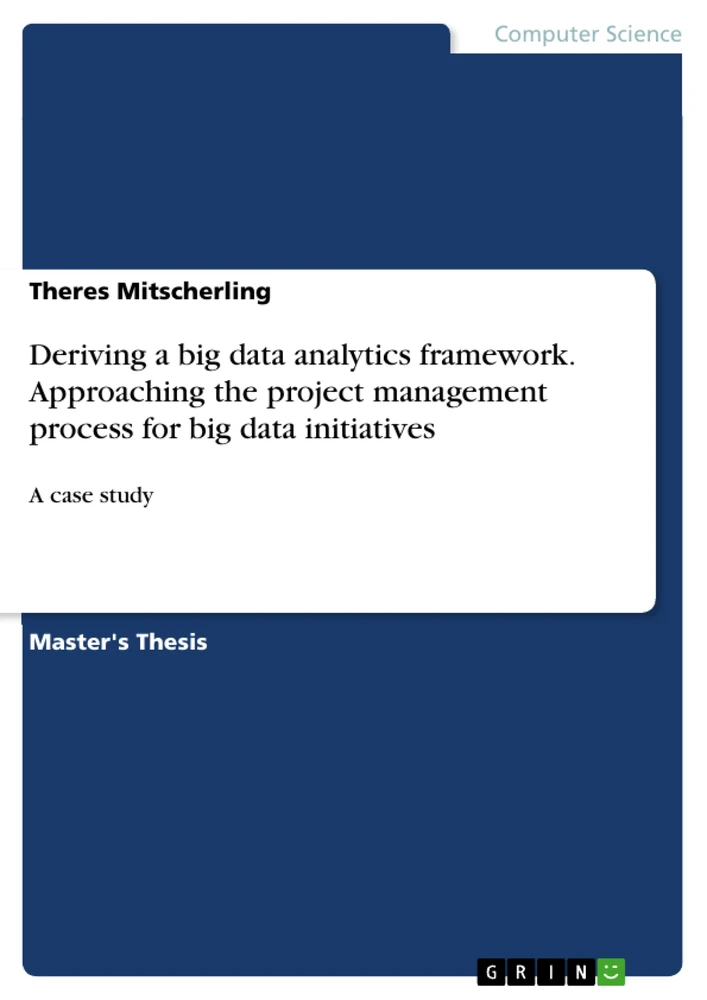
Table of Contents
A. Introduction
Background
Industry partner
Project objective
Significance
B. Research methodology
Business Process Management Lifecycle
Method overview
Literature review
Phase 1 - Extraction of literature
Phase 2 – Organization and preparation for analysis of artefacts
Phase 3 – Coding and analysis
Phase 4 – Write up and presentation
Interviews
Project management approach for this research project
C. Results
Summary of literature review results
Waterfall approach
Agile
CRISP-DM
Hybrid agile and waterfall approach
Summary of interview findings
Big data Analytics Framework
1. Business Understanding
2. Understand and Prepare Data
3. Validate Business Understanding
4. Design Solution
5. Evaluate Solution
6. Validate Business Understanding
7. Deployment
D. Discussion
E. Conclusion
Project Objectives and Thematic Focus
The primary aim of this research is to identify best practice project management techniques for big data initiatives and to develop a structured framework that assists organizations in delivering successful big data projects. The research specifically addresses the high failure rate and unexpected costs currently associated with such projects by investigating industry-standard methodologies and validating them through corporate case study interviews.
- Analysis of project management methodologies for big data (Agile vs. Waterfall).
- Evaluation of the applicability of the CRISP-DM process in modern big data environments.
- Investigation into the effectiveness of hybrid project management approaches.
- Development of a standardized Big Data Analytics Framework.
- Validation of project management best practices through expert interviews in the corporate sector.
Excerpt from the Book
Hybrid agile and waterfall approach
Hayata et al (2011) states that a hybrid agile and waterfall approach is an evolving trend within organisations. Organisational change takes time and as technology teams are accustomed to their traditional way of working in a waterfall approach, the transition to an agile organisation can take many years. By using an agile and waterfall approach, it allows the organization to practice some of the agile techniques while remaining in waterfall-based world (Hotle et al, 2018). The initial literature review did not find supporting evidence for a hybrid agile and waterfall project management approach. The majority of the documents were very clear to validate an agile approach. However, the interviews confirmed that a hybrid approach was used although sometimes not prescribed and rather unknowingly. Two of the interviews operated in a waterfall approach. However, when questioned on the techniques and processes like CRISP DM used for the data analytics, it was confirmed that unknowingly this process has been followed. Further, interview 1 used a very pure agile approach which enabled the team to quickly commission a working solution to the organisation. Although one of the challenges encountered was insufficient licensing which could have been prevented by using a traditional waterfall approach. This suggests that a hybrid agile and waterfall approach would be more suitable for this organisation.
Summary of Chapters
A. Introduction: Provides background on big data, outlines the project objective, and details the significance of managing big data initiatives for the industry partner, Red Rocks Company.
B. Research methodology: Describes the application of the Business Process Management (BPM) Lifecycle, the literature review process, and the qualitative research methods used for conducting interviews.
C. Results: Presents the findings from the literature review and interviews, concluding with the development and step-by-step description of the Big Data Analytics Framework.
D. Discussion: Evaluates the research findings, correlates the project outcomes with the initial research goals, and addresses the limitations of the current study.
E. Conclusion: Synthesizes the core findings, confirming the value of the Big Data Analytics Framework and suggesting future research directions.
Keywords
Big Data, Project Management, Agile, Waterfall, CRISP-DM, Business Process Management, Data Analytics, Framework, Case Study, Innovation, Stakeholder Management, Hybrid Approach, Mining Industry, Technology Implementation, Process Automation
Frequently Asked Questions
What is the core focus of this research report?
The report investigates the project management approaches best suited for big data initiatives to address the current 50% failure rate and budget overruns common in the sector.
What are the central thematic fields covered in this document?
The core themes include the comparison of Agile and Waterfall methodologies, the role of CRISP-DM, and the practical challenges of integrating data analytics within large-scale corporate environments.
What is the primary objective of this work?
The objective is to understand best practices for managing big data projects and to develop a new, validated framework that helps organizations achieve their digital transformation goals.
Which scientific methodology was employed?
The researcher conducted a brief literature review of nine artefacts and performed five qualitative, semi-structured, face-to-face interviews with industry stakeholders.
What topics are discussed in the main part of the report?
The main section analyzes literature trends, presents interview findings, and outlines the seven-step Big Data Analytics Framework, providing justification for each phase.
Which keywords best characterize this work?
Key terms include Big Data, Project Management, Agile, Waterfall, CRISP-DM, and Data Analytics Framework.
Why is the CRISP-DM model still considered relevant in this framework?
The research concludes that while CRISP-DM is an older methodology, it provides the fundamental logical steps required for successful data analytics that many modern vendors continue to build upon.
How does the research reconcile the differences between Agile and Waterfall for big data?
The findings suggest a hybrid approach: While literature strongly recommends Agile, industry stakeholders often use Waterfall due to the nature of large assets, leading to the conclusion that a hybrid method is often more pragmatic.
Ende der Leseprobe aus 44 Seiten
- nach oben
- Arbeit zitieren
- Theres Mitscherling (Autor:in), 2018, Deriving a big data analytics framework. Approaching the project management process for big data initiatives, München, Page::Imprint:: GRINVerlagOHG, https://www.diplomarbeiten24.de/document/499625

neugierig - aktuell - relevant
Entdecken Sie hilfreiche Tipps und Tricks rund ums Studium!

Entdecken Sie hilfreiche Tipps und Tricks rund ums Studium!
Ihre Hausarbeit / Abschlussarbeit:

- - Publikation als E-Book und Buch
- - Hohes Honorar auf die Verkäufe
- - Für Sie komplett kostenlos - mit ISBN
- - Es dauert nur 5 Minuten
- - Jede Arbeit findet Leser

- © GRIN Publishing GmbH.
- Alle Inhalte urheberrechtlich geschützt. Kopieren und verbreiten untersagt.
- info@grin.com
- AGB
- Open Publishing
Der GRIN Verlag hat sich seit 1998 auf die Veröffentlichung akademischer eBooks und Bücher spezialisiert. Der GRIN Verlag steht damit als erstes Unternehmen für User Generated Quality Content. Die Verlagsseiten GRIN.com, Hausarbeiten.de und Diplomarbeiten24 bieten für Hochschullehrer, Absolventen und Studenten die ideale Plattform, wissenschaftliche Texte wie Hausarbeiten, Referate, Bachelorarbeiten, Masterarbeiten, Diplomarbeiten, Dissertationen und wissenschaftliche Aufsätze einem breiten Publikum zu präsentieren.
Kostenfreie Veröffentlichung: Hausarbeit, Bachelorarbeit, Diplomarbeit, Dissertation, Masterarbeit, Interpretation oder Referat jetzt veröffentlichen!
Folgen Sie GRIN auf


- GRIN Verlag GmbH
-
- Nymphenburger Str. 86
- 80636
- Munich, Deutschland
- +49 89-550559-0
- +49 89-550559-10
- info@grin.com
-
