
präsentiert von

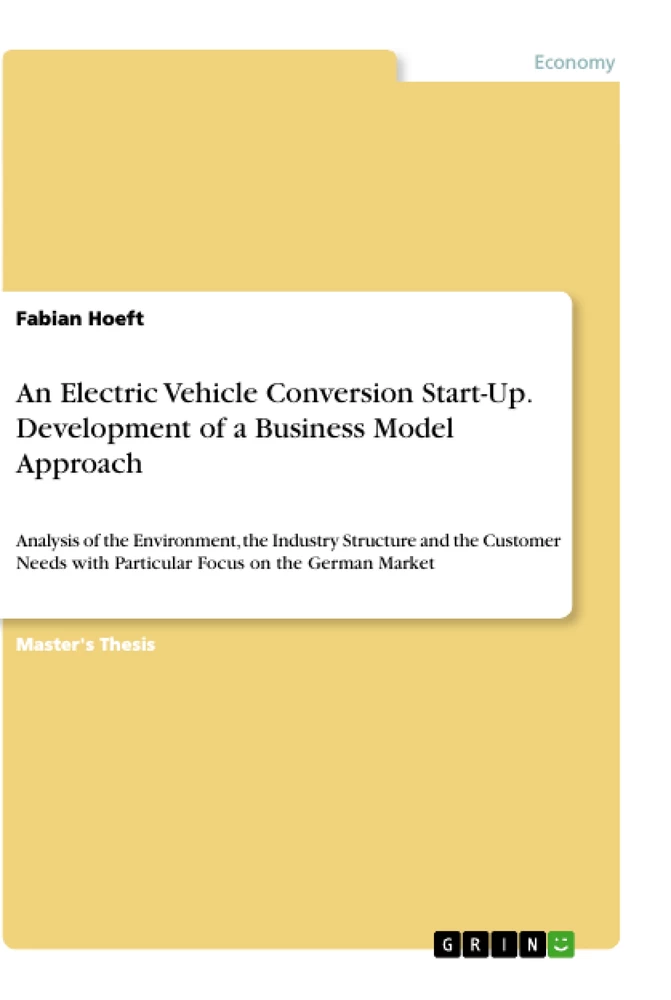
Table of Contents
1 Introduction
1.1 Description of the problem
1.2 Relevance and objectives of the research
1.3 Thesis structure and overview of research methodology
2 Theoretical foundations of the strategic management of a new business in the field of passenger car electrification
2.1 Technical description of passenger car electrification
2.2 Relevant foundations of strategic analysis
2.2.1 Strategic analysis within the strategic management process
2.2.2 Environmental analysis using PESTEL
2.2.3 Industry structure analysis using Porter’s Five Forces
2.2.4 Investigation of customer needs through qualitative and quantitative market research
2.3 Introduction to the Business Model Canvas
3 Strategic analysis of the passenger car electrification business
3.1 PESTEL environmental analysis
3.1.1 Political factors
3.1.2 Economic factors
3.1.3 Social factors
3.1.4 Technological factors
3.1.5 Ecological factors
3.1.6 Legal factors
3.1.7 Issue-Impact-Matrix
3.2 Industry structure and competition analysis using Porter’s Five Forces
3.2.1 Industry rivalry
3.2.2 Bargaining power of suppliers
3.2.3 Bargaining power of customers
3.2.4 Threat of new entry
3.2.5 Threat of substitution
3.3 Empirical investigation: Analysis of customer needs
3.3.1 Qualitative preliminary study
3.3.1.1 Research objectives and key questions
3.3.1.2 Selection of the type of interview
3.3.1.3 Determination of the quota arrangement
3.3.1.4 Presentation of the examination design
3.3.1.5 Development of a thematic guide for the study
3.3.1.6 Outline of the procedure for evaluating the in-depth interviews
3.3.1.7 Presentation and interpretation of the results
3.3.2 Quantitative analysis
3.3.2.1 Research objectives and research hypotheses
3.3.2.2 Survey type selection and presentation of the research setting
3.3.2.3 Sample selection and population definition
3.3.2.4 Estimation of the necessary sample size
3.3.2.5 Development of the survey instrument
3.3.2.6 Presentation and interpretation of the results
4 Derivation of a business model approach
4.1 Consolidation of the underlying problems
4.2 Customer segments
4.3 Value proposition
4.4 Distribution and communication channels
4.5 Customer relation
4.6 Revenue streams
4.7 Key resources
4.8 Key activities
4.9 Key partners
4.10 Cost structure
5 Review and outlook
5.1 Summary of findings
5.2 Critical reflection of the chosen approach and elaboration
5.3 Outlook on the business model approach
Research Objectives and Core Themes
The core objective of this master thesis is the development of a business model approach for the implementation of passenger car electrification in the German market, derived from a thorough analysis of the environmental factors, industry structure, and specific customer needs.
- Strategic analysis of the German market for vehicle electrification using PESTEL and Porter's Five Forces.
- Empirical investigation of customer preferences, barriers, and purchasing motives through qualitative interviews and quantitative surveys.
- Development of a holistic business model using the Business Model Canvas framework.
- Evaluation of technical, economic, and regulatory success factors for a new start-up in the conversion industry.
- Strategic roadmap for market entry and sustainable operational growth.
Excerpt from the Thesis
2.2.1 Strategic analysis within the strategic management process
The approach chosen for the master thesis and the development of a business model approach is based on the process of strategic management. This process typically incorporates strategic analysis, strategy development, strategy selection, and strategy implementation. The procedure was chosen to develop strategic options based on a well-founded analysis, to evaluate them, and to develop the business model approach based on the complex network of influencing factors. In the following, the approach of this master thesis and its integration into the process of strategic management is explained in more detail.
Strategic management refers to the field of activity that deals with the orientation of a company. It defines the company's goals, develops and implements plans as well as measures to execute them. A widespread time horizon for strategic management is two to five years. The following figure shows the process of strategic management, according to Hungenberg.
Summary of Chapters
1 Introduction: This chapter outlines the problem statement regarding vehicle emissions and introduces the research objectives and methodology.
2 Theoretical foundations of the strategic management of a new business in the field of passenger car electrification: This section provides the technical basis for car retrofitting and details the strategic management tools (PESTEL, Porter's Five Forces, Business Model Canvas) used in the analysis.
3 Strategic analysis of the passenger car electrification business: This chapter conducts a detailed PESTEL and industry analysis, followed by an empirical investigation into customer needs through qualitative and quantitative research.
4 Derivation of a business model approach: Using the gathered insights, this chapter builds a comprehensive business model following the nine blocks of the Business Model Canvas.
5 Review and outlook: This final chapter summarizes the research findings, reflects critically on the chosen approach, and provides a roadmap for future business development.
Keywords
Passenger car electrification, business model approach, strategic analysis, PESTEL, Porter's Five Forces, Business Model Canvas, customer needs, empirical investigation, electromobility, German market, sustainability, market entry, vehicle conversion, retrofitting, transport transition.
Frequently Asked Questions
What is the core focus of this thesis?
The thesis focuses on developing a viable business model for a start-up specializing in the electrification (retrofitting) of passenger cars within the German market.
What are the main research themes?
The study centers on strategic management, industry structure analysis, environmental factors (PESTEL), and the empirical assessment of customer acceptance regarding car retrofitting.
What is the primary research goal?
The goal is to determine how a sustainable and viable business model for passenger car electrification can be designed to address current mobility challenges in Germany.
Which methodology is applied?
The research uses a multi-method approach: a secondary literature analysis for the environmental and industry scan, followed by a qualitative pre-study (in-depth interviews) and a quantitative online survey for market research.
What topics are covered in the main body?
The main body covers the theoretical framework of strategic management, a PESTEL environmental scan, Porter's Five Forces industry analysis, and a comprehensive empirical study of user attitudes towards electric retrofitting.
What terms best describe this work?
Key terms include Car Electrification, Business Model Canvas, Strategic Analysis, Market Research, Sustainability, and Electric Mobility.
How does this thesis address the issue of customer acceptance?
Customer acceptance is analyzed through a survey examining specific purchase barriers, such as concerns about battery safety, charging processes, and vehicle range, compared against conventional combustion vehicles.
What is the significance of the "Business Model Canvas" in this research?
The canvas is utilized as a structured framework to map out the start-up's value proposition, customer segments, revenue streams, cost structures, and key partners, ensuring all business-critical areas are addressed.
Ende der Leseprobe aus 373 Seiten
- nach oben
- Arbeit zitieren
- Fabian Hoeft (Autor:in), 2019, An Electric Vehicle Conversion Start-Up. Development of a Business Model Approach, München, Page::Imprint:: GRINVerlagOHG, https://www.diplomarbeiten24.de/document/502124

neugierig - aktuell - relevant
Entdecken Sie hilfreiche Tipps und Tricks rund ums Studium!

Entdecken Sie hilfreiche Tipps und Tricks rund ums Studium!
Ihre Hausarbeit / Abschlussarbeit:

- - Publikation als E-Book und Buch
- - Hohes Honorar auf die Verkäufe
- - Für Sie komplett kostenlos - mit ISBN
- - Es dauert nur 5 Minuten
- - Jede Arbeit findet Leser

- © GRIN Publishing GmbH.
- Alle Inhalte urheberrechtlich geschützt. Kopieren und verbreiten untersagt.
- info@grin.com
- AGB
- Open Publishing
Der GRIN Verlag hat sich seit 1998 auf die Veröffentlichung akademischer eBooks und Bücher spezialisiert. Der GRIN Verlag steht damit als erstes Unternehmen für User Generated Quality Content. Die Verlagsseiten GRIN.com, Hausarbeiten.de und Diplomarbeiten24 bieten für Hochschullehrer, Absolventen und Studenten die ideale Plattform, wissenschaftliche Texte wie Hausarbeiten, Referate, Bachelorarbeiten, Masterarbeiten, Diplomarbeiten, Dissertationen und wissenschaftliche Aufsätze einem breiten Publikum zu präsentieren.
Kostenfreie Veröffentlichung: Hausarbeit, Bachelorarbeit, Diplomarbeit, Dissertation, Masterarbeit, Interpretation oder Referat jetzt veröffentlichen!
Folgen Sie GRIN auf


- GRIN Verlag GmbH
-
- Nymphenburger Str. 86
- 80636
- Munich, Deutschland
- +49 89-550559-0
- +49 89-550559-10
- info@grin.com
-
