
präsentiert von

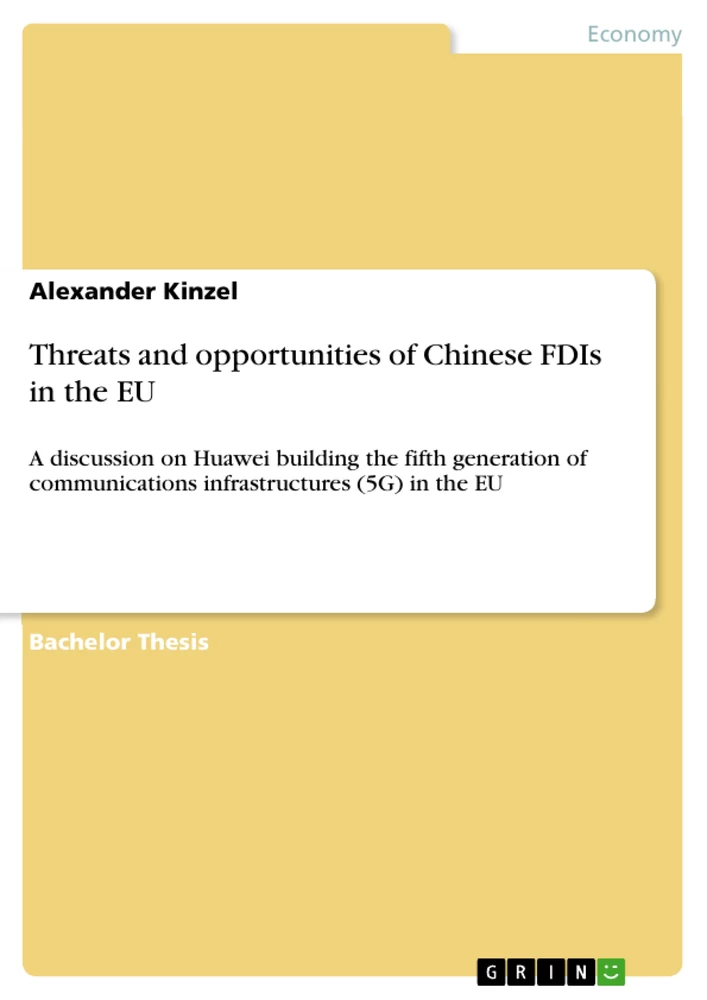
Table of Contents
1) INTRODUCTION
2) CURRENT SITUATION OF CHINESE-EU TRADE AND CHINESE FDI COMING TO THE EU
3) HUAWEI OVERVIEW
4) WHAT IS THE FIFTH GENERATION 5G INFRASTRUCTURE AND HOW DOES IT DIFFER FROM PREVIOUS GENERATIONS OF TELECOMMUNICATION INFRASTRUCTURES?
5) EU PERSPECTIVE
5.1) THREATS FROM HUAWEI CONDUCTING FDIS IN THE EUROPEAN UNION
5.1.1) SECURITY CONCERN
5.1.2) DETRIMENTAL IMPACT FOR EU COMPANIES IF CHEAP CHINESE HUAWEI COMES WITH COMPETITION
5.1.3 EU’S TRADE DEFICIT WITH CHINA CREATES A STRONG DEPENDENCY ON CHINA FOR TRADE
5.2) OPPORTUNITIES FROM HUAWEI CONDUCTING FDIS IN THE EUROPEAN UNION
5.2.1) WITH HUAWEI, THE 5G INFRASTRUCTURE COMES SOONER, CHEAPER AND BOOSTS EU COMPETITIVENESS
5.2.2) JOB CREATION IN THE EU
5.2.3) CONTRIBUTING TO ECONOMIC GROWTH, LABOUR MARKET RECEIVES MORE KNOW-HOW THROUGH CHN INVESTMENT
6) CHINESE PERSPECTIVE
6.1) THREATS FROM HUAWEI CONDUCTING FDIS IN THE EUROPEAN UNION
6.1.1) INCREASING CAPITAL FLIGHT AND THE INCREASING REGULATION THEREOF
6.1.2) THE UNCERTAINTY OF EU MEMBER STATES’ POLICIES CONCERNING CHINESE FDI IN 5G TELECOMUNICATION INFRASTRUCTURE AND LACK OF COMMON SECURITY FRAMEWORK CREATING ADDITIONAL COSTS
6.2.3) LIABILITY OF FOREIGNNESS
6.2) OPPORTUNITIES FROM HUAWEI CONDUCTING FDIS IN THE EUROPEAN UNION
6.2.1) CHINA’S POTENTIAL TO ATTAIN A STRONGER COMPETITIVE ADVANTAGE THROUGH R&D
6.2.2) “SCIENCE DIPLOMACY” AS AN OPPORTUNITY FOR MORE TRADE WITH THE EU AND FOR MORE DECONSTRUCTION OF THE LIABILITIES OF FOREIGNNESS
7) CONCLUSION AND RECOMMENDATIONS
Research Objectives and Themes
The primary objective of this thesis is to provide an in-depth analysis of the threats and opportunities associated with Chinese Foreign Direct Investment (FDI) in the European Union, specifically using the case study of Huawei's involvement in the construction of 5G telecommunications infrastructure to examine the political and economic implications.
- Analysis of security risks and political concerns regarding Chinese technology integration.
- Evaluation of economic impacts, including competition, job creation, and know-how transfers.
- Examination of the Chinese perspective, including capital flight regulation and liability of foreignness.
- Assessment of the role of 5G infrastructure in global competitiveness and industrial growth.
- Review of current EU regulatory frameworks for foreign investment screening.
Auszug aus dem Buch
5.1.1) Security Concern
The threat that will first come to mind, out of the perspective of the European Union member states, is the security concern for the European telecommunication network. Voices have been raised about the relevant Chinese law, of which several articles can be interpreted as to require Chinese companies to assist the Chinese government in obtaining information when ordered by the Chinese government. These laws, applied to the 5G telecommunications network of Huawei in the European Union, could be used to gather vast amounts of intelligence. The two following articles of Chinese Law, could be applied to coerce Chinese companies to submit intelligence to the Chinese government:
Article 7 of the Chinese National Intelligence Law (国家情报法) of 2016 declares:
“Any organisation and citizen shall, in accordance with the law, support, provide assistance, and cooperate in national intelligence work, and guard the secrecy of any national intelligence work that they are aware of [emphasis added]. The state shall protect individuals and organisations that support, cooperate with, and collaborate in national intelligence work.”26
In a similar fashion, Article 22 of the Counter-Espionage Law (反间谍法) of 2014:
“states that during the course of a counter-espionage investigation, ‘relevant organisations and individuals’ must ‘truthfully provide’ information and ‘must not refuse’.” 27
Summary of Chapters
1) INTRODUCTION: Defines the research scope regarding Chinese FDI in the EU, focusing on the political and macroeconomic impact of Huawei's participation in 5G infrastructure.
2) CURRENT SITUATION OF CHINESE-EU TRADE AND CHINESE FDI COMING TO THE EU: Reviews historical trends in Chinese investment in Europe, noting recent volatility and regulatory impacts on trade flows.
3) HUAWEI OVERVIEW: Provides a structural background of Huawei, covering corporate governance, employee shareholding, and its strategic importance in global telecommunications.
4) WHAT IS THE FIFTH GENERATION 5G INFRASTRUCTURE AND HOW DOES IT DIFFER FROM PREVIOUS GENERATIONS OF TELECOMMUNICATION INFRASTRUCTURES?: Explains the technical advantages of 5G, such as lower latency and higher bandwidth, and its potential as a key economic asset for Europe.
5) EU PERSPECTIVE: Analyzes the security-focused concerns of EU member states alongside the potential benefits, such as job creation and improved competitiveness through Chinese investment.
6) CHINESE PERSPECTIVE: Explores the motivations and challenges from the Chinese side, including navigating European regulatory environments and managing the liabilities of foreignness.
7) CONCLUSION AND RECOMMENDATIONS: Synthesizes the findings, suggesting the need for a unified EU screening framework to balance economic opportunities with essential national security requirements.
Keywords
Foreign Direct Investment, FDI, Huawei, 5G Infrastructure, European Union, China, Telecommunications, Security Concerns, National Intelligence Law, Counter-Espionage Law, Economic Growth, Know-how Transfer, Liability of Foreignness, Science Diplomacy, Trade Deficit
Frequently Asked Questions
What is the core focus of this research?
The work focuses on the multifaceted impacts of Chinese FDI in the EU, specifically examining the threats and opportunities surrounding Huawei's role in the development of 5G telecommunications infrastructure.
What are the primary thematic areas explored?
The research explores security policy, macroeconomic stability, FDI trends between China and the EU, technological advancements in 5G, and the corporate strategy of Chinese multinationals.
What is the central research question?
The research investigates whether China should be permitted to compete in the race to build 5G infrastructure in the EU, balancing the necessity for technological advancement against national security risks.
Which scientific methods are employed?
The thesis utilizes a case study approach, leveraging empirical data on previous FDIs, legal analysis of Chinese intelligence laws, and expert opinion from the field of political economy.
What topics are covered in the main section?
The main sections cover the EU's security concerns, economic arguments for investment (job creation, R&D), Chinese regulatory challenges (capital flight), and the concept of "science diplomacy."
What keywords characterize the study?
The study is characterized by terms like Foreign Direct Investment, Huawei, 5G, security, economic growth, and science diplomacy.
How does the Chinese National Intelligence Law affect the discussion on 5G?
It creates a security dilemma for EU states, as the legal obligation for Chinese companies to cooperate with state intelligence suggests potential risks for European telecommunications security.
What is meant by the "Liability of Foreignness" in this context?
It refers to the additional costs and operational barriers that Chinese firms, like Huawei, face when operating in foreign markets due to cultural, regulatory, and political differences.
Does the author suggest a specific policy recommendation?
Yes, the author recommends the implementation of a unified EU framework, potentially modeled after a "banking union" for telecommunications, to ensure secure and consistent screening standards across member states.
Ende der Leseprobe aus 39 Seiten
- nach oben
- Arbeit zitieren
- Alexander Kinzel (Autor:in), 2019, Threats and opportunities of Chinese FDIs in the EU, München, Page::Imprint:: GRINVerlagOHG, https://www.diplomarbeiten24.de/document/502812

neugierig - aktuell - relevant
Entdecken Sie hilfreiche Tipps und Tricks rund ums Studium!

Entdecken Sie hilfreiche Tipps und Tricks rund ums Studium!
Ihre Hausarbeit / Abschlussarbeit:

- - Publikation als E-Book und Buch
- - Hohes Honorar auf die Verkäufe
- - Für Sie komplett kostenlos - mit ISBN
- - Es dauert nur 5 Minuten
- - Jede Arbeit findet Leser

- © GRIN Publishing GmbH.
- Alle Inhalte urheberrechtlich geschützt. Kopieren und verbreiten untersagt.
- info@grin.com
- AGB
- Open Publishing
Der GRIN Verlag hat sich seit 1998 auf die Veröffentlichung akademischer eBooks und Bücher spezialisiert. Der GRIN Verlag steht damit als erstes Unternehmen für User Generated Quality Content. Die Verlagsseiten GRIN.com, Hausarbeiten.de und Diplomarbeiten24 bieten für Hochschullehrer, Absolventen und Studenten die ideale Plattform, wissenschaftliche Texte wie Hausarbeiten, Referate, Bachelorarbeiten, Masterarbeiten, Diplomarbeiten, Dissertationen und wissenschaftliche Aufsätze einem breiten Publikum zu präsentieren.
Kostenfreie Veröffentlichung: Hausarbeit, Bachelorarbeit, Diplomarbeit, Dissertation, Masterarbeit, Interpretation oder Referat jetzt veröffentlichen!
Folgen Sie GRIN auf


- GRIN Verlag GmbH
-
- Nymphenburger Str. 86
- 80636
- Munich, Deutschland
- +49 89-550559-0
- +49 89-550559-10
- info@grin.com
-
