
präsentiert von

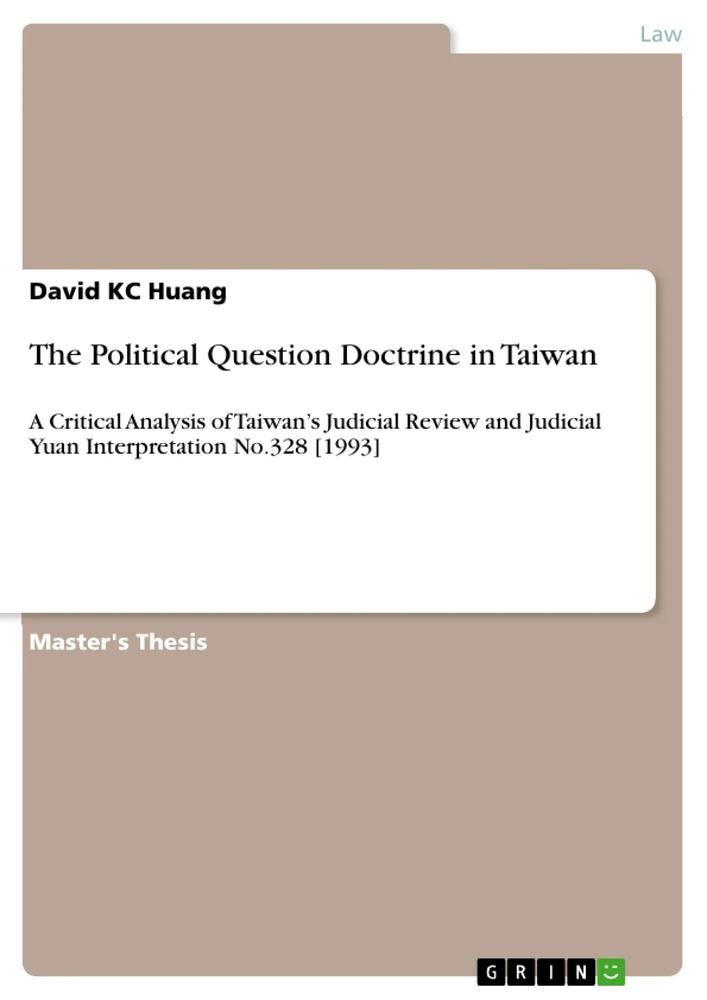
Table of Contents
1. INTRODUCTION
2. LITERATURE REVIEW: POLITICAL QUESTION DOCTRINE
3. METHODOLOGY
4. POLITICAL QUESTION REVIEW ONE: TERRITORIAL CONTROVERSIES
Formosa and the Pescadores
Mainland China
Outer Mongolia
5. POLITICAL QUESTION REVIEW TWO: CONSTITUTIONAL ANALYSIS
6. POLITICAL QUESTION REVIEW THREE: JUDICIAL BEHAVIOUR
7. CONCLUSION
Research Objectives and Themes
This thesis investigates the application of the political question doctrine by the Judicial Yuan in Taiwan, specifically focusing on the landmark Judicial Yuan Interpretation No.328 [1993]. The central research question examines whether the court's use of this doctrine stems from an actual lack of constitutional jurisdiction or if it serves as a strategic instrument for judicial self-restraint to avoid politically sensitive controversies regarding national identity and territorial integrity.
- The historical origin and legal definition of the political question doctrine in Western and Taiwanese jurisprudence.
- The territorial disputes of the Republic of China (ROC), encompassing Taiwan, Mainland China, and Outer Mongolia.
- A comparative constitutional analysis of how different legal systems address territorial boundary controversies.
- The influence of public opinion, national identity, and judicial politics on the behavior of the Justices.
Excerpt from the Book
4. POLITICAL QUESTION REVIEW ONE: TERRITORIAL CONTROVERSIES
The traditional definition of national territory of the ROC splits the country into three main regions – Formosa and the Pescadores, Mainland China and Outer Mongolia. However, due to military defeat in the Chinese Civil War, the ROC has actual controlled only Formosa and the Pescadores since the 1950s. The Chinese mainland became the People’s Republic of China, while Outer Mongolia has since declared its independence.
Judicial Yuan Interpretation No.328 [1993] was a constitutional litigation involving a political controversy referring to the delimitation of the ROC’s national territory. As a result, it is important to analyse this political question firstly through a review of the ROC’s territorial claims to Formosa (including the Pescadores), Mainland China, and Outer Mongolia.
Formosa Island (Taiwan) and the Pescadores are the current national territories of the Republic of China, which have amounted to 99 percent of the actual control territories of the country since the 1950s. Formosa Island and the Pescadores were returned to the ROC from Japan by the Allied Powers in 1945 after their victory in the Second World War, and the ROC have claimed sovereignty over the two territories according to the 1943 Cairo Communiqué and the 1945 Potsdam Declaration since then.
The two territories were absorbed into the Chinese Qing Empire as prefectures of the Fujian Province in 1683 and were granted Imperial Charter in forming Province of Taiwan in 1885. The majority of Taiwan’s population is Han Chinese (around 98 percent) with a southern Fujian origin (more than sixty-six percent). Meanwhile, the so-called Taiwanese language, which is the mother tongue of the majority population in Taiwan, is actually a Fujian language.
Summary of Chapters
1. INTRODUCTION: Outlines the scope of the thesis, introducing the political question doctrine as a mechanism of judicial self-restraint and identifying Judicial Yuan Interpretation No.328 [1993] as the primary case study.
2. LITERATURE REVIEW: POLITICAL QUESTION DOCTRINE: Explores the origins of the doctrine in English Royal Prerogative and its evolution in the United States, providing a theoretical foundation for the study.
3. METHODOLOGY: Details the historical, comparative, and political approaches used to argue that the court's application of the doctrine is a strategic choice rather than a constitutional mandate.
4. POLITICAL QUESTION REVIEW ONE: TERRITORIAL CONTROVERSIES: Provides a historical overview of the ROC’s territorial claims over Taiwan, Mainland China, and Outer Mongolia.
5. POLITICAL QUESTION REVIEW TWO: CONSTITUTIONAL ANALYSIS: Compares the Taiwanese constitutional framework with the German Basic Law to evaluate the Judicial Yuan's duty regarding territorial disputes.
6. POLITICAL QUESTION REVIEW THREE: JUDICIAL BEHAVIOUR: Analyzes the impact of public opinion surveys and national identity in Taiwan on the court's decision-making process.
7. CONCLUSION: Summarizes the findings that the doctrine serves as a shield for the Judicial Yuan to navigate complex, polarized political landscapes without damaging its reputation.
Keywords
Political question doctrine, Judicial Yuan, Taiwan, Constitutional law, Judicial review, National territory, Republic of China, Judicial behavior, Self-restraint, Territorial controversies, National identity, Constitutional litigation, Judicial supremacy, Comparative law, Political controversy.
Frequently Asked Questions
What is the primary focus of this research?
The work focuses on the political question doctrine in Taiwan, analyzing why and how the Judicial Yuan utilizes this principle to decline jurisdiction in cases involving sensitive political and territorial controversies.
What are the central themes of the work?
The central themes include judicial self-restraint, the influence of political environment on court decisions, the legal history of the Republic of China’s territorial claims, and the role of national identity in constitutional interpretation.
What is the core objective of the thesis?
The objective is to demonstrate that the Judicial Yuan’s application of the political question doctrine is not a result of a legal inability to act, but rather a deliberate strategy to avoid political entanglement.
Which scientific methodology is applied?
The author employs a multi-dimensional approach combining historical analysis of territorial claims, comparative legal theory, and political realism, including an evaluation of public opinion data.
What does the main body of the work cover?
The main body systematically reviews the doctrine's origins, examines the specific territorial disputes regarding Mainland China and Mongolia, compares these with international constitutional examples, and interprets the court's behavior through social and political lens.
Which keywords best characterize this work?
Key terms include political question doctrine, Judicial Yuan, constitutional law, judicial behavior, and national territory.
How does the author explain the court's decision in Interpretation No.328?
The author argues that the court invoked the doctrine because it recognized that a definitive ruling on national territory would force it to take a side in the highly divisive debate over Taiwan's national identity.
What role did public opinion play in the court's reasoning?
Public opinion surveys indicated that the population was deeply polarized; the court viewed the potential political fallout from a concrete decision as a threat to its institutional reputation and stability.
Is this doctrine a permanent fixture in the Taiwanese legal system?
The thesis suggests the doctrine is used sparingly and strategically as a 'shield' rather than as a strict, consistently applied rule of law.
Ende der Leseprobe aus 39 Seiten
- nach oben
- Arbeit zitieren
- David KC Huang (Autor:in), 2012, The Political Question Doctrine in Taiwan, München, Page::Imprint:: GRINVerlagOHG, https://www.diplomarbeiten24.de/document/503643

neugierig - aktuell - relevant
Entdecken Sie hilfreiche Tipps und Tricks rund ums Studium!

Entdecken Sie hilfreiche Tipps und Tricks rund ums Studium!
Ihre Hausarbeit / Abschlussarbeit:

- - Publikation als E-Book und Buch
- - Hohes Honorar auf die Verkäufe
- - Für Sie komplett kostenlos - mit ISBN
- - Es dauert nur 5 Minuten
- - Jede Arbeit findet Leser

- © GRIN Publishing GmbH.
- Alle Inhalte urheberrechtlich geschützt. Kopieren und verbreiten untersagt.
- info@grin.com
- AGB
- Open Publishing
Der GRIN Verlag hat sich seit 1998 auf die Veröffentlichung akademischer eBooks und Bücher spezialisiert. Der GRIN Verlag steht damit als erstes Unternehmen für User Generated Quality Content. Die Verlagsseiten GRIN.com, Hausarbeiten.de und Diplomarbeiten24 bieten für Hochschullehrer, Absolventen und Studenten die ideale Plattform, wissenschaftliche Texte wie Hausarbeiten, Referate, Bachelorarbeiten, Masterarbeiten, Diplomarbeiten, Dissertationen und wissenschaftliche Aufsätze einem breiten Publikum zu präsentieren.
Kostenfreie Veröffentlichung: Hausarbeit, Bachelorarbeit, Diplomarbeit, Dissertation, Masterarbeit, Interpretation oder Referat jetzt veröffentlichen!
Folgen Sie GRIN auf


- GRIN Verlag GmbH
-
- Nymphenburger Str. 86
- 80636
- Munich, Deutschland
- +49 89-550559-0
- +49 89-550559-10
- info@grin.com
-
