
präsentiert von

Contents
1 Introduction
2 Determinants of cartel survival
2.1 Fundamentals of Cartel Stability
2.2 Geographical Scope
2.3 Number of Firms
2.4 Ringleader
2.5 Type of Infringement
2.6 Internal Enforcement Methods
2.7 Entry and Exit Dynamics
2.8 Cartel Enforcement
2.9 Macroeconomic Determinants
3 Data
3.1 Data Set Description
3.2 Variables
4 Methodology and estimation strategy
4.1 Principles of Survival Analysis
4.2 Duration Modeling and Competing Risks
4.3 Time-varying Covariates
4.4 Models
5 Results and discussion
5.1 Estimation Results
5.2 Robustness Checks and Biases
6 Conclusion
Research Objectives & Core Topics
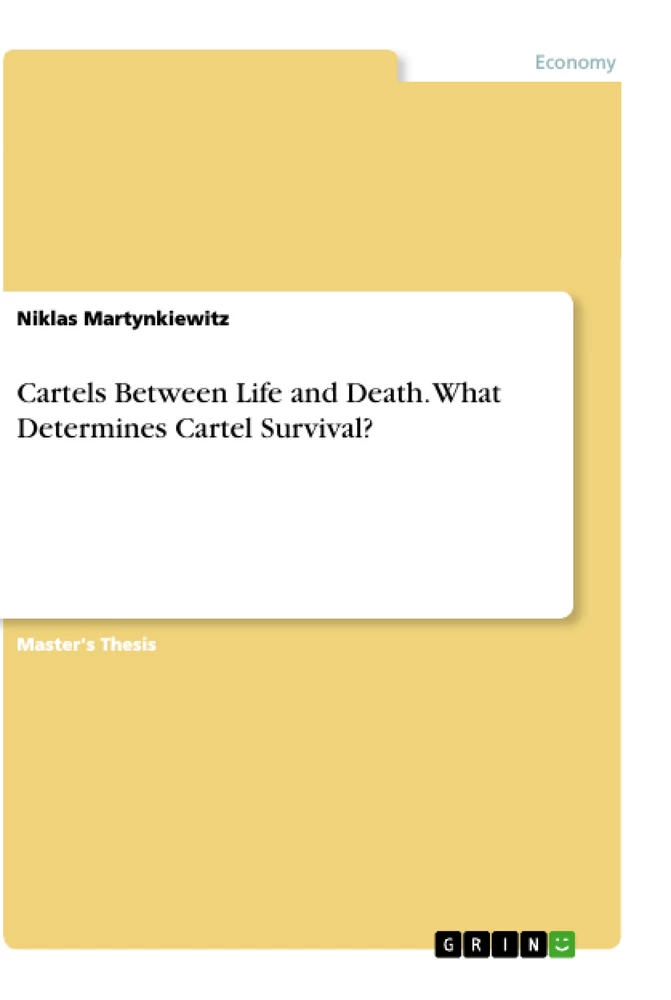
The primary objective of this thesis is to examine the determinants of cartel duration by analyzing a dataset of 123 cartel cases convicted by the European Commission. The research aims to replicate and extend existing studies on cartel survival by incorporating internal enforcement mechanisms and macroeconomic indicators to determine which factors contribute to the life-shortening or life-prolonging effects of cartels.
- Analysis of organizational determinants such as firm number, ringleaders, and geographical scope.
- Evaluation of internal cartel enforcement techniques, including monitoring and compensation mechanisms.
- Investigation of external macroeconomic factors, specifically interest rates, demand growth, and demand volatility.
- Assessment of the effectiveness of the EU corporate leniency program on cartel stability.
- Methodological application of Cox proportional hazard models and piecewise-constant exponential models.
Excerpt from the Book
2.1 Fundamentals of Cartel Stability
Before I begin to outline the determinants, which are tested later in this paper, I will address some introducing words to the terminology used in this branch of research and highlight a few seminal theoretical contributions to the literature of cartel stability.
The paper at hand is related to cartel survival. A cartel survives until a certain point in time if it remained stable in all previous periods. Hence, I denote the persistence over a series of consecutive periods by cartel survival, whereas a cartel is said to be stable if it survives in a certain period. Formally, the cartel Γ survives until the beginning of period t if it has not experienced a breakdown in all t − 1 previous periods. Therefore, the determinants of periodical cartel stability are directly linked to determinants of overall cartel survival.
Instabilities can arise from several different threats which can be grouped loosely into internal and external threats. First and foremost, a cartel can break down internally because of its organizational and operational characteristics. Organizational characteristics refer to the overall structure of the cartel. Examples are the number of active firms in the cartel, the hierarchy and distribution of power or the number of cartel entries and exits. Operational characteristics incorporate the acting of the cartel within its market but also any form of communication among cartel members. Examples are the type of infringement used by the cartel, the geographical scope of the cartel activity, enforcement related mechanisms like monitoring, retaliation and compensation.
Summary of Chapters
1 Introduction: Provides an overview of the legal and economic landscape concerning cartels, the motivation for cartel survival analysis, and a summary of the thesis contributions.
2 Determinants of cartel survival: Reviews theoretical literature and case studies to establish testable hypotheses regarding internal and external factors influencing cartel duration.
3 Data: Describes the construction of the survival datasets comprising 123 cartel cases and details the operationalization of variables.
4 Methodology and estimation strategy: Outlines the econometric framework, focusing on survival analysis, proportional hazard models, and the handling of competing risks and time-varying covariates.
5 Results and discussion: Presents the empirical estimation results, compares findings with existing literature, and evaluates the robustness of the models.
6 Conclusion: Summarizes the key findings regarding the drivers of cartel instability and offers policy recommendations based on the empirical evidence.
Keywords
Cartel Survival, Antitrust Policy, Proportional Hazard Model, EU Corporate Leniency Program, Demand Volatility, Market Stability, Enforcement Mechanisms, Cartel Duration, Competition Authorities, Macroeconomic Determinants, Survival Analysis, Collusion, Internal Enforcement, Cartel Breakdown, Industrial Organization.
Frequently Asked Questions
What is the core focus of this research?
The research focuses on identifying which specific factors either extend or shorten the lifespan of cartels that have been prosecuted by the European Commission.
What are the primary themes covered?
The themes include the internal structure of cartels, the impact of antitrust policies like leniency programs, and the influence of macroeconomic factors on cartel stability.
What is the main objective or research question?
The central goal is to determine the factors that influence cartel duration, specifically evaluating how internal organization and market conditions affect the probability of cartel breakdown.
Which scientific methodology is utilized?
The study employs survival analysis techniques, primarily using Cox proportional hazard models and piecewise-constant exponential models to measure the hazard rate of cartel failure.
What is addressed in the main body of the work?
The work details the theoretical determinants of cartel stability, explains the data construction process, presents the econometric estimation strategy, and discusses the regression results and robustness checks.
What are the defining keywords for this study?
Key terms include Cartel Survival, Antitrust Policy, Leniency Program, Survival Analysis, and Demand Volatility.
How does the EU leniency program affect cartel stability?
The study concludes that the availability of the EU corporate leniency program is the strongest driver of cartel instability, significantly increasing the probability of cartel breakdown.
Does demand volatility increase or decrease cartel lifespan?
Contrary to initial intuition regarding uncertainty, the study finds that higher demand volatility has a hazard-decreasing, or strengthening, effect on cartel stability, suggesting cartels act as a hedge against uncertain economic conditions.
How does the study define 'natural death' for a cartel?
The study distinguishes 'natural death' from 'agency death' (breakdowns forced by authority intervention) using different time-based thresholds, allowing for a more nuanced analysis of cartel dissolution.
Ende der Leseprobe aus 63 Seiten
- nach oben
- Arbeit zitieren
- Niklas Martynkiewitz (Autor:in), 2018, Cartels Between Life and Death. What Determines Cartel Survival?, München, Page::Imprint:: GRINVerlagOHG, https://www.diplomarbeiten24.de/document/504104

neugierig - aktuell - relevant
Entdecken Sie hilfreiche Tipps und Tricks rund ums Studium!

Entdecken Sie hilfreiche Tipps und Tricks rund ums Studium!
Ihre Hausarbeit / Abschlussarbeit:

- - Publikation als E-Book und Buch
- - Hohes Honorar auf die Verkäufe
- - Für Sie komplett kostenlos - mit ISBN
- - Es dauert nur 5 Minuten
- - Jede Arbeit findet Leser

- © GRIN Publishing GmbH.
- Alle Inhalte urheberrechtlich geschützt. Kopieren und verbreiten untersagt.
- info@grin.com
- AGB
- Open Publishing
Der GRIN Verlag hat sich seit 1998 auf die Veröffentlichung akademischer eBooks und Bücher spezialisiert. Der GRIN Verlag steht damit als erstes Unternehmen für User Generated Quality Content. Die Verlagsseiten GRIN.com, Hausarbeiten.de und Diplomarbeiten24 bieten für Hochschullehrer, Absolventen und Studenten die ideale Plattform, wissenschaftliche Texte wie Hausarbeiten, Referate, Bachelorarbeiten, Masterarbeiten, Diplomarbeiten, Dissertationen und wissenschaftliche Aufsätze einem breiten Publikum zu präsentieren.
Kostenfreie Veröffentlichung: Hausarbeit, Bachelorarbeit, Diplomarbeit, Dissertation, Masterarbeit, Interpretation oder Referat jetzt veröffentlichen!
Folgen Sie GRIN auf


- GRIN Verlag GmbH
-
- Nymphenburger Str. 86
- 80636
- Munich, Deutschland
- +49 89-550559-0
- +49 89-550559-10
- info@grin.com
-
