
präsentiert von

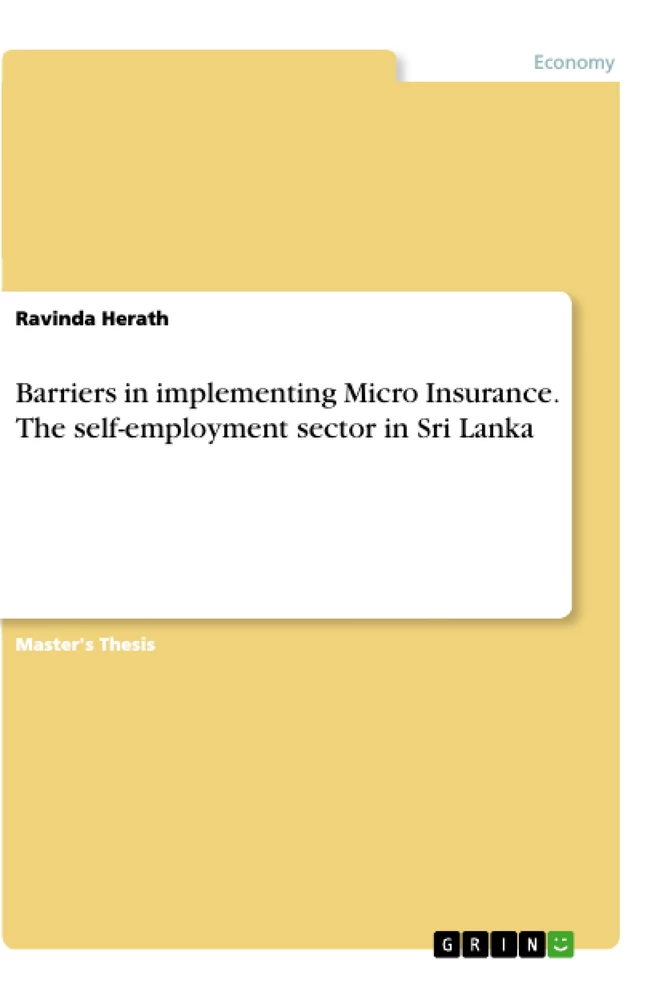
Table of Contents
Chapter 01:Introduction of the study
Introduction
1.1 Background of the study
1.2 Problem statement
1.3 Problem justification
1.4 Objectives of the Study
1.5 Significance of the study
1.6 Scope of the study
Chapter 02: Literature review
2.1 Introduction
2.2 Willingness to pay/buy for insurance
2.3 Poor accessibility for insurance by rural communities
2.4 Affordability
2.5 Consumer trust/ confidence on micro insurance
2.6 Conclusion
Chapter 03: Research Methodology
3.1 Introduction
3.2 Conceptual Framework
3.3 Research Hypotheses
3.4 Population
3.5 Sample
3.6 Data Collection
3.7 Statistical methodology
Chapter 04:Data Presentation and Analysis
4.1 Profile of Respondents
4.2 Findings
4.2.1. Analysis of Independent variable 01 - Willingness to pay/buy for insurance
4.2.2. Analysis of Independent variable 02 – Accessibility for insurance by rural community
4.2.3. Analysis of Independent variable 03 – Affordability
4.2.4. Analysis of Independent variable 04 – Consumer trust /Confidence in micro insurance
Chapter 05:Discussions of Findings and Interpretation
5.1 Interpretation and discussion of hypothesis
5.2. Variable 01 – Willingness to pay/buy for insurance
5.3 Variable 02 - Accessibility for insurance by rural communities
5.4 Variable 03 – Affordability
5.5 Variable 04 - Consumer trust/ confidence in micro insurance
Chapter 06: Conclusion
6.1 The Overall Study
6.2 Recommendations
6.3 Directions for future research
Research Objectives and Key Focus Areas
The primary objective of this dissertation is to investigate and identify the critical barriers that impede the effective implementation of micro insurance programs, specifically within the self-employment sector in Sri Lanka. The research seeks to understand how variables such as willingness to pay, accessibility, affordability, and consumer trust influence the adoption and sustainability of these financial services among low-income and rural populations.
- Analysis of consumer willingness to pay for insurance products.
- Evaluation of accessibility challenges faced by rural communities in obtaining insurance.
- Assessment of the affordability of insurance premiums for the self-employment sector.
- Examination of the role of consumer trust and confidence in the success of micro insurance schemes.
Excerpt from the Dissertation
2.4 Consumer trust/ confidence in micro insurance
Trust is presented in different forms to address different concerns but there is no definite expression to explain what exactly trust is. This may vary according to the problem and the type of risk to be mitigated (Ma, and Orgun 2006). Trust plays a significant role in creating customer perception and their relationships with the organizations (Taylor, 2001).In the frame work of Health Insurance, trust has become a vague principle. Nevertheless trust in insurance can be categorized in to three directions such as client’s trust in provider/agent, trust in insurers and trust in legal contracts of insurance (Schneider, 2004).
Nowadays people are always concern about the quality of the services and they are brand-conscious. Therefore micro insurers have to secure the market trust and confidence of their clients to ensure their service quality. Micro insurance market has immersed by the Bottom of the Pyramid (BOP) in many places around the world. Awareness about the micro insurance among poor is a major challenge as many of them are reluctant to pay for intangible products such as insurance that would never be paid out and also they have a little faith on insurance companies. However informal insurance structures based on group concept, which depend on trust and mutuality are significantly play a major role amongst rural communities in group lending. (Churchill, 2006).
The reasons for lack of reliability for insurance companies are social aloofness, geographical location of rural communities and also it is time bound. Further micro insurance clients often trust mutual insurance arrangements than commercial organizations because the insurance agents from these organizations may come from different walks of lives, with different social backgrounds and attitudes. However, Insurance companies ready to provide reliable micro insurance products for their clients who pay regular premiums and people believe that they get claim payments on time when they encounter with perils(Loewe, 2006).It is highly believed that the successful selling is heavily based on trust perception in financial and insurance services (Urban, Sultan, and Qualls, 2000).
Summary of Chapters
Chapter 01:Introduction of the study: This chapter introduces the core concept of micro insurance and highlights the specific problem of implementing these schemes within the Sri Lankan self-employment sector, outlining the research objectives and significance.
Chapter 02: Literature review: This section reviews existing academic research regarding willingness to pay, accessibility, affordability, and consumer trust, identifying these as key barriers for micro insurance implementation.
Chapter 03: Research Methodology: This chapter defines the conceptual framework and the statistical approaches used to test the research hypotheses, including the data collection methods through questionnaires distributed in SANASA societies.
Chapter 04:Data Presentation and Analysis: This chapter presents the findings from the survey data, utilizing descriptive statistics, regression analysis, and Pearson correlation to measure the relationships between the independent variables and micro insurance implementation.
Chapter 05:Discussions of Findings and Interpretation: This chapter interprets the statistical results and links them back to the literature, discussing the implications of willingness to pay, accessibility, affordability, and consumer trust on the practical implementation of micro insurance.
Chapter 06: Conclusion: This final chapter synthesizes the research findings, provides actionable recommendations for stakeholders such as insurers and regulators, and suggests directions for future academic study in this field.
Keywords
Micro insurance, self-employment, Sri Lanka, willingness to pay, accessibility, affordability, consumer trust, rural communities, risk mitigation, financial inclusion, SANASA, insurance implementation, low-income group, insurance premiums, insurance sustainability.
Frequently Asked Questions
What is the primary focus of this dissertation?
The research focuses on the barriers that prevent the effective implementation of micro insurance programs for the self-employment sector in Sri Lanka.
What are the main thematic areas analyzed in the study?
The four main thematic variables analyzed are willingness to pay, accessibility of insurance services, affordability for low-income groups, and consumer trust in insurance providers.
What is the central research question?
The study asks whether factors such as accessibility, affordability, and consumer trust significantly influence the implementation of micro insurance programs among self-employed individuals in rural Sri Lanka.
Which research methodology was employed?
The author used a quantitative approach, collecting data through a structured questionnaire from 278 respondents across 16 districts, and analyzed the results using Pearson correlation and simple linear regression models in IBM SPSS.
What is covered in the main body of the work?
The main body covers a comprehensive literature review, the conceptual framework of the study, detailed presentation and statistical analysis of survey data, and a discussion on how these findings address the initial problem statement.
Which keywords best characterize this work?
Key terms include micro insurance, self-employment, willingness to pay, accessibility, affordability, and consumer trust.
How did the study address the role of consumer trust?
The study found that trust is a critical final determinant for consumers; it emphasizes that even if insurance is affordable and accessible, consumers require faith in the insurer’s ability to pay future claims before committing to a policy.
What were the specific findings regarding the influence of gender?
The analysis revealed that female self-employers in the sample showed a more favorable attitude toward obtaining insurance compared to their male counterparts.
What recommendation does the author give for future implementation?
The author recommends that insurers should design bundled, tailor-made products, reduce paper-intensive processes, and recruit insurance agents from within the local community to build stronger trust.
Ende der Leseprobe aus 73 Seiten
- nach oben
- Arbeit zitieren
- Ravinda Herath (Autor:in), 2016, Barriers in implementing Micro Insurance. The self-employment sector in Sri Lanka, München, Page::Imprint:: GRINVerlagOHG, https://www.diplomarbeiten24.de/document/504105

neugierig - aktuell - relevant
Entdecken Sie hilfreiche Tipps und Tricks rund ums Studium!

Entdecken Sie hilfreiche Tipps und Tricks rund ums Studium!
Ihre Hausarbeit / Abschlussarbeit:

- - Publikation als E-Book und Buch
- - Hohes Honorar auf die Verkäufe
- - Für Sie komplett kostenlos - mit ISBN
- - Es dauert nur 5 Minuten
- - Jede Arbeit findet Leser

- © GRIN Publishing GmbH.
- Alle Inhalte urheberrechtlich geschützt. Kopieren und verbreiten untersagt.
- info@grin.com
- AGB
- Open Publishing
Der GRIN Verlag hat sich seit 1998 auf die Veröffentlichung akademischer eBooks und Bücher spezialisiert. Der GRIN Verlag steht damit als erstes Unternehmen für User Generated Quality Content. Die Verlagsseiten GRIN.com, Hausarbeiten.de und Diplomarbeiten24 bieten für Hochschullehrer, Absolventen und Studenten die ideale Plattform, wissenschaftliche Texte wie Hausarbeiten, Referate, Bachelorarbeiten, Masterarbeiten, Diplomarbeiten, Dissertationen und wissenschaftliche Aufsätze einem breiten Publikum zu präsentieren.
Kostenfreie Veröffentlichung: Hausarbeit, Bachelorarbeit, Diplomarbeit, Dissertation, Masterarbeit, Interpretation oder Referat jetzt veröffentlichen!
Folgen Sie GRIN auf


- GRIN Verlag GmbH
-
- Nymphenburger Str. 86
- 80636
- Munich, Deutschland
- +49 89-550559-0
- +49 89-550559-10
- info@grin.com
-
