
präsentiert von

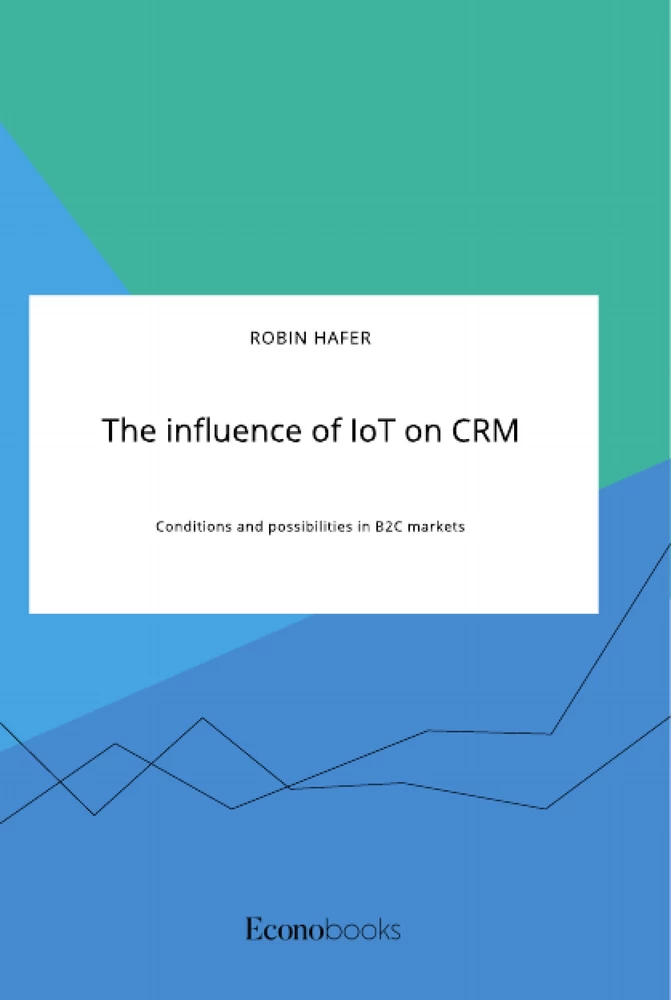
Table of Contents
1 Introduction
1.1 Purpose of the Thesis
1.2 Procedure and Research
2 Selected theoretical Aspects of the Internet of Things and Customer Relationship Management
2.1 Basic Principles of the Internet of Things
2.1.1 Definition and Concept
2.1.2 Opportunities for Application
2.1.2.1 Industrial Production
2.1.2.2 Smart Home
2.1.2.3 Smart City
2.1.2.4 Smart Grid
2.1.2.5 Healthcare
2.1.2.6 Transport and Logistic
2.1.2.7 Agriculture
2.1.2.8 Smart Store
2.1.3 Technological Functionality
2.1.3.1 Identification
2.1.3.2 Sensor networks
2.1.3.3 Communication
2.1.4 Detailed Examination of Big Data
2.1.5 Detailed Examination of Data Mining
2.1.6 Detailed Examination of Digital Footprint
2.2 Basic Principles of Customer Relationship Management
2.2.1 Definition and Concept
2.2.2 Elements of Customer Relationship Management
2.2.3 Strategic Consideration of Customer Relationship Management in the Corporate Context
2.2.4 Detailed Examination of the Customer Lifetime Value
2.2.5 Detailed Examination of Customer Loyalty
2.2.6 Detailed Examination of Customer Journey
3 Study of the Influence of the Internet of Things on Customer Relationship Management
3.1 Status Quo of Technology and its Dissemination
3.2 Presentation of relevant research results on the Internet of Things in Customer Relationship Management
3.2.1 Study 1: Use of the Smart Store for Persuasive Marketing and Immersive Customer Experiences
3.2.2 Study 2: Product Delivery Service Provider Selection and Customer Satisfaction in the Era of Internet of Things: A Chinese e-Retailer’s Perspective.
3.2.3 Study 3: Blending Internet-of-Things (IoT) Solutions into Relationship Marketing Strategies
3.3 Presentation and Analysis of first Implementation Attempts
3.3.1 Babolat’s “Smart Racquet”
3.3.2 Nike’s Smart Products
3.4 Effects on strategic Customer Retention through the Internet of Things
4 Conclusion
Objectives & Topics
This thesis examines the impact of the Internet of Things (IoT) on Customer Relationship Management (CRM) within business-to-consumer (B2C) markets. The primary goal is to identify strategies and practical options for organizations to integrate IoT technologies into their existing CRM systems to enhance customer engagement and retention.
- The theoretical foundations of IoT and CRM
- Key IoT application areas (e.g., Smart Home, Smart Retail)
- The role of data analytics and digital footprints in modern marketing
- Empirical analysis of IoT-driven CRM implementations in real-world case studies
Excerpt from the Book
3.3.1 Babolat’s “Smart Racquet”
Babolat is a French manufacturer for tennis, squash and badminton products. Founded in 1875, the company mainly focused on producing strings. Later in 1994, they changed the primary purpose in the production of racquets. Today Babolat is one of the leading companies in the business and till 2011 main sponsor of the French Open. Moreover, many high-class male and female players, like Raphael Nadal or Dominic Thiem, get sponsorships (Babolat 2019).
In 2014 the tennis equipment company Babolat offered a new kind of tennis racquet on the market (BBC 2014). This racquet has a chip included, which is connected to a smartphone and sends data about the play to the phone. Therefore, the player gathers information about the speed of serves, fore- and backhand play or the ball impact (Babolat 2019). This information should help the players to enhance their game. It can be part of the training session to analyse the racquet data to work on, for instance, slice balls or the speed of serves.
The function itself makes the customer loyal because Babolat has the competitive advantage to be the first on the market with that kind of service. Though, in this case, the racquet illustrates the door opener to the customer’s relationship. It is the needed product everybody needs, who wants to play tennis. However, using this digital feature, it is not possible to use that without the smartphone app. The app is free of charge and on both major platforms available, which means a low entrance barrier for customers to use this service.
Summary of Chapters
1 Introduction: This chapter defines the purpose of the thesis, outlining the evolution of connectivity and the shift towards IoT in the B2C sector, while establishing the central research questions regarding its impact on CRM.
2 Selected theoretical Aspects of the Internet of Things and Customer Relationship Management: This section provides a comprehensive overview of the fundamental technologies driving IoT, such as RFID and sensor networks, alongside the core principles of CRM, including customer lifetime value and the customer journey.
3 Study of the Influence of the Internet of Things on Customer Relationship Management: This chapter serves as the research component, presenting a qualitative content analysis of current IoT trends and specific case studies, such as the smart store concept, delivery service optimization, and smart product implementations by brands like Babolat and Nike.
4 Conclusion: The final chapter summarizes the findings, highlighting the enormous potential of IoT for personalized customer relationships while emphasizing the ongoing challenges regarding data security, interoperability, and the need for robust connectivity.
Keywords
Internet of Things, IoT, Customer Relationship Management, CRM, B2C, Smart Products, Customer Journey, Data Mining, Big Data, Customer Loyalty, Customer Lifetime Value, Digital Footprint, Retail Technology, Marketing Strategy
Frequently Asked Questions
What is the core focus of this research?
The research investigates how Internet of Things (IoT) technologies influence and transform Customer Relationship Management (CRM) within the B2C marketplace.
Which specific themes are covered in the work?
The work covers theoretical foundations of IoT and CRM, current technological developments, data analysis methods, and practical case studies showing how these technologies are applied in modern business.
What is the primary objective of this thesis?
The objective is to analyze the effects of IoT on CRM and to determine effective ways for organizations to implement these technologies to improve customer retention and experience.
What research methodology is employed?
The thesis utilizes a qualitative content analysis approach based on a detailed literature review and the study of specific real-world implementation examples.
What key topics are addressed in the main body?
The main body focuses on technology dissemination, the integration of smart products in retail, delivery service optimization, and how these factors impact strategic customer retention.
Which keywords best characterize the work?
The work is best characterized by terms such as IoT, CRM, B2C, Smart Store, Data Mining, Customer Journey, and Digital Transformation.
How does the "Smart Store" concept support CRM?
The smart store uses technologies like facial recognition, augmented reality, and smart hangers to collect real-time data on customer behavior, allowing for personalized marketing and improved store layout.
What role do Nike and Babolat play in the research?
Nike and Babolat serve as practical case studies to demonstrate how companies use IoT-connected products and platforms to build active communities and strengthen customer loyalty.
What are the primary challenges for IoT in CRM according to the author?
The author identifies significant challenges in the areas of data security, user privacy, the need for technical interoperability, and the requirement for robust high-performance connectivity.
Ende der Leseprobe aus 88 Seiten
- nach oben
- Arbeit zitieren
- Robin Hafer (Autor:in), 2020, The influence of IoT on CRM. Conditions and possibilities in B2C markets, München, Page::Imprint:: GRINVerlagOHG, https://www.diplomarbeiten24.de/document/504359

neugierig - aktuell - relevant
Entdecken Sie hilfreiche Tipps und Tricks rund ums Studium!

Entdecken Sie hilfreiche Tipps und Tricks rund ums Studium!
Ihre Hausarbeit / Abschlussarbeit:

- - Publikation als E-Book und Buch
- - Hohes Honorar auf die Verkäufe
- - Für Sie komplett kostenlos - mit ISBN
- - Es dauert nur 5 Minuten
- - Jede Arbeit findet Leser

- © GRIN Publishing GmbH.
- Alle Inhalte urheberrechtlich geschützt. Kopieren und verbreiten untersagt.
- info@grin.com
- AGB
- Open Publishing
Der GRIN Verlag hat sich seit 1998 auf die Veröffentlichung akademischer eBooks und Bücher spezialisiert. Der GRIN Verlag steht damit als erstes Unternehmen für User Generated Quality Content. Die Verlagsseiten GRIN.com, Hausarbeiten.de und Diplomarbeiten24 bieten für Hochschullehrer, Absolventen und Studenten die ideale Plattform, wissenschaftliche Texte wie Hausarbeiten, Referate, Bachelorarbeiten, Masterarbeiten, Diplomarbeiten, Dissertationen und wissenschaftliche Aufsätze einem breiten Publikum zu präsentieren.
Kostenfreie Veröffentlichung: Hausarbeit, Bachelorarbeit, Diplomarbeit, Dissertation, Masterarbeit, Interpretation oder Referat jetzt veröffentlichen!
Folgen Sie GRIN auf


- GRIN Verlag GmbH
-
- Nymphenburger Str. 86
- 80636
- Munich, Deutschland
- +49 89-550559-0
- +49 89-550559-10
- info@grin.com
-
