
präsentiert von

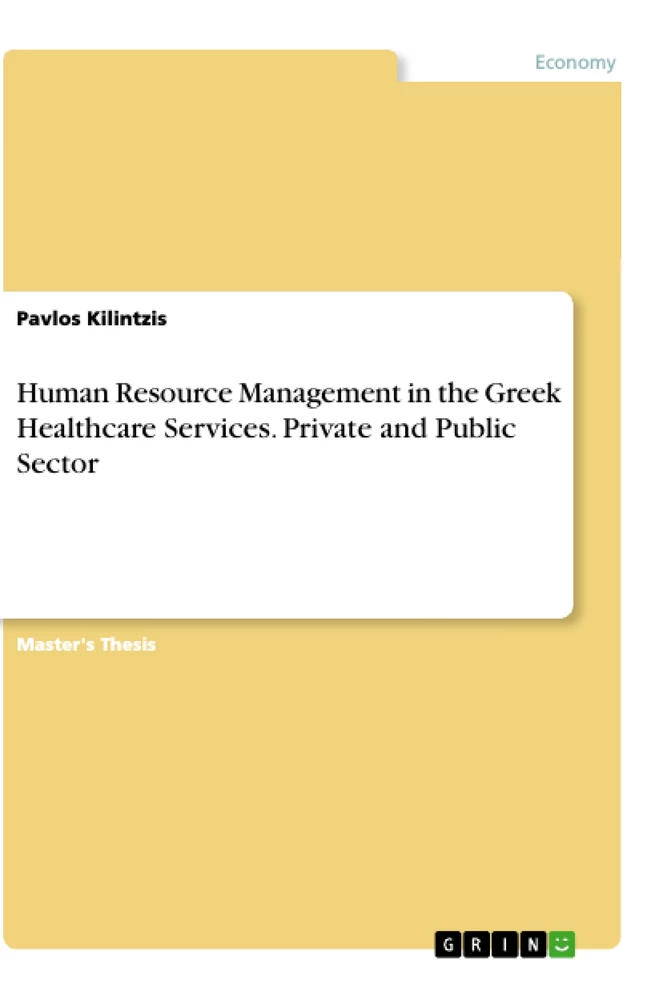
Table of Contents
1. INTRODUCTION
1.1 A Historical background of Human Resource Management (HRM)
1.2 HRM objectives – the evolution of Personnel Management
1.3 Analysis of HRM objectives
2. THE HUMAN RESOURCE FOR HEALTH (HRH)
2.1 The need for HRH development and health policies
2.2 Limitations of current approaches to HRM and workforce issues on health policies
2.3 The challenges of health systems reforms and the HRM in healthcare organizations
3. THE CASE OF GREECE
3.1 General frame and procedure of selection and recruitment
3.2 Training and Development
3.3 Performance Appraisal
3.4 Rewards – Awards
3.5 Labor Relations
3.6 Career and Evolution Ranking Scale
3.7 Disciplinary control system in the Public Health Sector
4. RESEARCH METHODOLOGY
5. RESEARCH AND DISCUSSION
5.1 Descriptive Statistics
5.2 Inferential Analysis
5.3 Study Limitations
6. CONCLUSION
Research Objective and Scope
The research aims to investigate and compare the operational efficiency of Human Resource Management (HRM) practices within the Greek public and private healthcare sectors, focusing on how these practices influence organizational performance and workforce management in the context of the Greek healthcare system.
- Comparison of HRM practices between public and private healthcare units.
- Evaluation of the five basic HRM objectives (recruitment, training, performance appraisal, rewards, labor relations).
- Statistical assessment of organizational efficiency and employee satisfaction.
- Identification of structural and legislative challenges affecting HRH in Greece.
Excerpt from the Book
1.1 A Historical background of Human Resource Management (HRM)
Human Resource Management (HRM) today is linked with multiple tasks such as manpower planning, recruitment and selection, employee motivation, performance monitoring and appraisal, industrial relations, provision management of employee benefits and employee training. However the base for its creation has been the need for increased employee performance during the twentieth century. At that time, the industrialists were constantly aiming at higher volumes of production, meaning higher profits and business growth. Employees were perceived as economic entities that had to be managed according to the general target of maximum production and growth. Human resource specialists at that time were developing their initial ideas of managing people, by only taking into consideration their contribution to maximized industrial output rather than any of the employee’s needs.
Scientific Management was first introduced by Frederick Taylor (1911). He was also investigating ways to improve efficiency and speed for the sake of maximized industrial output. But he was the first to connect employee’s characteristics and working conditions with those terms. According to Taylor, Scientific Management is simply a systematic analysis and breakdown of work into its smallest mechanical elements and rearranging them into their most efficient combination. In addition to the scientific study of the task itself, Taylor argued that individuals selected to perform the tasks should be as perfectly matched, physically and mentally to the requirements of the task as possible and that overqualified individuals should be excluded. Employees should also be trained carefully by supervisors to ensure that they performed the task exactly as specified by prior scientific analysis. A differential piece rate system was also advocated by Taylor to provide an incentive for employees to follow the detailed procedures, specified by supervisors.
Summary of Chapters
1. INTRODUCTION: Covers the evolution of HRM from early industrial concepts to modern strategic management and its five basic objectives.
2. THE HUMAN RESOURCE FOR HEALTH (HRH): Analyzes the specific needs for HRH policy development and the unique challenges faced in healthcare systems.
3. THE CASE OF GREECE: Describes the application of HRM within the Greek public and private healthcare frameworks, including relevant legislation.
4. RESEARCH METHODOLOGY: Details the research design, including the use of semi-structured questionnaires to collect comparative data.
5. RESEARCH AND DISCUSSION: Presents and analyzes the demographic and statistical data collected from both healthcare units.
6. CONCLUSION: Synthesizes the research findings, highlighting the superior performance of private sector HRM and suggesting potential improvements for the public sector.
Keywords
Human Resource Management, HRM, Greek Healthcare, Public Sector, Private Sector, Workforce Performance, Recruitment, Training and Development, Performance Appraisal, Reward System, Labor Relations, Healthcare Reform, HRH, Employee Satisfaction, Statistical Analysis.
Frequently Asked Questions
What is the core focus of this dissertation?
This work investigates and compares the implementation of Human Resource Management practices in the Greek public and private healthcare sectors.
What are the primary themes discussed in the paper?
Key themes include the evolution of personnel management, the unique needs of healthcare human resources (HRH), recruitment processes, performance evaluation, reward policies, and labor relations.
What is the main goal of the research?
The research aims to measure and quantify HRM effectiveness in Greek healthcare units to identify differences in operational efficiency between the public and private sectors.
Which scientific methodology is employed?
The study utilizes a semi-structured questionnaire distributed to employees in both a public insurance institution and a private healthcare facility, followed by a comparative statistical analysis.
What does the main part of the paper cover?
The main part covers the theoretical background of HRM, the regulatory framework of the Greek health system, the demographic profile of the respondents, and the numerical analysis of their responses regarding HRM practices.
Which keywords best describe this study?
Key terms include Human Resource Management, Greek Healthcare, Workforce Performance, Recruitment, Performance Appraisal, and Comparative Analysis.
How does the recruitment process differ between the sectors?
Public recruitment is highly regulated by state legislation and standardized meritocratic procedures, whereas the private sector is significantly more flexible and simplified.
What is the main finding regarding performance appraisal?
The research concludes that public sector employees perceive the current performance appraisal system as inefficient, whereas private sector employees generally view it as more meaningful and linked to their professional development.
What is the main limitation mentioned?
The study notes a relatively small sample size and the potential impact of the ongoing Greek financial crisis on the employees' responses during the survey period.
Ende der Leseprobe aus 92 Seiten
- nach oben
- Arbeit zitieren
- Pavlos Kilintzis (Autor:in), 2013, Human Resource Management in the Greek Healthcare Services. Private and Public Sector, München, Page::Imprint:: GRINVerlagOHG, https://www.diplomarbeiten24.de/document/504586

neugierig - aktuell - relevant
Entdecken Sie hilfreiche Tipps und Tricks rund ums Studium!

Entdecken Sie hilfreiche Tipps und Tricks rund ums Studium!
Ihre Hausarbeit / Abschlussarbeit:

- - Publikation als E-Book und Buch
- - Hohes Honorar auf die Verkäufe
- - Für Sie komplett kostenlos - mit ISBN
- - Es dauert nur 5 Minuten
- - Jede Arbeit findet Leser

- © GRIN Publishing GmbH.
- Alle Inhalte urheberrechtlich geschützt. Kopieren und verbreiten untersagt.
- info@grin.com
- AGB
- Open Publishing
Der GRIN Verlag hat sich seit 1998 auf die Veröffentlichung akademischer eBooks und Bücher spezialisiert. Der GRIN Verlag steht damit als erstes Unternehmen für User Generated Quality Content. Die Verlagsseiten GRIN.com, Hausarbeiten.de und Diplomarbeiten24 bieten für Hochschullehrer, Absolventen und Studenten die ideale Plattform, wissenschaftliche Texte wie Hausarbeiten, Referate, Bachelorarbeiten, Masterarbeiten, Diplomarbeiten, Dissertationen und wissenschaftliche Aufsätze einem breiten Publikum zu präsentieren.
Kostenfreie Veröffentlichung: Hausarbeit, Bachelorarbeit, Diplomarbeit, Dissertation, Masterarbeit, Interpretation oder Referat jetzt veröffentlichen!
Folgen Sie GRIN auf


- GRIN Verlag GmbH
-
- Nymphenburger Str. 86
- 80636
- Munich, Deutschland
- +49 89-550559-0
- +49 89-550559-10
- info@grin.com
-
