
präsentiert von

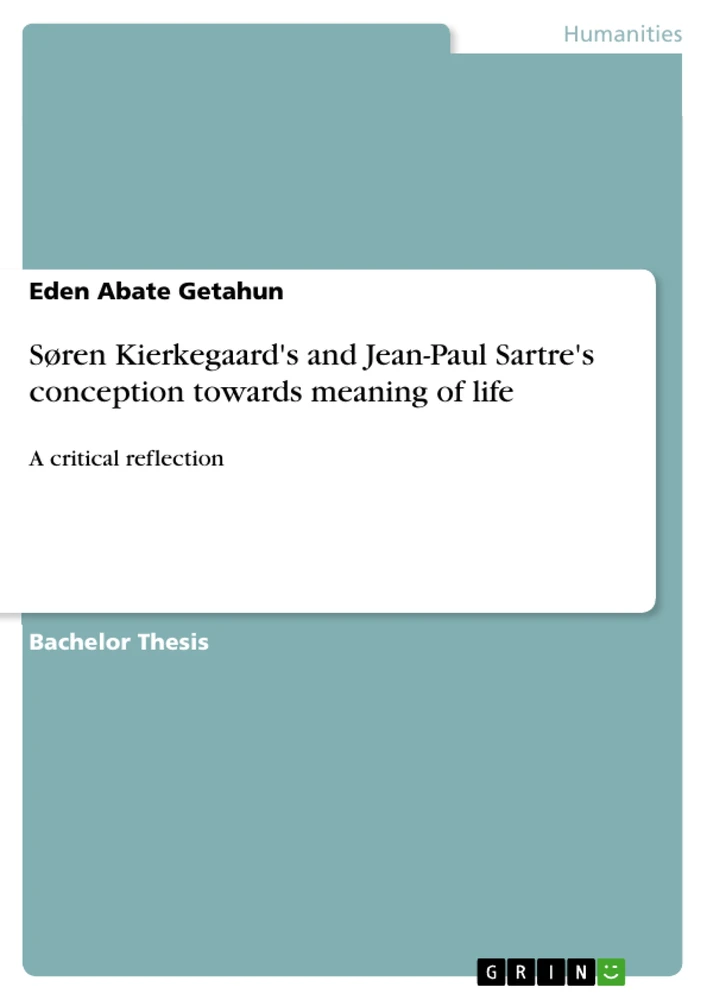
Table of Contents
1. GENERAL INTRODUCTION
2. THE ARGUMENTS OF SOME EXISTENTIALPHILOSOPHERS
2.1. EXISTENTIALIST IN RELATION TO MEANING OF LIFE
2.1.2. ARTHUR SCHOPENHAUER’S ARGUMENT
2.1.2. FRIEDRICH NIETZSCHE’S PERSPECTIVE
2.1.3 MARTIN HEIDEGGER’S ATTITUDE
2.1.4 ALBERT CAMUS’S ATTITUDE
3. SOREN KIERKEGAARD AND JEAN-PAUL-SARTRE ARGUMENTS
3.1. SOREN KIERKEGAARD’S ARGUMENT
3.2. JEAN-PAUL-SARTRE’S ARGUMENT
4. SUMMARY, REFELECTION AND CONCLUSION
Research Objectives & Key Themes
The primary objective of this essay is to critically analyze existentialist perspectives on the meaning of life, specifically contrasting the theistic existentialism of Soren Kierkegaard with the atheistic existentialism of Jean-Paul Sartre, while also incorporating the contributions of Schopenhauer, Nietzsche, Heidegger, and Camus to establish a foundational framework for the discussion.
- Analysis of existential nihilism and the inherent absurdity of existence.
- Contrast between theistic meaning (Kierkegaard) and atheistic construction of meaning (Sartre).
- The role of individual responsibility, freedom, and personal choice in defining life's purpose.
- The relationship between the search for meaning and the prevention of existential despair and suicide.
- The critical reflection on the importance of faith and subjectivity in the pursuit of a meaningful life.
Excerpt from the Book
ARTHUR SCHOPENHAUER’S ARGUMENT
Arthur Schopenhauer is the first western philosopher to link the ideas of life and meaning, and to ask expressly “what is the meaning of life?’’ At least he was the first to ask the question and get it noticed by other philosophers. He can be regarded as the springboard that launched modern western philosophical inquiry into the problem of the meaning of life.
Furthermore, in the question of meaning of life Schopenhauer posits a grim view that denies any inherent meaning to human existence whatsoever. Schopenhauer’s pessimistic philosophy is one of the first major western discourses on existential nihilism, or the philosophy which holds that meaning is absolutely absent from human life (Wardle, 2016) here is the passage in which Schopenhauer explicitly asked the question:
Since a man does not alter, and his moral character remains absolutely the same all through his life: since he must play out the part which he has received, without the least deviation from the character: since neither experience, nor philosophy, nor religion can effect any improvement in him, the question arises, what is the meaning of life at all? (O'Briem, 2017, p. 25)
Summary of Chapters
1. GENERAL INTRODUCTION: Provides the definition of existentialism, its historical emergence with Kierkegaard, and outlines the scope of the study regarding existence preceding essence.
2. THE ARGUMENTS OF SOME EXISTENTIALPHILOSOPHERS: Examines how Schopenhauer, Nietzsche, Heidegger, and Camus addressed the concept of meaning, setting the stage for deeper analysis.
3. SOREN KIERKEGAARD AND JEAN-PAUL-SARTRE ARGUMENTS: Offers a detailed comparison of Kierkegaard’s theistic focus on faith and Sartre’s atheistic focus on radical freedom and responsibility.
4. SUMMARY, REFELECTION AND CONCLUSION: Synthesizes the discussed arguments and presents the author’s final critical reflection on the subjective necessity of finding meaning through a relation to God.
Keywords
Existentialism, Meaning of Life, Soren Kierkegaard, Jean-Paul Sartre, Arthur Schopenhauer, Friedrich Nietzsche, Martin Heidegger, Albert Camus, Existential Nihilism, Existence precedes Essence, Subjectivity, Faith, Freedom, Absurdity, Theistic Existentialism.
Frequently Asked Questions
What is the core focus of this essay?
This work explores the philosophical question of the "meaning of life" through the lens of various existentialist thinkers, with a primary focus on comparing the arguments of Soren Kierkegaard and Jean-Paul Sartre.
What are the primary thematic areas covered?
The essay covers existential nihilism, the tension between faith and atheism, the concept of "existence preceding essence," the burden of radical freedom, and the necessity of finding purpose in an absurd world.
What is the central research question?
The research asks how human beings can define the meaning of life given the constraints of existence, specifically investigating if a meaningful life can exist without or within a religious framework.
Which scientific methods are utilized?
The paper utilizes a qualitative philosophical approach, involving critical text analysis, comparative study of major existentialist philosophers, and personal reflection on these theories.
What does the main body of the work address?
It provides an overview of Schopenhauer, Nietzsche, Heidegger, and Camus before diving into a specific, in-depth comparison of Kierkegaard's religious leap of faith and Sartre's atheistic view of absolute responsibility.
Which keywords best characterize this publication?
Key terms include Existentialism, Meaning of Life, Theistic vs. Atheistic Existentialism, Kierkegaard, Sartre, Subjectivity, and Human Freedom.
How does the author view the "existential vacuum"?
The author discusses this term in relation to Viktor Frankl and the feeling of aimlessness, suggesting that a lack of meaning often leads to despair and that a structured philosophy of life is required to combat it.
What is the author's final conclusion regarding the meaning of life?
The author concludes that while existence involves inherent challenges, it is highly possible to find meaning, and argues for a perspective rooted in a subjective yet committed relationship with God.
Ende der Leseprobe aus 46 Seiten
- nach oben
- Arbeit zitieren
- Eden Abate Getahun (Autor:in), 2019, Søren Kierkegaard's and Jean-Paul Sartre's conception towards meaning of life, München, Page::Imprint:: GRINVerlagOHG, https://www.diplomarbeiten24.de/document/505465

neugierig - aktuell - relevant
Entdecken Sie hilfreiche Tipps und Tricks rund ums Studium!

Entdecken Sie hilfreiche Tipps und Tricks rund ums Studium!
Ihre Hausarbeit / Abschlussarbeit:

- - Publikation als E-Book und Buch
- - Hohes Honorar auf die Verkäufe
- - Für Sie komplett kostenlos - mit ISBN
- - Es dauert nur 5 Minuten
- - Jede Arbeit findet Leser

- © GRIN Publishing GmbH.
- Alle Inhalte urheberrechtlich geschützt. Kopieren und verbreiten untersagt.
- info@grin.com
- AGB
- Open Publishing
Der GRIN Verlag hat sich seit 1998 auf die Veröffentlichung akademischer eBooks und Bücher spezialisiert. Der GRIN Verlag steht damit als erstes Unternehmen für User Generated Quality Content. Die Verlagsseiten GRIN.com, Hausarbeiten.de und Diplomarbeiten24 bieten für Hochschullehrer, Absolventen und Studenten die ideale Plattform, wissenschaftliche Texte wie Hausarbeiten, Referate, Bachelorarbeiten, Masterarbeiten, Diplomarbeiten, Dissertationen und wissenschaftliche Aufsätze einem breiten Publikum zu präsentieren.
Kostenfreie Veröffentlichung: Hausarbeit, Bachelorarbeit, Diplomarbeit, Dissertation, Masterarbeit, Interpretation oder Referat jetzt veröffentlichen!
Folgen Sie GRIN auf


- GRIN Verlag GmbH
-
- Nymphenburger Str. 86
- 80636
- Munich, Deutschland
- +49 89-550559-0
- +49 89-550559-10
- info@grin.com
-
