
präsentiert von

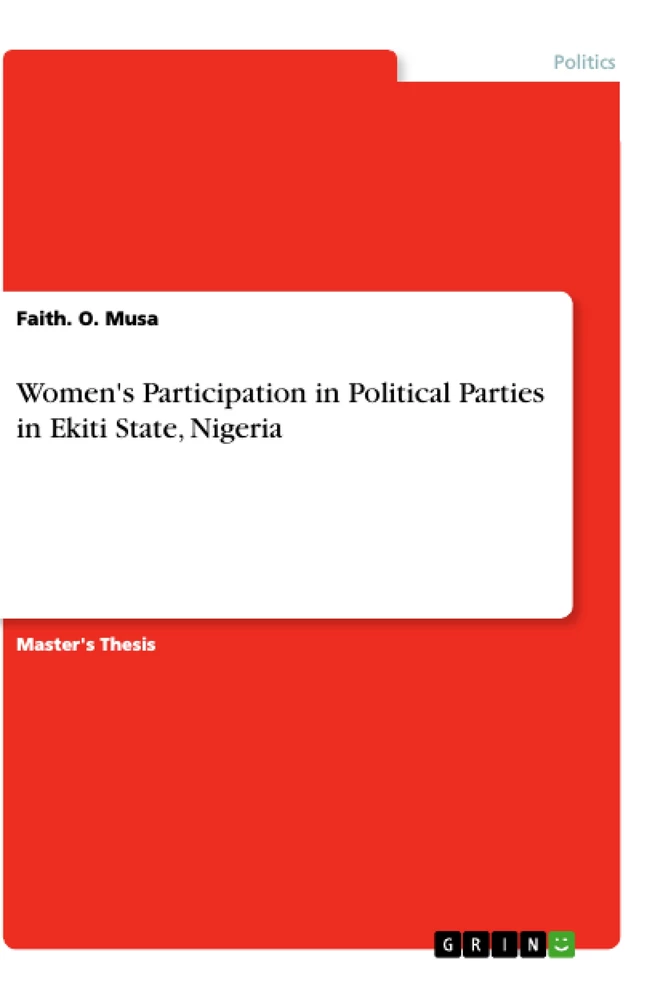
Table of Contents
1. INTRODUCTION
1.1 Background to the Study
1.2 Statement of the problem
1.3 Research Objectives
1.4 Research questions
1.5 Significance of the Study
1.6 Scope of the Study
1.7 Limitations of the Study
1.8 Definition of key Terms
1.9 Organization of the study
2. LITERATURE REVIEW
2.0 Preamble
2.1 Review of key concept
2.1.1 Political parties
2.1.2 Women participation in Politics
2.1.3 Women Empowerment
2.2 Review of Related Empirical Work
2.3 Gap in Literature
2.4 Theoretical Framework
2.4.1 Liberal Feminism
3. METHODOLOGY
3.0 Preamble
3.1 Research Design
3.2 Population o the Study
3.3 Sampling
3.4 Data Collection
3.5 Instrument of Data collection
3.6 Validity and Reliability
3.7 Ethical consideration
3.8 Data Analysis
4. DATA PRESENTATION AND ANALYSIS
4.0 Preamble
4.1 Description of Respondent
4.2 Result and Findings
4.2.1 The Status, Roles and Responsibilities of women in political parties
4.2.2 Women access to resources and benefits in their political parties
4.2.3 Extent to which political parties empower women
4.3 Discussion
5. SUMMARY CONCLUSION AND RECOMMENDATION
5.0 preamble
5.1 Summary of key findings
5.2 Contribution to knowledge
5.3 Conclusion
5.4 Recommendations
Research Objectives and Themes
The primary objective of this research is to evaluate the extent of women's participation in political parties within Ekiti State, Nigeria. It specifically investigates the diverse functions performed by women within these parties, assesses their access to political and economic empowerment resources, and determines how political party structures facilitate or hinder the representation and professional development of female members.
- Status, roles, and responsibilities of women within political parties.
- Women's access to financial, economic, and material resources within political parties.
- Evaluation of party-led empowerment programs and human capacity development.
- Theoretical analysis of Liberal Feminism in the context of political gender equality.
- Identification of barriers to women's participation and decision-making roles.
Excerpt from the Book
Mobilizing /Organizing Roles
Women leaders and women within the party play the role of mobilizing fellow women either before election or during the election campaign period. The women leaders mobilize women within their party during campaigns and rallies; mobilize non-members of their parties (women and men) to vote for the party; promote the qualities and competencies of their party’s candidates and explain party manifestos to people. Their major targets are where women often converge in a large number such as marketplaces and residential areas. This mobilizing role was mentioned in all the political parties interviewed. This mobilizing role was pointed out clearly by one of the participants from APA, “Women can go where men cannot penetrate and mobilize fellow women to vote for our party candidates, we need women to also contest for our party candidates”.
The interview also reveals how political parties engage women in their parties with the task of mobilizing in groups or as individuals during rallies. Furthermore, women are involved in creating awareness during the election period, within the local community, local government to the state capitals in road shows, street walking, where they sing and dance. This point was clearly expressed by one respondent:
"Recently, we did a road show mainly women, a women initiative for the forthcoming election we canvassed some local government Itapa, Oye, Ilupeju, Ikole, Ode and Omuo Ekitito create awareness for the party and encourage fellow women to vote for our party candidates"
Summary of Chapters
INTRODUCTION: Provides the background of partisan governance in Nigeria, the research problem regarding the underrepresentation of women in political decision-making, and defines the research scope and objectives.
LITERATURE REVIEW: Reviews key concepts such as political parties, women's political participation, and empowerment, while discussing the theoretical framework of Liberal Feminism to address structural gender barriers.
METHODOLOGY: Details the qualitative research design, including the use of in-depth interviews and focus group discussions with party members in Ekiti State to gather primary data.
DATA PRESENTATION AND ANALYSIS: Presents the empirical findings on women's roles, their access to resources within political parties, and the effectiveness of party-led empowerment initiatives.
SUMMARY CONCLUSION AND RECOMMENDATION: Concludes the study by synthesizing findings and offering recommendations for policy change, quota implementation, and mandatory training to improve women's political representation.
Key Words
Women's Participation, Political Parties, Ekiti State, Nigeria, Political Empowerment, Liberal Feminism, Decision-Making, Gender Equality, Resource Access, Mobilization, Human Capacity Development, Electoral Politics, Party Administration, Women Representation, Governance.
Frequently Asked Questions
What is the core focus of this research?
The research explores the participation, specific roles, and empowerment of women within political parties in Ekiti State, Nigeria, analyzing why they remain underrepresented in decision-making positions.
What are the primary themes investigated?
The study centers on the status of women in parties, their access to financial and material resources, their role in mobilization and organization, and the effectiveness of empowerment programs.
What is the overarching research goal?
The goal is to determine the actual functions of women in political parties and identify the obstacles preventing them from reaching the 35% representation quota mandated by global and national frameworks.
What research methodology was employed?
The study utilized a qualitative research design, incorporating in-depth interviews (IDI) and focus group discussions (FGD) across four major political parties in Ekiti State.
What does the main body of the work cover?
It covers theoretical frameworks of feminism, existing literature on women in politics, detailed presentation of field data, and an analysis of how political parties provide resources and training to their female members.
Which keywords define this study?
Keywords include Women's Participation, Political Parties, Ekiti State, Political Empowerment, Gender Equality, and Decision-Making.
How do women currently contribute to political parties in Ekiti State?
Findings show that women perform vital executive, mobilizing, spiritual, and intermediary roles, often acting as the bridge between the party executive and community members, even if decision-making power remains male-dominated.
What is the conclusion regarding women's empowerment in these parties?
While larger parties provide some economic and financial resources, access varies significantly, and parties often prioritize mobilizing and cheering roles over providing women with real influence in policy and candidate selection.
Ende der Leseprobe aus 80 Seiten
- nach oben
- Arbeit zitieren
- Faith. O. Musa (Autor:in), 2019, Women's Participation in Political Parties in Ekiti State, Nigeria, München, Page::Imprint:: GRINVerlagOHG, https://www.diplomarbeiten24.de/document/507228

neugierig - aktuell - relevant
Entdecken Sie hilfreiche Tipps und Tricks rund ums Studium!

Entdecken Sie hilfreiche Tipps und Tricks rund ums Studium!
Ihre Hausarbeit / Abschlussarbeit:

- - Publikation als E-Book und Buch
- - Hohes Honorar auf die Verkäufe
- - Für Sie komplett kostenlos - mit ISBN
- - Es dauert nur 5 Minuten
- - Jede Arbeit findet Leser

- © GRIN Publishing GmbH.
- Alle Inhalte urheberrechtlich geschützt. Kopieren und verbreiten untersagt.
- info@grin.com
- AGB
- Open Publishing
Der GRIN Verlag hat sich seit 1998 auf die Veröffentlichung akademischer eBooks und Bücher spezialisiert. Der GRIN Verlag steht damit als erstes Unternehmen für User Generated Quality Content. Die Verlagsseiten GRIN.com, Hausarbeiten.de und Diplomarbeiten24 bieten für Hochschullehrer, Absolventen und Studenten die ideale Plattform, wissenschaftliche Texte wie Hausarbeiten, Referate, Bachelorarbeiten, Masterarbeiten, Diplomarbeiten, Dissertationen und wissenschaftliche Aufsätze einem breiten Publikum zu präsentieren.
Kostenfreie Veröffentlichung: Hausarbeit, Bachelorarbeit, Diplomarbeit, Dissertation, Masterarbeit, Interpretation oder Referat jetzt veröffentlichen!
Folgen Sie GRIN auf


- GRIN Verlag GmbH
-
- Nymphenburger Str. 86
- 80636
- Munich, Deutschland
- +49 89-550559-0
- +49 89-550559-10
- info@grin.com
-
