
präsentiert von

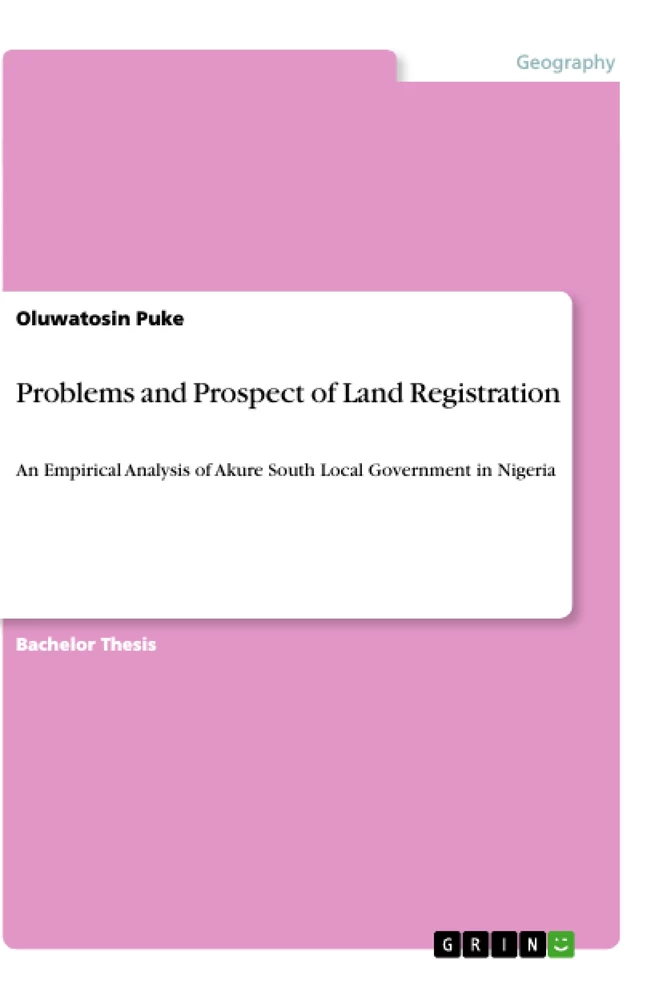
Table of Contents
1.0 Introduction
1.1 Background of Study
1.2 Research Problems
1.3 Aim and Objectives
1.4 Research justification
1.5 Research Question
1.6 Scope of the Study
1.7 The Study Area
2.0 Conceptual Framework And Literature Review
2.1 Introduction
2.2 Concept Of Land And Land Registration
2.2.1 Land
2.2.2 Land Registration
2.2.3 Adjudication
2.2.4 The Concept of Cadaster
2.2.5 Textual and Graphical Component of a Cadaster
2.3 Land Tenure
2.4 Cadastral Map and Land Rights
2.5 Land Administration and Cadaster in Nigeria
2.5.1 Land Right Management in Nigeria
2.5.2 Cadastral Mapping and Land Registration in Nigeria
2.5.3 Reforms in Land Registration and Cadastral Mapping in Nigeria
2.5.4 The National Cadastre Mapping Program
2.6 Geographic Information System and Remote Sensing
2.7 Geodatabase/Geo Spatial Database
2.8 Geographic Information System and Remote Sensing in Cadastral Mapping
2.9 Method Cadastral Mapping Using GIS
2.9.1 Preparation of Cadaster Base Map
2.9.1.1 Manual Digitizing from Analogue Maps
2.9.1.2 Scanning
2.9.1.3 Automatic Vectoriztaion
2.9.1.4 Heads-Up Digitizing
2.9.1.5 Coordinate Geometry (COGO)
2.9.1.6 Positioning Property Corners with GPS
2.10 Land Ownership in Nigeria
2.10.1 Land Ownership in Nigeria before the Colonial Rule
2.10.2 Land Ownership in Nigeria during the Colonial Rule
2.10.3 Land Ownership in Nigeria after Independence
2.10.4 The Land Tenure Law of 1962
2.10.5 The Land Use Act of 1978
2.10.6 Current Issues in Land Ownership in Nigeria
3.0 Research Methodology
3.1 Research Design
3.2 Sources Of Data Collection
3.2.1 Primary Data Source
3.2.2 Secondary Data Source
3.2.3 Use Of GIS
3.3 Research Population
3.4 Research Procedure
3.4.1 Sample Frame
3.4.2 Sample Size
3.4.3 Sample Technique
3.4.4 Sample Procedure
3.5 Data Collection
4.0 Discussion Of Findings
4.1 Respondent Socio-Economic Characteristics
4.1.1 Gender of Respondent
4.1.2 Age Distribution of Respondents
4.2 Analysis of Land Registration within Akure South
4.2.1 Land Owners
4.2.2 Plots Owned by Respondents
4.2.3 Time of Acquisition
4.2.4 Mode of Acquisition
4.2.5 Registered Lands
4.2.6 Challenges of Respondents
4.2.7 Respondents Opinion on Land Registration
4.2.8 Governments Approach to Land Registration
4.2.9 Human Related Challenges in Land registration Process
4.2.10 Government Discretion in Handling Public Information
4.2.11 Enforcement of Nigerian Laws Concerning Land Registration
4.2.12 Public Awareness on Land Registration
4.2.13 Land Dispute
4.2.14 Administrative Challenges
5.0 Recommendation and Conclusion
5.1 Summary of the Study
5.2 Recommendation
5.3 Conclusion
Research Objectives and Themes
This study aims to examine the current state of land registration in Akure South, Nigeria, identifying key challenges faced by land owners and evaluating potential prospects for an improved, more transparent, and efficient land administration system.
- Challenges within current land registration processes.
- Impact of the Land Use Act on land ownership.
- Role of GIS and digital technologies in land management.
- Socio-economic factors affecting land registration compliance.
- Strategies for public awareness and administrative reform.
Excerpt from the Book
1.1 Background of Study
Land registration generally describes systems by which matters concerning ownership, possession or other rights in land can be recorded to provide evidence of title, facilitate transactions and prevent unlawful disposal. It is also a system by which ownership of real property is established through the issuance of an official certificate indicating the name of the individual in whom such ownership is vested. Land registration according to Riddell (2000), Joireman (2006) is necessary to enhance capacity to defend individual rights of ownership where the need arises. Despite its huge benefits, it is sometimes mitigated by poor administrative procedures experienced by applicants. Meadow and Arnot (2006); Pienaar (2009) also affirm land administration in most parts of Africa, and especially land registration, is often associated with old, gray men shuffling around with maps and deeds which is unnecessarily time consuming, results in poor service delivery, delays in obtaining information, continual frustration of registry staff and opaque official procedures. Nigeria is not an exception to this; recognizing the problems, Lagos State Government in 2005 introduced the Electronic Document Management System (EDMS) with the main objectives of firstly storing all available data electronically; secondly, to ensure proper indexing of documents, to centralize and consolidate file storage, to make information available in an on-line real time manner and to set up an on-line document search and retrieval system at the registry.
Summary of Chapters
1.0 Introduction: This chapter introduces the core subject of land registration, outlining the research problem, objectives, and the scope of the study within Akure South.
2.0 Conceptual Framework And Literature Review: This section reviews existing literature on land registration, cadastral systems, land tenure, and the evolution of land laws in Nigeria.
3.0 Research Methodology: This chapter details the research design, data collection methods, population sampling techniques, and the procedure used to gather information from respondents.
4.0 Discussion Of Findings: This chapter analyzes the gathered data regarding respondent socio-economic characteristics and their specific experiences with land registration challenges.
5.0 Recommendation and Conclusion: The final chapter summarizes findings, provides strategic recommendations for government action, and concludes on the prospects for improved land management.
Keywords
Land Registration, Cadastre, Land Tenure, Akure South, GIS, Land Use Act, Land Ownership, Property Rights, Adjudication, Digital Mapping, Land Administration, Socio-Economic Development, Statutory Right of Occupancy, Nigeria.
Frequently Asked Questions
What is the primary focus of this research?
The research focuses on identifying the challenges and prospects of land registration within the Akure South local government area of Ondo State, Nigeria.
What are the core themes addressed in the study?
The study addresses land ownership rights, the impact of administrative hurdles, the transition from manual to digital record-keeping, and the effectiveness of current government land policies.
What is the central research goal?
The main goal is to evaluate the factors contributing to registration challenges and to propose effective strategies for a more reliable, efficient land administration system.
Which methodology does the author employ?
The author uses a descriptive research method, combining quantitative surveys (structured questionnaires distributed to property owners) with qualitative in-depth interviews conducted with ministry staff.
What topics are discussed in the main body?
The main body covers the conceptual framework of cadastre and land registration, the historical evolution of Nigerian land laws, analysis of field data, and administrative bottlenecks.
Which keywords define this work?
Key terms include Land Registration, Cadastre, Land Tenure, GIS, Land Use Act, and Property Rights.
How does the Land Use Act of 1978 affect land registration in Nigeria?
The Act vests all land within a state in the Governor, changing the nature of individual land rights to a statutory right of occupancy and creating specific processes for alienation and transfer that influence current registration practices.
What role does the "Electronic Document Management System" (EDMS) play in this study?
The EDMS is presented as a crucial technological solution to replace outdated paper-based, time-consuming filing methods, aimed at improving data storage, indexing, and retrieval efficiency.
Ende der Leseprobe aus 85 Seiten
- nach oben
- Arbeit zitieren
- Oluwatosin Puke (Autor:in), 2017, Problems and Prospect of Land Registration, München, Page::Imprint:: GRINVerlagOHG, https://www.diplomarbeiten24.de/document/510382

neugierig - aktuell - relevant
Entdecken Sie hilfreiche Tipps und Tricks rund ums Studium!

Entdecken Sie hilfreiche Tipps und Tricks rund ums Studium!
Ihre Hausarbeit / Abschlussarbeit:

- - Publikation als E-Book und Buch
- - Hohes Honorar auf die Verkäufe
- - Für Sie komplett kostenlos - mit ISBN
- - Es dauert nur 5 Minuten
- - Jede Arbeit findet Leser

- © GRIN Publishing GmbH.
- Alle Inhalte urheberrechtlich geschützt. Kopieren und verbreiten untersagt.
- info@grin.com
- AGB
- Open Publishing
Der GRIN Verlag hat sich seit 1998 auf die Veröffentlichung akademischer eBooks und Bücher spezialisiert. Der GRIN Verlag steht damit als erstes Unternehmen für User Generated Quality Content. Die Verlagsseiten GRIN.com, Hausarbeiten.de und Diplomarbeiten24 bieten für Hochschullehrer, Absolventen und Studenten die ideale Plattform, wissenschaftliche Texte wie Hausarbeiten, Referate, Bachelorarbeiten, Masterarbeiten, Diplomarbeiten, Dissertationen und wissenschaftliche Aufsätze einem breiten Publikum zu präsentieren.
Kostenfreie Veröffentlichung: Hausarbeit, Bachelorarbeit, Diplomarbeit, Dissertation, Masterarbeit, Interpretation oder Referat jetzt veröffentlichen!
Folgen Sie GRIN auf


- GRIN Verlag GmbH
-
- Nymphenburger Str. 86
- 80636
- Munich, Deutschland
- +49 89-550559-0
- +49 89-550559-10
- info@grin.com
-
