
präsentiert von

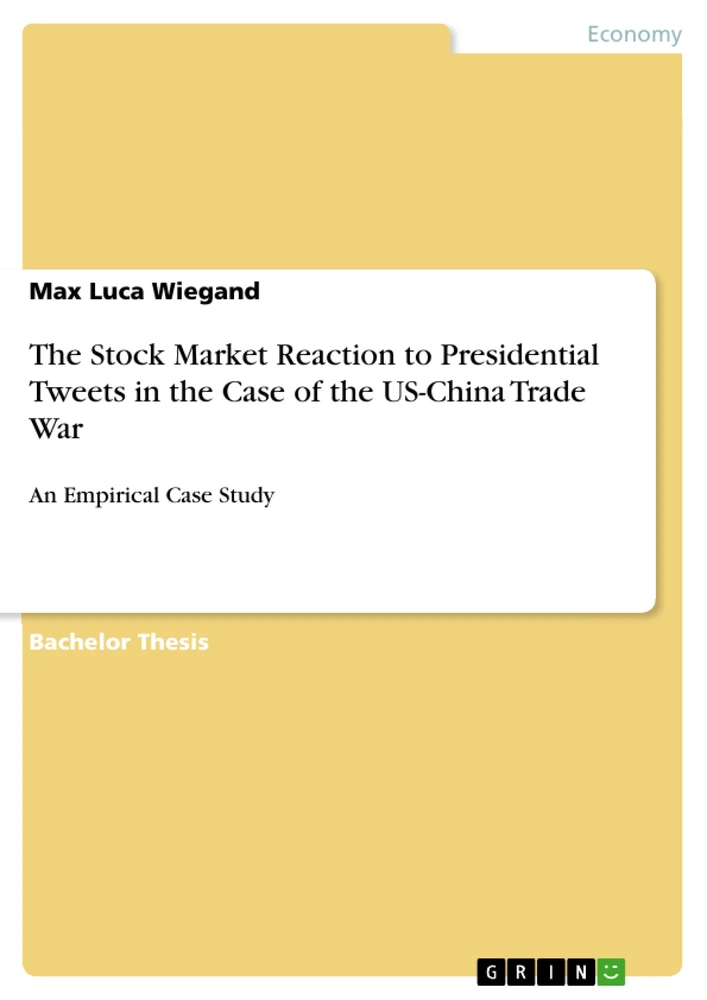
Table of Contents
1 Introduction
2 Literature review
2.1 Financial markets’ reaction to new information
2.2 The impact of macroeconomic announcements on U.S. stock markets
3 Event Study
3.1 Event Review – the US-China trade war
3.1.1 Emergence and sources of conflict
3.1.2 Development and imposed tariffs
3.2 Methodology and theoretical framework
3.2.1 Assumptions
3.2.2 Event definition and selection criteria
3.2.3 Event window, post-event window and estimation window
3.2.4 Expected return models and (cumulative) abnormal returns
3.2.5 Null hypothesis and statistical validation
3.3 Data description
4 Discussion of results
4.1 Events’ impacts on aggregated stock market valuations
4.2 Events’ impacts on stock markets on a country level
4.2.3 U.S. American stock market – S&P 500
4.2.4 Chinese stock market – Hang Seng Index
4.2.5 German stock market – DAX
4.3 Overview and conclusion
4.4 Quality of the study and limitations
5 Conclusion and areas of future research
Objectives and Research Themes
This thesis examines the impact of Donald Trump’s Twitter activity concerning the US-China trade dispute on international stock market indices (S&P 500, HSI, and DAX) to determine if impulsive social media messages act as a causal driver for market movements.
- Application of the event study methodology to assess market responsiveness to presidential tweets.
- Categorization of tweets into positive, negative, and neutral sentiment classes.
- Comparative analysis of stock market reactions across the United States, China, and Germany.
- Evaluation of market efficiency and the speed of information processing in modern financial markets.
Excerpt from the Book
3.1.1 Emergence and sources of conflict
On August 14, 2017, president Donald Trump (p. 1) wrote in a memorandum to the Office of the United States Trade Representative8 (USTR):
“China has implemented laws, policies, and practices and has taken actions related to intellectual property, innovation, and technology that may encourage or require the transfer of American technology and intellectual property to enterprises in China or that may otherwise negatively affect American economic interests.”
He subsequently instructed the government agency to determine whether to investigate those circumstances under Section 301 of the U.S. Trade Act of 19749. Said investigation was initiated shortly thereafter, and yielded the formal argumentative basis for the first round of tariffs on behalf of the United States. Amongst others, USTR (2018) confirmed both regulatory and administrative restrictions on foreign investments on the part of China with the purpose to pressure companies into transferring technology, as well as government backed cyber-attacks into U.S. commercial networks. By gaining unauthorized access to a wide range of sensitive information for over a decade, China had committed theft of intellectual property and other confidential business information. In consequence of those allegations, Trump regularly refers to the U.S.’ massive and long-standing trade deficit – it accumulated to a total of $375.4 Bn. by the end of 2017 and even $419.5 Bn. by the end of 2018 (United States Census Bureau, n.d.; see Appendix A) – as a result of unfair trade practices exercised by China.
Summary of Chapters
1 Introduction: This chapter introduces the rise of presidential communication via Twitter and outlines the research objective of analyzing the causal link between Trump's trade-related tweets and global stock market volatility.
2 Literature review: This section provides a theoretical foundation by discussing the efficient-market hypothesis (EMH), random walk theory, and the documented impact of macroeconomic announcements on asset prices.
3 Event Study: This chapter reviews the US-China trade war, defines the methodological framework including event windows and return models, and describes the data collection process.
4 Discussion of results: This section evaluates the findings across the aggregate market level and country-specific indices, identifying patterns of responsiveness and testing for statistical significance.
5 Conclusion and areas of future research: This final chapter summarizes the results, confirming significant market impacts, and suggests future research directions, particularly focusing on behavioral finance.
Keywords
Event study, Donald Trump, Twitter, US-China trade war, Stock market, S&P 500, Hang Seng Index, DAX, Efficient-market hypothesis, Abnormal return, Trade tariffs, Sentiment analysis, Financial markets, Asset pricing, Behavioral finance
Frequently Asked Questions
What is the core focus of this research?
The paper examines whether unscheduled, impulsive tweets from U.S. President Donald Trump regarding the US-China trade war influence international stock market valuations.
Which stock markets are analyzed in this study?
The study analyzes the U.S. American S&P 500, the Chinese Hang Seng Index (HSI), and the German DAX.
What is the primary goal of this thesis?
The goal is to determine if market participants perceive presidential tweets as significant news that causes abnormal returns, thereby testing market efficiency in the context of social media communication.
Which methodology is employed?
The author utilizes an event study methodology to measure the impact of ten selected tweets on asset prices, using a constant-mean-return model (CMRM) to calculate abnormal returns.
What topics are covered in the main body?
The main body covers the development of the US-China trade conflict, the theoretical framework for the event study, and a detailed discussion of the results for each index and the aggregated market.
Which keywords best describe the research?
Key terms include Event study, stock market reaction, sentiment analysis, efficient-market hypothesis, and presidential communication.
How does the Hang Seng Index differ in its reaction from the S&P 500?
The study finds that the HSI shows higher responsiveness and significant reactions to all classes of tweets, including neutral ones, whereas the S&P 500 (Trump’s native market) appears the least responsive.
What role does the DAX play in this study?
The DAX serves as a proxy for the German market, acting as an important intercontinental trade partner for both the U.S. and China, and demonstrating moderate market responsiveness compared to the other two indices.
Ende der Leseprobe aus 53 Seiten
- nach oben
- Arbeit zitieren
- Max Luca Wiegand (Autor:in), 2019, The Stock Market Reaction to Presidential Tweets in the Case of the US-China Trade War, München, Page::Imprint:: GRINVerlagOHG, https://www.diplomarbeiten24.de/document/511509

neugierig - aktuell - relevant
Entdecken Sie hilfreiche Tipps und Tricks rund ums Studium!

Entdecken Sie hilfreiche Tipps und Tricks rund ums Studium!
Ihre Hausarbeit / Abschlussarbeit:

- - Publikation als E-Book und Buch
- - Hohes Honorar auf die Verkäufe
- - Für Sie komplett kostenlos - mit ISBN
- - Es dauert nur 5 Minuten
- - Jede Arbeit findet Leser

- © GRIN Publishing GmbH.
- Alle Inhalte urheberrechtlich geschützt. Kopieren und verbreiten untersagt.
- info@grin.com
- AGB
- Open Publishing
Der GRIN Verlag hat sich seit 1998 auf die Veröffentlichung akademischer eBooks und Bücher spezialisiert. Der GRIN Verlag steht damit als erstes Unternehmen für User Generated Quality Content. Die Verlagsseiten GRIN.com, Hausarbeiten.de und Diplomarbeiten24 bieten für Hochschullehrer, Absolventen und Studenten die ideale Plattform, wissenschaftliche Texte wie Hausarbeiten, Referate, Bachelorarbeiten, Masterarbeiten, Diplomarbeiten, Dissertationen und wissenschaftliche Aufsätze einem breiten Publikum zu präsentieren.
Kostenfreie Veröffentlichung: Hausarbeit, Bachelorarbeit, Diplomarbeit, Dissertation, Masterarbeit, Interpretation oder Referat jetzt veröffentlichen!
Folgen Sie GRIN auf


- GRIN Verlag GmbH
-
- Nymphenburger Str. 86
- 80636
- Munich, Deutschland
- +49 89-550559-0
- +49 89-550559-10
- info@grin.com
-
