
präsentiert von

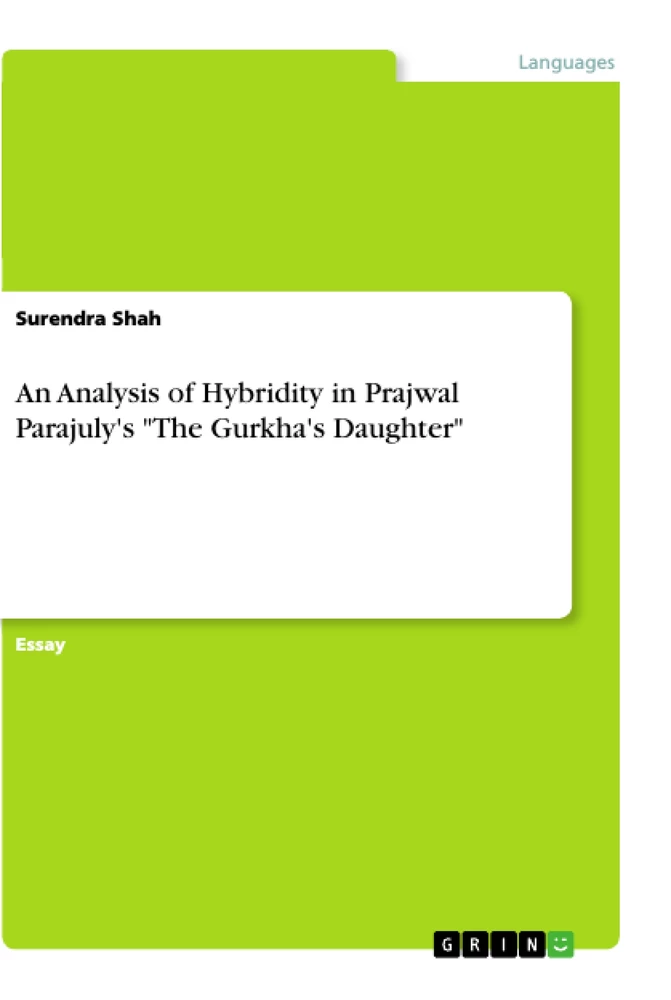
Table of Contents
1. Abstract
2. Introduction
3. Review of Literature
4. Theoretical Framework
5. Analysis
5.1 The Cleft
5.2 Missed Blessing
5.3 The Immigrants
6. Conclusion
7. Works Cited
Research Objectives and Themes
This paper explores how the characters in Prajwal Parajuly’s short story collection "The Gurkha’s Daughter" utilize hybrid cultural practices as a survival strategy when navigating unfamiliar environments in host countries. By analyzing the negotiation of language, social norms, religion, and lifestyle, the study seeks to reveal how characters construct a "third space" of identity to facilitate their acceptance and survival.
- Exploration of hybridity as a deliberate survival mechanism.
- Examination of cultural adaptation and negotiation in diasporic contexts.
- Analysis of the interplay between Nepali and English/Western cultural conventions.
- Identification of hybrid identity formation through language and social practice.
Excerpt from the Book
Hybridity in Prajwal Parajuly’s The Gurkha’s Daughter
In the short stories, The Gurkha’s Daughter (2012), Prajwal Parajuly concerns characters survival through cultural practices between Nepali and English convention as hybridity in a host country. The characters of these stories immigrate to the host country with some purpose where they develop hybrid cultural space. They seem to have difficulty in coping with the host culture and the country because of which they start to negotiate and adapt new language, behavior, religion, lifestyle, relationship etc. In order to show the presence of hybrid cultural space, different hybrid elements from the stories were identified and reasoned for hybridity. Hybrid is a word termed by Homi K. Bhabha which gives rise to new and unidentifiable cultural identity that has negotiation of meaning and representation. Hybridity is a product of adaptation and negotiation that is developed by immigrants in a host country for acceptance by the host community or for survival.
Chapter Summary
Abstract: Provides a concise overview of the research focus on characters' survival through hybrid cultural practices in Prajwal Parajuly's work.
Introduction: Outlines the research scope, detailing the focus on three specific stories ("The Cleft", "Missed Blessing", and "The Immigrants") and the application of Bhabha's hybridity theory.
Review of Literature: Summarizes various critical perspectives on the collection, highlighting existing themes like diaspora and class struggle while identifying the gap regarding hybrid identity.
Theoretical Framework: Defines Homi K. Bhabha’s concept of "Hybridity" and its application as a method to interpret the characters' cross-cultural negotiations.
Analysis: Examines specific story narratives where characters negotiate cultural differences in language, religion, and living arrangements to survive in their respective host environments.
Conclusion: Synthesizes the findings, confirming that hybridity serves as an inevitable survival strategy for the immigrant characters in the stories.
Works Cited: Lists the academic and secondary sources used to support the research arguments.
Keywords
Community, Culture, Immigrants, Hybridity, Negotiation, Adaptation, Survival, Host Country, Diaspora, Identity Crisis, Ethnicity, Social Reality.
Frequently Asked Questions
What is the primary subject of this research paper?
The paper fundamentally explores the theme of "hybridity" in Prajwal Parajuly’s short story collection "The Gurkha’s Daughter", specifically focusing on how immigrants use it as a survival strategy.
What are the central thematic fields addressed?
The work covers diaspora, cultural negotiation, survival, identity formation, socio-economic challenges, and the adaptation of religious and social norms in foreign environments.
What is the primary objective of the study?
The goal is to reveal the rationale behind characters adopting and negotiating foreign cultural norms, language, and lifestyles, thereby creating a hybrid cultural space.
Which theoretical approach is applied in this paper?
The study utilizes the concept of "Hybridity" as defined by the postcolonial theorist Homi K. Bhabha to interpret the behavior and development of the selected characters.
What content is covered in the main section?
The main section analyzes three specific stories: "The Cleft", "Missed Blessing", and "The Immigrants", examining how characters in each navigate their specific social and cultural crises.
Which keywords best characterize the work?
Key terms include Community, Culture, Immigrants, Hybridity, Negotiation, Adaptation, Survival, and Host Country.
How does the character Erin in "The Cleft" demonstrate hybridity?
Erin navigates the host culture by learning to recite Hindu Shlokas and adopting Nepali customs, such as being called "Aamaa", to facilitate her integration and acceptance within the local community.
Why do Michael and Christa in "Missed Blessing" adopt Nepali cultural practices?
They adopt the local lifestyle and learn fluent Nepali primarily to bridge the cultural gap and make their missionary goal of preaching and spreading Christianity more acceptable to the local population.
How does the concept of "living together" in "The Immigrants" signify hybridity?
The characters Amit and Sabitri adopt the Western practice of living together—which contradicts traditional Hindu norms—as a pragmatic survival strategy to overcome personal, economic, and social challenges in the U.S.
Ende der Leseprobe aus 28 Seiten
- nach oben
- Arbeit zitieren
- Surendra Shah (Autor:in), 2019, An Analysis of Hybridity in Prajwal Parajuly's "The Gurkha's Daughter", München, Page::Imprint:: GRINVerlagOHG, https://www.diplomarbeiten24.de/document/512212

neugierig - aktuell - relevant
Entdecken Sie hilfreiche Tipps und Tricks rund ums Studium!

Entdecken Sie hilfreiche Tipps und Tricks rund ums Studium!
Ihre Hausarbeit / Abschlussarbeit:

- - Publikation als E-Book und Buch
- - Hohes Honorar auf die Verkäufe
- - Für Sie komplett kostenlos - mit ISBN
- - Es dauert nur 5 Minuten
- - Jede Arbeit findet Leser

- © GRIN Publishing GmbH.
- Alle Inhalte urheberrechtlich geschützt. Kopieren und verbreiten untersagt.
- info@grin.com
- AGB
- Open Publishing
Der GRIN Verlag hat sich seit 1998 auf die Veröffentlichung akademischer eBooks und Bücher spezialisiert. Der GRIN Verlag steht damit als erstes Unternehmen für User Generated Quality Content. Die Verlagsseiten GRIN.com, Hausarbeiten.de und Diplomarbeiten24 bieten für Hochschullehrer, Absolventen und Studenten die ideale Plattform, wissenschaftliche Texte wie Hausarbeiten, Referate, Bachelorarbeiten, Masterarbeiten, Diplomarbeiten, Dissertationen und wissenschaftliche Aufsätze einem breiten Publikum zu präsentieren.
Kostenfreie Veröffentlichung: Hausarbeit, Bachelorarbeit, Diplomarbeit, Dissertation, Masterarbeit, Interpretation oder Referat jetzt veröffentlichen!
Folgen Sie GRIN auf


- GRIN Verlag GmbH
-
- Nymphenburger Str. 86
- 80636
- Munich, Deutschland
- +49 89-550559-0
- +49 89-550559-10
- info@grin.com
-
