
präsentiert von

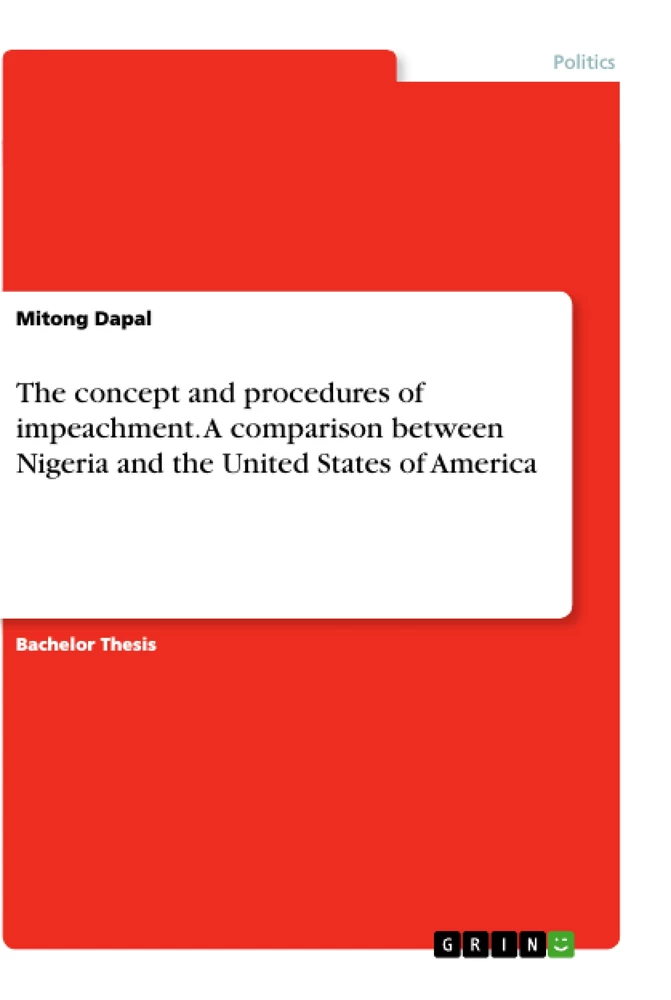
Table of Contents
1. GENERAL INTRODUCTION
1.1 BACKGROUND OF THE STUDY
1.2 STATEMENT OF THE PROBLEM
1.3 AIM AND OBJECTIVES OF THE STUDY
1.4 SCOPE AND LIMITATION OF THE STUDY
1.5 SIGNIFICANCE OF THE STUDY
1.6 RESEARCH METHODOLOGY
1.7 LITERATURE REVIEW
1.8 SYNOPSIS OF CHAPTERS
2. CONCEPTUAL FOUNDATION/HISTORICAL DEVELOPMENT
2.1 HISTORY OF IMPEACHMENT
2.2 CONCEPT OF IMPEACHMENT IN THE UNITED STATES OF AMERICA
2.3 CONCEPT OF REMOVAL FROM OFFICE IN NIGERIA
2.4 DEFINITION OF IMPEACHMENT
3. LEGAL FRAMEWORK FOR IMPEACHMENT IN NIGERIA AND THE UNITED STATES OF AMERICA
3.1 IMPEACHMENT IN NIGERIA
3.2 IMPEACHMENT IN THE UNITED STATES OF AMERICA
3.3. GROUNDS FOR IMPEACHMENT IN NIGERIA
3.4. GROUNDS FOR IMPEACHMENT IN THE UNITED STATES OF AMERICA
3.5. PROCEDURE FOR IMPEACHMENT IN NIGERIA
3.6. PROCEDURE FOR IMPEACHMENT IN THE UNITED STATES OF AMERICA
4. COMPARATIVE ANALYSIS OF IMPEACHMENT IN NIGERIA AND THE UNITED STATES OF AMERICA
4.1. THE ATTITUDE OF NIGERIAN COURTS TOWARDS IMPEACHMENTS
4.2. THE ATTITUDE OF COURTS IN THE UNITED STATES` OF AMERICA TOWARDS IMPEACHMENT
4.3. ANALYSIS OF THE PROCEDURE FOR IMPEACHMENT IN NIGERIA AND THE UNITED STATES OF AMERICA
5. CONCLUSION
5.1 SUMMARY OF FINDINGS
5.2 OBSERVATION
5.3 SUGGESTION AND RECOMMENDATIONS
5.4 CONTRIBUTION TO KNOWLEDGE
5.5 CONCLUSION
Objectives and Research Themes
The primary objective of this research is to provide a comparative analysis of the concept and procedures of impeachment within the legal frameworks of Nigeria and the United States of America. It aims to identify the procedural lapses in both jurisdictions and explore the judiciary's role in governing these political processes.
- Comparative analysis of impeachment procedures in Nigeria and the U.S.
- Examination of the "gross misconduct" doctrine versus U.S. constitutional high crimes.
- Evaluation of judicial interventions and the application of ouster clauses.
- Identification of legislative abuses of the impeachment mechanism.
- Development of recommendations for institutional and constitutional reform.
Excerpts from the Book
1.1 BACKGROUND OF THE STUDY
The presidential system of government is simply a democratic (government of the people, for the people and by the people) and republican (a state where supreme power is held by the people through their elected representatives which has an elected or nominated president rather than a monarch) system of government where a head of government leads an executive branch that is separate from the legislative branch and the judicial branch. The presidential system is deeply rooted in the foundations of the doctrine of separation of power propounded by French philosopher Baron de Montesquieu, which posits that to ensure that each arm of government – executive, legislature and judiciary; performs a distinctive function in order to avoid consolidation of the powers of governance into one hand which is capable of promoting tyranny and accentuate human rights violations.
Fundamentally, Montesquieu advocated that the legislature must make the law, the executive to execute the law made by legislature and the judiciary to interpret the laws in the case of ambiguity or where the law is sought to be interpreted. This will in a great way reduce the abuse of power.
However, due to the interdependent nature of the three arms of government, it became important for any government to align itself with the doctrine of checks and balances as formulated by A.V. Dicey. The only remedy to abuse of power is the effective employment of the principle of checks and balances within the three arms of government. As it is found in the presidential system of government, when officials of government are elected or appointed into their respective offices and they serve the will of the electorates for the term they have been elected or for the term allowed by the law in place.
Summary of Chapters
1. GENERAL INTRODUCTION: Provides the foundational context of the presidential system, separation of powers, and defines the research problem regarding impeachment.
2. CONCEPTUAL FOUNDATION/HISTORICAL DEVELOPMENT: Traces the historical evolution of impeachment from its British roots to its specific application in Nigeria and the United States.
3. LEGAL FRAMEWORK FOR IMPEACHMENT IN NIGERIA AND THE UNITED STATES OF AMERICA: Details the specific constitutional procedures and legal requirements for removing executive officers at both federal and state levels.
4. COMPARATIVE ANALYSIS OF IMPEACHMENT IN NIGERIA AND THE UNITED STATES OF AMERICA: Evaluates the judiciary’s stance toward impeachment and compares similarities and differences between the two legal systems.
5. CONCLUSION: Summarizes research findings, observations, and provides actionable recommendations for constitutional reform to prevent the abuse of the impeachment process.
Keywords
Impeachment, Removal from Office, Constitution, Nigeria, United States of America, Gross Misconduct, Separation of Powers, Checks and Balances, Judiciary, Legislature, Ouster Clause, Due Process, Fair Hearing, Political Stability, Constitutionalism
Frequently Asked Questions
What is the primary focus of this academic work?
This work focuses on the constitutional and political procedures for removing executive officers from office in Nigeria and the United States, specifically analyzing how the legislature utilizes impeachment powers.
What is the core research objective?
The core objective is to critically compare the impeachment frameworks of Nigeria and the U.S. to identify procedural gaps and suggest reforms to prevent political abuse.
How is "gross misconduct" defined in the Nigerian context?
It is defined broadly as a grave violation of the constitution, leaving the determination largely to the subjective discretion of the state or national legislature.
What methodology is employed in this research?
The author employs a doctrinal method of legal research, relying on primary constitutional sources, case law, and secondary academic commentary.
How does the role of the judiciary differ between the two countries?
Nigerian courts often interpret ouster clauses narrowly to ensure procedural compliance (like fair hearing), whereas U.S. courts typically view impeachment as a non-justiciable political question.
What is the significance of the "ouster clause" in this study?
The ouster clause is central as it aims to bar judicial review of impeachment, posing a conflict between legislative autonomy and the protection of constitutional rights.
Does the book distinguish between "impeachment" and "removal from office"?
Yes, especially in the Nigerian context, the author clarifies that impeachment is the formal preference of charges, while removal is the ultimate consequence following a specific constitutional process.
What is the significance of the case "Inakoju v Adeleke"?
It is a landmark case cited to distinguish between impeachment and removal, and to assert that procedural conditions precedent must be met for an ouster clause to be effective.
Why did the impeachment process against President Obasanjo fail?
The author notes that political pressure from various interest groups caused the National Assembly to abandon the process before a formal investigation could be conducted.
What recommendations does the author propose for reform?
The author suggests defining "gross misconduct" more precisely, allowing judicial review of the impeachment procedure, and banning impeached officials from future political contest if found guilty of significant misconduct.
Ende der Leseprobe aus 103 Seiten
- nach oben
- Arbeit zitieren
- Mitong Dapal (Autor:in), 2019, The concept and procedures of impeachment. A comparison between Nigeria and the United States of America, München, Page::Imprint:: GRINVerlagOHG, https://www.diplomarbeiten24.de/document/512624

neugierig - aktuell - relevant
Entdecken Sie hilfreiche Tipps und Tricks rund ums Studium!

Entdecken Sie hilfreiche Tipps und Tricks rund ums Studium!
Ihre Hausarbeit / Abschlussarbeit:

- - Publikation als E-Book und Buch
- - Hohes Honorar auf die Verkäufe
- - Für Sie komplett kostenlos - mit ISBN
- - Es dauert nur 5 Minuten
- - Jede Arbeit findet Leser

- © GRIN Publishing GmbH.
- Alle Inhalte urheberrechtlich geschützt. Kopieren und verbreiten untersagt.
- info@grin.com
- AGB
- Open Publishing
Der GRIN Verlag hat sich seit 1998 auf die Veröffentlichung akademischer eBooks und Bücher spezialisiert. Der GRIN Verlag steht damit als erstes Unternehmen für User Generated Quality Content. Die Verlagsseiten GRIN.com, Hausarbeiten.de und Diplomarbeiten24 bieten für Hochschullehrer, Absolventen und Studenten die ideale Plattform, wissenschaftliche Texte wie Hausarbeiten, Referate, Bachelorarbeiten, Masterarbeiten, Diplomarbeiten, Dissertationen und wissenschaftliche Aufsätze einem breiten Publikum zu präsentieren.
Kostenfreie Veröffentlichung: Hausarbeit, Bachelorarbeit, Diplomarbeit, Dissertation, Masterarbeit, Interpretation oder Referat jetzt veröffentlichen!
Folgen Sie GRIN auf


- GRIN Verlag GmbH
-
- Nymphenburger Str. 86
- 80636
- Munich, Deutschland
- +49 89-550559-0
- +49 89-550559-10
- info@grin.com
-
