
präsentiert von

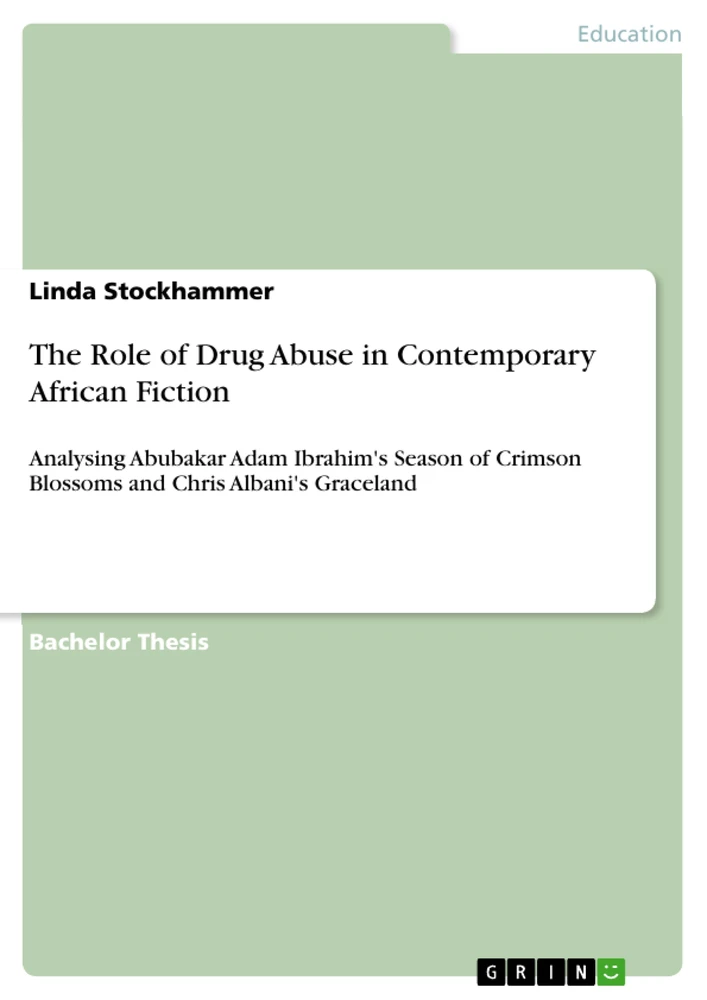
Table of Contents
1. Introduction
2. African Culture
3. Africa and Drugs
4. Drug Abuse in African Literature
4.1. Abubakar Adam Ibrahim's Season of Crimson Blossoms
4.2. Chris Abani's Graceland
5. Women and Drugs
6. Conclusion
Research Objectives and Key Topics
This thesis examines the role of drug consumption and trafficking within the context of contemporary African literature, specifically analyzing how these issues are represented and whether they reflect the actual social and cultural situation in Africa. By utilizing a literature sociological approach, the study investigates the connection between societal conditions, such as poverty and instability, and the portrayal of drug-related themes in selected fictional works.
- Cultural foundations of African society and the impact of modernization.
- Historical and contemporary overview of drug consumption and drug policies in Africa.
- Comparative analysis of drug-related narratives in Abubakar Adam Ibrahim's Season of Crimson Blossoms and Chris Abani's Graceland.
- Sociological exploration of the link between drug abuse, poverty, and corruption.
- Gender-specific representations of drug users and victims in literature versus reality.
Excerpt from the Book
4.1. Abubakar Adam Ibrahim's Season of Crimson Blossoms
Right from the beginning of the novel it becomes clear that violence and drug abuse go hand in hand. In the first chapter Binta gets attacked by a stranger: "A strong arm clasped her from behind, pressing firmly across her mouth. [...] The point of a dagger pressed lightly into her throat. She discerned the pungent smell of marijuana coming off her assailant" (Abubakar 12). Later, joints are smoked before somebody is attacked or while somebody is kept hostage (cf. Abubakar 135, 228). Drugs are even used as sedatives in the process of abductions to keep the victims calm and motionless:
The drugged girl was lying on the red and blue plastic mat where she had been dumped, her decency saved by the jeans beneath her knee-length kaftan. [...] She looked so fragile it would be easy to kill her. [...] He could even have her overdose on chloroform. (Abubakar: 197)
'Move her. The police have been tipped off about your location. They will be there in the next thirty minutes. She mustn't be found. Move her [...]'
[...]
'And the girl?' Gattuso sounded alert.
'Drug her.'
(Abubakar: 282)
Summary of Chapters
1. Introduction: Outlines the research scope, highlighting the sociological approach to analyze the role of drug abuse in African literature as a reflection of society.
2. African Culture: Defines the cultural context of the African continent, emphasizing its dynamic nature, social norms, and the prevalence of specific traditions and gender roles.
3. Africa and Drugs: Discusses the history and current state of drug trafficking and consumption in Africa, identifying the social and economic triggers behind the crisis.
4. Drug Abuse in African Literature: Analyzes the literary representation of drug abuse in selected works, exploring how characters interact with drugs amid poverty and crime.
4.1. Abubakar Adam Ibrahim's Season of Crimson Blossoms: Examines the intersection of violence and drug use in the novel, highlighting how despair and economic instability drive character behavior.
4.2. Chris Abani's Graceland: Investigates the portrayal of the drug trade in Lagos and how historical trauma and social inequality shape the narrative of the main character.
5. Women and Drugs: Critiques the gender bias in literary portrayals of drug users, contrasting the fictional victimhood of women with the reality of their drug use.
6. Conclusion: Synthesizes findings, confirming that drug abuse is an emerging and significant theme in African literature that mirrors real-world sociological challenges.
Keywords
African literature, drug abuse, drug trafficking, Abubakar Adam Ibrahim, Season of Crimson Blossoms, Chris Abani, Graceland, sociology of literature, cultural context, gender roles, codeine, poverty, social instability, Nigeria, globalization.
Frequently Asked Questions
What is the core focus of this thesis?
The thesis explores the intersection of literature and sociology by analyzing how drug abuse is represented in contemporary African fiction.
What are the primary themes discussed?
Central themes include the social and cultural construction of Africa, the reality of drug consumption and trafficking, poverty, corruption, and the portrayal of gender dynamics.
What is the research goal?
The objective is to determine how accurately the fictional representation of drug abuse reflects the actual social and cultural situation in Africa.
Which methodology is employed?
The work utilizes a literature sociological approach to analyze the relationship between society and literature.
What does the main body cover?
It provides an overview of African cultural norms, the historical and present drug landscape in Africa, and a detailed literary analysis of two specific novels.
Which keywords best characterize this work?
Key terms include African literature, drug abuse, Season of Crimson Blossoms, Graceland, and sociology.
How does the author connect literature to historical events?
The analysis links drug abuse in Graceland to the Nigerian Civil War (Biafran War), showing how historical trauma informs the current social reality.
Why is the role of women highlighted in the thesis?
The author addresses the discrepancy between the literary portrayal of women as passive drug victims and the reality of women using drugs in contemporary Africa.
What distinguishes the depiction of drug use in the two analyzed novels?
While Graceland (2004) treats drug involvement as a peripheral symptom of the main character's life, Season of Crimson Blossoms (2015) portrays drug abuse as a more pervasive, entrenched societal issue.
Ende der Leseprobe aus 18 Seiten
- nach oben
- Arbeit zitieren
- Linda Stockhammer (Autor:in), 2018, The Role of Drug Abuse in Contemporary African Fiction, München, Page::Imprint:: GRINVerlagOHG, https://www.diplomarbeiten24.de/document/512721

neugierig - aktuell - relevant
Entdecken Sie hilfreiche Tipps und Tricks rund ums Studium!

Entdecken Sie hilfreiche Tipps und Tricks rund ums Studium!
Ihre Hausarbeit / Abschlussarbeit:

- - Publikation als E-Book und Buch
- - Hohes Honorar auf die Verkäufe
- - Für Sie komplett kostenlos - mit ISBN
- - Es dauert nur 5 Minuten
- - Jede Arbeit findet Leser

- © GRIN Publishing GmbH.
- Alle Inhalte urheberrechtlich geschützt. Kopieren und verbreiten untersagt.
- info@grin.com
- AGB
- Open Publishing
Der GRIN Verlag hat sich seit 1998 auf die Veröffentlichung akademischer eBooks und Bücher spezialisiert. Der GRIN Verlag steht damit als erstes Unternehmen für User Generated Quality Content. Die Verlagsseiten GRIN.com, Hausarbeiten.de und Diplomarbeiten24 bieten für Hochschullehrer, Absolventen und Studenten die ideale Plattform, wissenschaftliche Texte wie Hausarbeiten, Referate, Bachelorarbeiten, Masterarbeiten, Diplomarbeiten, Dissertationen und wissenschaftliche Aufsätze einem breiten Publikum zu präsentieren.
Kostenfreie Veröffentlichung: Hausarbeit, Bachelorarbeit, Diplomarbeit, Dissertation, Masterarbeit, Interpretation oder Referat jetzt veröffentlichen!
Folgen Sie GRIN auf


- GRIN Verlag GmbH
-
- Nymphenburger Str. 86
- 80636
- Munich, Deutschland
- +49 89-550559-0
- +49 89-550559-10
- info@grin.com
-
