
präsentiert von

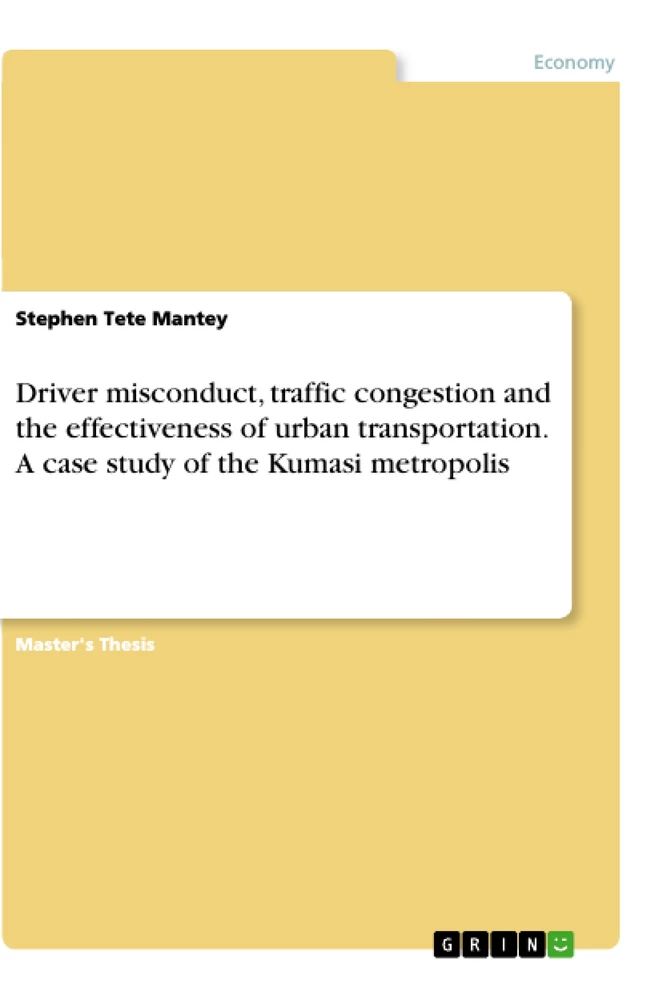
Table of Contents
1.0 Background to the Study
1.1 Statement of the Problem
1.2 Objectives of the Study
1.3 Research Questions
1.4 Significance of the Study
1.5 Scope of the Study
1.6 Research Methodology
1.7 Limitation of the Study
1.8 Organization of the thesis
2.0 Introduction
2.1 Global Urbanization
2.2 Urbanization in Ghana
2.3 Key issues of Urban Transportation
2.4 Ghana National Transport Policy (2008)
2.5 Transportation in Ghana
2.6 Transport Infrastructure
2.7 Urban Transportation system
2.7.1 Trends, challenges and opportunities of urban transportation
2.7.2 Urban transportation trends
2.8 Traffic congestion
2.8.1 Causes of traffic congestion
2.8.1.1 Separation of work and residential areas
2.8.1.2 Mathematical theories
2.8.1.3 Economic theories
2.8.2 Ways to Reduce Congestion
2.9 Driver Behavior and Misconduct
2.10 Effectiveness of Urban Transportation
2.11 Influence of the Interactions between Driver and Traffic congestion on Effective transportation
2.12 Conceptual framework
2.13 Research Hypothesis
3.0 Introduction
3.1 Research Design
3.2 Population of the Study
3.3 Sampling Techniques and Sample size
3.4 Data Collection Methods
3.5. Reliability and Validity
3.6 Ethical Review
3.7 Data Analysis
3.8 Profile of Kumasi Metropolitan Area
4.0 Introduction
4.1 Response Rate of the Study
4.2.1 Profile of Respondents
4.3 Descriptive Analysis of Study Variables
4.4 Causes of Driver Misconduct and Traffic Congestion in the Kumasi Metropolis
4.5 Relationship between Study Variables
4.5.1 Relationship between Driver Misconduct and Transportation Effectiveness
4.5.2 Relationship between Traffic Congestion and Transportation Effectiveness
4.5.2 The Influence of Traffic Congestion on the relationship between Driver Misconduct and Transportation Effectiveness
5.0 Introduction
5.1 Summary of Finginds
5.1.1 Causes of Driver Misconduct and Traffic Congestion in the Kumasi Metropolis
5.1.2 The Relationship between Driver Misconduct and Effectiveness of Urban Transportation In Kumasi Metropolis
5.2.3 Influence of Traffic Congestion on the Relationship between Driver Misconduct and Effectiveness of Urban Transportation
5.2.4 Other Findings
5.2 Conclusion
5.3 Recommendations
Research Goal and Focus
The primary aim of this study is to analyze the complex dynamics between driver behavior, traffic congestion, and the overall efficiency of urban transport systems within the Kumasi Metropolis, ultimately providing recommendations to enhance infrastructure and policy planning.
- Causes and impact of driver misconduct on urban mobility.
- Evaluation of traffic congestion patterns and their influence on the transport sector.
- Relationship analysis between human driving behavior and infrastructure effectiveness.
- Strategic policy recommendations to mitigate traffic congestion and improve urban transport efficiency.
Excerpt from the Book
2.8 Traffic congestion
Traffic jamming is a situation on transportation system which happens as utilization upsurges, and is described by leisure speeds, lengthier journey periods, and augmented car queue up. Once traffic need is abundant that the communication amid cars decelerates the speed of the traffic line, this leads to some jamming. At the same time jamming is an option for every type of transport, this part concentrates on car jamming on public streets (Monayem, 2001).
As needed methods the volume of a street (or of the connections alongside the street), great traffic jamming come in. Once cars are completely immobile for several of periods, this is colloquially referred to as traffic snarl-up or traffic jam. Arithmetically, jamming is commonly observed as the number of cars that goes via a point in a gap of a flow. Jamming movement offers itself to values of fluid dynamics.
Summary of Chapters
Chapter One: Provides the foundational background, problem statement, research objectives, and the significance of studying transportation issues in Kumasi.
Chapter Two: Reviews existing literature on global and local urbanization, transport policies, traffic congestion theories, and driver behavior.
Chapter Three: Details the case study research design, sampling techniques, and data collection methodology employed within the Kumasi Metropolis.
Chapter Four: Presents the analysis and discussion of the field data, including demographic profiles and statistical relationships between key variables.
Chapter Five: Summarizes the major research findings, offers final conclusions regarding the transport system, and provides actionable policy recommendations.
Keywords
Urban Transportation, Kumasi Metropolis, Traffic Congestion, Driver Misconduct, Road Infrastructure, Transport Efficiency, Urbanization, Public Transport, Road Safety, Commuting, Transportation Policy, Vehicle Maintenance, Traffic Management, Infrastructure Development, Sustainable Transport.
Frequently Asked Questions
What is the core focus of this research?
The research investigates the factors contributing to driver misconduct and traffic congestion, and how these elements impact the effectiveness of urban transportation in the Kumasi Metropolis.
What are the primary thematic areas covered?
The study covers urban population growth, road transport infrastructure, driver behavior (misconduct), traffic congestion dynamics, and policy frameworks for transport improvement.
What is the main objective of the thesis?
The objective is to determine the causes of driver misconduct and congestion, examine the relationship between these factors and transport effectiveness, and assess how congestion mediates this relationship.
Which methodology was utilized in this study?
A case study research design was used, employing quantitative methods via questionnaires administered to 300 respondents, including drivers, passengers, and transport managers in Kumasi.
What does the main body of the work analyze?
The main body analyzes the descriptive and statistical data gathered from the field to determine the impact of driver behavior and congestion on the urban transport system.
How would you characterize the keywords defining this research?
The work is defined by terms such as Urban Transportation, Kumasi Metropolis, Traffic Congestion, Driver Misconduct, and Infrastructure Development.
Did the study find that driver misconduct is the primary cause of transport inefficiency?
The study found that traffic congestion, driven largely by inadequate infrastructure, is a more significant factor than driver misconduct in affecting the overall efficiency of the transport system in Ghana.
What is the significance of the "interactive term" in the findings?
The interaction term analyzed whether traffic congestion exacerbates the negative impacts of driver misconduct, finding that congestion limits road space and creates environments where bad driving behaviors are more likely to occur.
What recommendations does the author provide for policy makers?
The author recommends expanding transport infrastructure, implementing better road signs, improving vehicle maintenance regulations, and promoting educational campaigns on driver behavior.
Ende der Leseprobe aus 89 Seiten
- nach oben
- Arbeit zitieren
- Stephen Tete Mantey (Autor:in), 2018, Driver misconduct, traffic congestion and the effectiveness of urban transportation. A case study of the Kumasi metropolis, München, Page::Imprint:: GRINVerlagOHG, https://www.diplomarbeiten24.de/document/514045

neugierig - aktuell - relevant
Entdecken Sie hilfreiche Tipps und Tricks rund ums Studium!

Entdecken Sie hilfreiche Tipps und Tricks rund ums Studium!
Ihre Hausarbeit / Abschlussarbeit:

- - Publikation als E-Book und Buch
- - Hohes Honorar auf die Verkäufe
- - Für Sie komplett kostenlos - mit ISBN
- - Es dauert nur 5 Minuten
- - Jede Arbeit findet Leser

- © GRIN Publishing GmbH.
- Alle Inhalte urheberrechtlich geschützt. Kopieren und verbreiten untersagt.
- info@grin.com
- AGB
- Open Publishing
Der GRIN Verlag hat sich seit 1998 auf die Veröffentlichung akademischer eBooks und Bücher spezialisiert. Der GRIN Verlag steht damit als erstes Unternehmen für User Generated Quality Content. Die Verlagsseiten GRIN.com, Hausarbeiten.de und Diplomarbeiten24 bieten für Hochschullehrer, Absolventen und Studenten die ideale Plattform, wissenschaftliche Texte wie Hausarbeiten, Referate, Bachelorarbeiten, Masterarbeiten, Diplomarbeiten, Dissertationen und wissenschaftliche Aufsätze einem breiten Publikum zu präsentieren.
Kostenfreie Veröffentlichung: Hausarbeit, Bachelorarbeit, Diplomarbeit, Dissertation, Masterarbeit, Interpretation oder Referat jetzt veröffentlichen!
Folgen Sie GRIN auf


- GRIN Verlag GmbH
-
- Nymphenburger Str. 86
- 80636
- Munich, Deutschland
- +49 89-550559-0
- +49 89-550559-10
- info@grin.com
-
