
präsentiert von

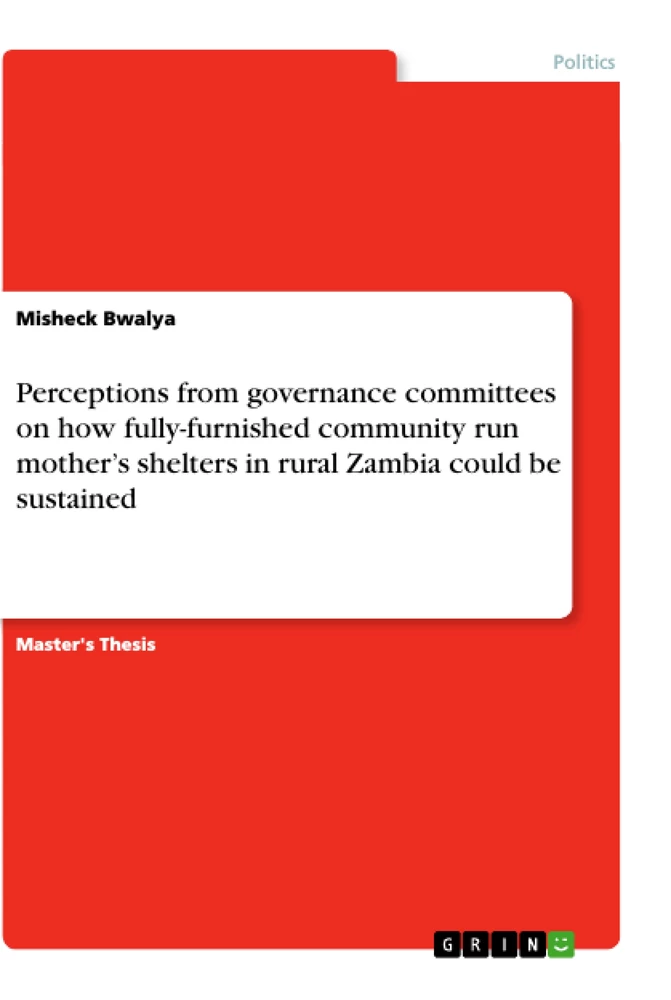
Table of Contents
CHAPTER ONE: INTRODUCTION TO THE STUDY
1.1 INTRODUCTION
1.2 SUSTAINABILITY PERSPECTIVES
1.3 Defining sustainability
1.4 A HISTORICAL PERSPECTIVE OF MATERNITY WAITING HOMES
1.5 Maternity waiting Homes in Zambia
1.6 Ministry of Health policy on Mother’s Shelters
1.7 The Mothers’ shelter project and sustainability design
1.7.1 Mothers’ Shelter components and design
1.8 STATEMENT OF THE PROBLEM
1.9 RESEARCH OBJECTIVES
1.9.1 PURPOSE OF THE STUDY
1.9.2 SPECIFIC OBJECTIVES
1.10 RESEARCH QUESTIONS
1.11 SCOPE OF THE STUDY
1.12 SIGNIFICANCE OF THE STUDY
1.13 ORGANIZATION OF THE THESIS
CHAPTER TWO: LITERATURE REVIEW
2.1 INTRODUCTION
2.2 Project sustainability at a global glance
2.3 FACTORS AFFECTING PROJECT SUSTAINABILITY
2.4 Literature analysis
2.5 Conclusion
CHAPTER 3: THEORETICAL AND CONCEPTUAL FRAMEWORK
3.0 INTRODUCTION
3.1 THEORETICAL PERSPECTIVES ON SUSTAINABILITY
3.1.1 Participatory theory
3.1.2 Empowerment theory
3.2 CONCEPTUAL FRAMEWORK OF SUSTAINABILITY
3.2.1 Conceptual framework of sustainability of public health programs
3.2.2 Whether benefits or outcomes for consumers, clients, or patients are continued (when the intervention provides services to individuals).
3.2.3 Continuing the program activities or components of the original intervention.
3.2.4 Maintaining community-level partnerships or coalitions developed during the funded program.
3.2.5 Maintaining new organizational practices, procedures, and policies that were started during program implementation.
3.2.6 Sustaining attention to the issue or problem.
3.2.7 Program diffusion and replication in other sites.
3.3 Conceptual Framework for the Sustainability of fully furnished Mother’s Shelters
3.3.1 The social environment
3.3.2 The economic and political environment
3.3.3 Factors of the intervention
3.4 Conclusion
CHAPTER 4: RESEARCH METHODOLOGY
4.1 INTRODUCTION
4.2 STUDY DESIGN
4.2.1 RESEARCH TYPE
4.2.2 RESEARCH PHILOSOPHY
4.2.3 Research design
4.2.4 Study context
4.2.5 Research Population
4.2.6 Sampling design
4.2.7 Sample size
4.2.8 Data Collection
4.2.9 Data Analysis
4.3 ETHICAL CONSIDERATIONS
4.4 QUALITY CRITERIA
4.5 CONCLUSION
CHAPTER 5: PRESENTATION OF FINDINGS AND EMPIRICAL ANALYSIS
5.1 INTRODUCTION
5.2 PURPOSE OF THE STUDY
5.3 STUDY GOVERNANCE COMMITTEES
5.4 DEMOGRAPHIC CHARACTERISTICS OF STUDY SUBJECTS
5.4.1 PROPORTION OF RESPONDENTS BY GENDER
5.4.2 RESPONDENTS BY POSITION IN THE GOVERNANCE COMMITTEES
5.4.3 RESPONDENTS LEVEL OF EDUCATION
5.4.4 N0. OF IDIs PER SITE
5.5 EMERGING THEMES
5.5.1 THEME ONE: ROLES OF GOVERNANCE COMMITTEE MEMBERS
5.5.2 THEME TWO: MOTHERS’ SHELTER SUCESSES
5.5.3 THEME THREE: CHALLENGES OF MOTHER’ SHELTERS
5.4 THEME FOUR: SUSTAINABILITY OF MOTHERS’ SHELTER THROUGH THE LENS OF GOVERNANCE COMMITTEE MEMBERS
5.5 Summary of findings
5.5.1 Roles of governance committee members
5.5.2 Mothers’ successes:
5.5.3 Mothers’ challenges
5.5.4 Sustainability of MS through the lens of governance committee members
CHAPTER 6: DISCUSSION AND INTERPRATATION OF RESULTS
6.1 INTRODUCTION
6.2 PURPOSE OF THE STUDY
6.3 SECTION 1a: RESEARCH QUESTION ONE A
6.3.1 Resource mobilization
6.3.2 Policy and Strategy Development
6.3.3 Oversight and Supervisory Function
6.3.4 Coordination.
6.4 SECTION 1B: RESEARCH QUESTION ONE B
6.5 SECTION TWO: RESEARCH QUESTION 2:
6.5.1 Linkages, integration and institutionalization of MS services
6.5.2 Maintenance and repair of MS structure and assets
6.5.3 Continuous utilization of the shelter
6.5.4 Leadership and systems
6.5.5 Income Generating Activities (IGA)
6.5.6 Community support and participation
6.6 SECTION 3: RESEARCH QUESTION 3
6.7 SUMMARY DISCUSION OF RESEARCH FINDINGS
CHAPTER 7: CONCLUSION AND RECOMENDATIONS
7.1 INTRODUCTION
7.2 PURPOSE OF THE STUDY
7.3 SUMMARY OF STUDY
7.4 RECOMMENDATIONS FOR FUTURE RESEARCH
7.5 RECOMMENDATIONS FOR FUTURE PRACTICE
7.6 STUDY LIMITATIONS
7.7 Conclusion
Study Objectives and Themes
The primary objective of this research is to establish the sustainability determinants of community-run mothers' shelters in the Choma and Kalomo Districts of Zambia. The study specifically examines the roles played by governance committees, how these members perceive the long-term sustainability of the shelters compared to original project intentions, and what specific adaptations have occurred during the project's lifecycle to ensure continued functionality beyond donor support.
- Role of governance committees in project sustainability.
- Perceptions of sustainability from the lens of local stakeholders.
- Adaptation strategies and challenges within community-based mother's shelters.
- The impact of Income Generating Activities (IGAs) on financial self-reliance.
- Integration of mother's shelter services within local health facility systems.
Excerpt from the Book
3.3.1 The social environment
For the purposes of this paper, social factors includes domains such as social capital, community synergies, attitudes, knowledge and skills. These are critical to deepening community ownership and acceptance of the mother’s shelters. The community can only participate in the maintenance and repair of the shelters once they identify with the benefits arising from the shelter. Consequently, utilization of the shelters is largely dependent on how the community perceives the value, efficacy, comfort and security of the shelters. Williams (2008) observed that failure by community and stakeholders to take up ownership of projects have plunged projects into immense financial huddles threatening the sustainability and hence threatening them to seize operations daily.
Involvement of stakeholders and partners whose concerns and experience are intrinsic to the project's success is an important factor for sustainability of projects (Admassu, 2008). The level of community support determines whether a project becomes established, how quickly and successfully it consolidates, and how it responds and adapts to meet changing needs (USAID, 2009). It is therefore important that local communities be involved right from the beginning of the project when decisions are being made about what type of project is required as this would ensure that he project is sustained.
Summary of Chapters
CHAPTER ONE: INTRODUCTION TO THE STUDY: This chapter provides a global and historical perspective on project sustainability and introduces the specific context of mothers' shelters in Zambia as a research subject.
CHAPTER TWO: LITERATURE REVIEW: This chapter synthesizes existing academic discourse on sustainability, highlighting the factors that affect community-based programs and identifying gaps regarding the beneficiary perspective.
CHAPTER 3: THEORETICAL AND CONCEPTUAL FRAMEWORK: This chapter presents the participatory and empowerment theories and defines the conceptual sustainability framework for the mothers' shelters.
CHAPTER 4: RESEARCH METHODOLOGY: This chapter outlines the exploratory, qualitative research design, including data collection methods like in-depth interviews and thematic analysis.
CHAPTER 5: PRESENTATION OF FINDINGS AND EMPIRICAL ANALYSIS: This chapter displays the primary findings from the field, categorizing respondent data into roles, successes, and challenges.
CHAPTER 6: DISCUSSION AND INTERPRATATION OF RESULTS: This chapter discusses the empirical findings in relation to the established theoretical framework, focusing on governance roles and sustainability adaptations.
CHAPTER 7: CONCLUSION AND RECOMENDATIONS: This chapter summarizes the study's conclusions regarding sustainability determinants and provides actionable recommendations for future research and practice.
Keywords
Mothers’ shelters, sustainability, project management, Zambia, community governance, stakeholder participation, healthcare, maternal health, empowerment theory, financial sustainability, income generating activities, infrastructure, public health, rural development, institutionalization.
Frequently Asked Questions
What is the primary focus of this research?
The research primarily focuses on understanding the determinants of sustainability for community-run mothers' shelters in rural Zambia beyond the phase-out of donor funding.
What are the key thematic areas covered?
The study covers the roles of governance committees, community participation, financial sustainability strategies (IGAs), and the integration of shelters within local health systems.
What is the main research objective?
The core objective is to identify how governance committees define and contribute to the sustainability of mothers' shelters compared to initial project intentions.
Which methodology was employed for this study?
The study utilized an explorative qualitative research design, employing thematic analysis of secondary data collected via in-depth interviews.
What does the main body of the work address?
The main body details the theoretical framework, the methodology, the presentation of findings based on governance committee perspectives, and a discussion on sustainability determinants.
What characterises this study?
This study is characterized by its focus on the primary stakeholder perspective, specifically examining how local governance committees manage shelters to achieve long-term viability.
How do governance committees influence shelter sustainability?
Governance committees act as the core management body, responsible for policy development, resource mobilization, and coordination, which ensures the shelters remain operational and accountable to the community.
What role do Income Generating Activities play in the findings?
IGAs, such as hammer mills or agro-shops, are identified as critical mechanisms for creating a solid financial base to cover maintenance, repairs, and emergency costs.
What is the importance of "Mainstreaming" mentioned in the study?
Mainstreaming involves integrating mothers' shelter activities into existing Ministry of Health policies and systems to ensure long-term institutional support and sustainability.
Ende der Leseprobe aus 68 Seiten
- nach oben
- Arbeit zitieren
- Misheck Bwalya (Autor:in), 2018, Perceptions from governance committees on how fully-furnished community run mother’s shelters in rural Zambia could be sustained, München, Page::Imprint:: GRINVerlagOHG, https://www.diplomarbeiten24.de/document/515010

neugierig - aktuell - relevant
Entdecken Sie hilfreiche Tipps und Tricks rund ums Studium!

Entdecken Sie hilfreiche Tipps und Tricks rund ums Studium!
Ihre Hausarbeit / Abschlussarbeit:

- - Publikation als E-Book und Buch
- - Hohes Honorar auf die Verkäufe
- - Für Sie komplett kostenlos - mit ISBN
- - Es dauert nur 5 Minuten
- - Jede Arbeit findet Leser

- © GRIN Publishing GmbH.
- Alle Inhalte urheberrechtlich geschützt. Kopieren und verbreiten untersagt.
- info@grin.com
- AGB
- Open Publishing
Der GRIN Verlag hat sich seit 1998 auf die Veröffentlichung akademischer eBooks und Bücher spezialisiert. Der GRIN Verlag steht damit als erstes Unternehmen für User Generated Quality Content. Die Verlagsseiten GRIN.com, Hausarbeiten.de und Diplomarbeiten24 bieten für Hochschullehrer, Absolventen und Studenten die ideale Plattform, wissenschaftliche Texte wie Hausarbeiten, Referate, Bachelorarbeiten, Masterarbeiten, Diplomarbeiten, Dissertationen und wissenschaftliche Aufsätze einem breiten Publikum zu präsentieren.
Kostenfreie Veröffentlichung: Hausarbeit, Bachelorarbeit, Diplomarbeit, Dissertation, Masterarbeit, Interpretation oder Referat jetzt veröffentlichen!
Folgen Sie GRIN auf


- GRIN Verlag GmbH
-
- Nymphenburger Str. 86
- 80636
- Munich, Deutschland
- +49 89-550559-0
- +49 89-550559-10
- info@grin.com
-
