
präsentiert von

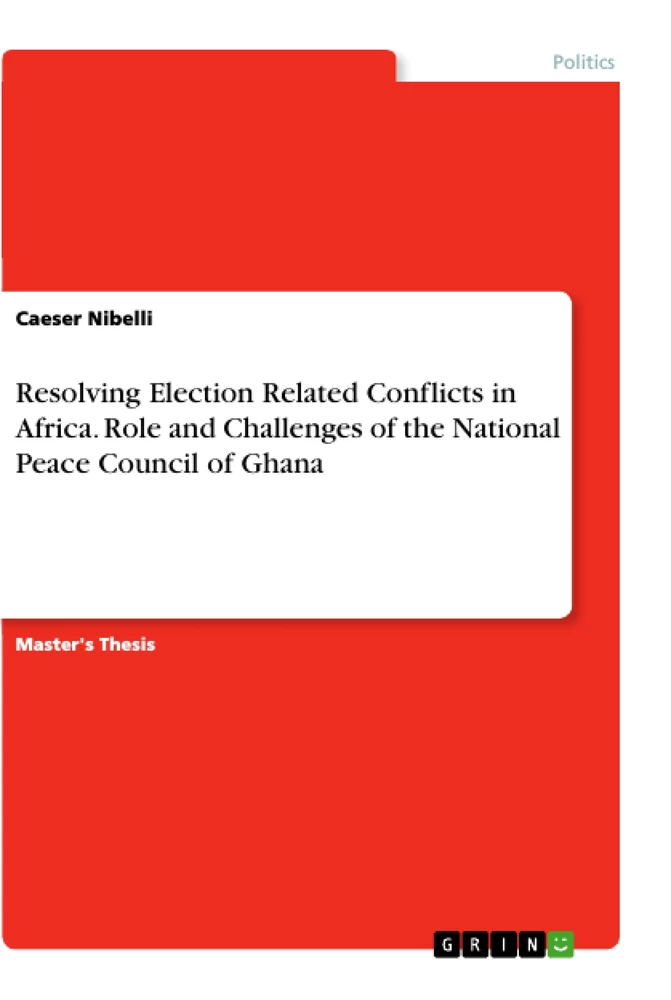
Table of Contents
1. Chapter One: Introduction
1.2 Statement of the Problem
1.3 Research Questions
1.4 Objectives of the Study
1.4.1 General Objective
1.4.2 Specific Objectives
1.5 Methodology
1.5.1 Research Design
1.5.2 Research Approach and Strategy
1.5.3 Study Population
1.5.4 Sample Size and Sampling Techniques
1.5.5 Data Collection and Research Instrument
1.5.6 Method of Data Analysis
1.5.7 Data Verification
1.5.8 Ethical Consideration
1.6 Theoretical Framework
1.6.1 Conflict Cycle Theory of Election
1.6.2 Theory of Conflict and Conflict Resolution
1.7 Literature Review
1.7.1 Electoral Conflicts in Africa
1.7.2 Elections and Conflicts in Ghana
1.7.3 The Youth and Elections in Ghana
1.7.4 The National Peace Council (NPC) of Ghana and Conflict Resolution
1.8 Significance of the Study of Defense and International Politics
1.9 Limitations of the Study
1.10 Organization of Chapters
2. Chapter Two: Elections and Conflicts in Africa
2.1 Introduction
2.2 The Electoral System in Africa
2.3 The National Electoral Bodies and Elections
2.4 Security Forces and Elections in Africa
2.5 Ethnicity and Africa Elections
2.6 Incumbency and Electoral Conflicts in Africa
2.7 Conclusion
3. Chapter Three: The Potential Causes of Election-Related Conflicts Ghana
3.1 Introduction
3.2 Background of Elections in Ghana
3.3 Ethnicity and Election-Related Conflicts in Ghana
3.4 Political Parties and Election-Related Conflicts
3.5 The Youth and Election-Related Conflicts in Ghana
3.6 The Electoral Commission and Ghana Elections
3.7 The Media and Elections in Ghana
3.8 Chieftaincy and Election-Related Conflicts in Ghana
3.9 The Abuse of Incumbency in Elections
3.10 Conclusion
4. Chapter Four: The Strategic Role of the National Peace Council in Ghana’s Elections
4.1 Introduction
4.2 Background of the National Peace Council of Ghana
4.3 The Strategies Role of the National Peace Council (NPC) in Elections
4.3.1 Gender, Youth, and Security Mainstreaming
4.3.2 Networking, Partnerships, and Coordination
4.3.3 Public Peace Education and Research
4.3.4 The National Peace Council (NPC) and Conflict Prevention
4.3.5 The National Peace Council (NPC) and Conflict Management
4.3.6 The National Peace Council (NPC) and Conflict Resolution
4.4 Dialogue with Stakeholders
4.5 Post-Election Issues
4.6 The Role of the National Peace Council (NPC) in the 2012 Elections in Ghana
4.7 The National Peace Council: Challenges and Prospects
4.8 Conclusion
5. Chapter Five: Summary, Conclusions and Recommendations
5.1 Introduction
5.2 Summary of Findings
5.2.1 Elections and Conflicts in Africa
5.2.2 Election-Related Conflicts in Ghana
5.2.3 The Role and Challenges of the National Peace Council (NPC) in Elections
5.3 Conclusions
5.4 Recommendations
5.4.1 Recommendations for Further Research
Research Objectives and Themes
The primary research objective is to examine the root causes of electoral conflicts in Ghana and the broader African context, while specifically analyzing the role, strategies, and challenges faced by the National Peace Council of Ghana in preventing, managing, and resolving such conflicts to ensure sustainable democratic stability.
- The impact of electoral systems and incumbency on political stability.
- The role of ethnicity, media, and political youth activism in election-related violence.
- Mechanisms and strategies for conflict prevention and management employed by the National Peace Council.
- Challenges to institutional effectiveness, including funding, staff, and public perception.
- Comparative analysis of electoral conflict resolution models in Africa.
Auszug aus dem Buch
3.9 The Abuse of Incumbency in Elections
One main form of electoral fraud is abuse of incumbency. Abuse of incumbency refers to the use of state resources to assist an incumbent’s campaign for re-election (CDD-Ghana et al, 2012:5). This happens when an incumbent party or candidate takes advantage of government power and resources which are not accessible to the incumbent’s contenders or competitors, or even deprives the contestants from using the resources (CDD-Ghana et al, 2012:5). Abuse of incumbency avoids unbiased elections by putting public resources that should be equally accessible to all aspirants behind one party or its incumbent (CDD-Ghana et al, 2012:5). It poses a severe danger to sustaining democracy. There are two categories of activities that are considered to be an abuse of incumbency. They are coercive practice and corrupt practice (Ibid: 5). The coercive practice involves physically avoiding aspirants from advertising, blocking the use of municipal facilities for campaign events, or denying challengers the right to engage people through the state media and acquiring votes through threats against voters (Ibid:5). The corrupt practice, involves unlawfully using state resources to fund electoral campaigns, using state media for political advertising, using public employees as campaign staff, using public transport facilities for electoral purposes, and vote-buying (Ibid: 5). Nevertheless, election can only guarantee democratic rule if only they are free and fair. As seen in previous elections in Ghana, there is a high tendency for incumbent candidates and parties to obstruct the campaign of other parties in order to create a partial advantage (Ibid: 5). Public officials ask for votes in public events funded with state resources, thereby turning the events into political campaign events (Ibid: 10).
Summary of Chapters
Chapter One: Introduction: Introduces the background, research questions, methodology, and theoretical framework, emphasizing the study's focus on electoral conflicts and the role of the National Peace Council.
Chapter Two: Elections and Conflicts in Africa: Analyzes the general causes of electoral violence across Africa, focusing on electoral systems, incumbency, security agencies, and ethnicity.
Chapter Three: The Potential Causes of Election-Related Conflicts Ghana: Examines specific factors contributing to electoral tensions in Ghana, including political party rivalry, the role of youth, and the influence of the media and chieftaincy.
Chapter Four: The Strategic Role of the National Peace Council in Ghana’s Elections: Details the strategies, mechanisms, and challenges the National Peace Council faces in its efforts to mediate and ensure peaceful elections.
Chapter Five: Summary, Conclusions and Recommendations: Provides a synthesis of findings and offers policy recommendations to enhance future electoral stability and institutional capacity.
Keywords
Electoral Conflict, Ghana, National Peace Council, Election Violence, Conflict Resolution, Democracy, Incumbency, Political Parties, Ethnicity, Youth Activism, Electoral Management Body, Conflict Prevention, Political Stability, Governance, Mediation
Frequently Asked Questions
What is the core focus of this research paper?
The research examines the causes of electoral conflicts in Ghana and Africa, evaluating how the National Peace Council of Ghana acts as a mechanism for prevention, management, and resolution of these disputes.
What are the primary themes discussed in the work?
The paper focuses on political incumbency, ethnic divisions, the role of security forces, political party conduct, media influence, and the specific impact of youth activism on electoral processes.
What is the overarching research goal?
The goal is to analyze the role and challenges of the National Peace Council in ensuring peaceful electoral outcomes, thereby providing a reference model for other African nations to prevent election-related violence.
What scientific method did the author employ?
The study utilizes a qualitative case study approach, incorporating secondary data sources such as reports, academic articles, and official documentation to analyze electoral conflict dynamics in Ghana.
What key aspects are covered in the main body?
The main body investigates the theoretical foundations of electoral conflict, the root causes of violence in Ghana, and a strategic review of the National Peace Council's initiatives, including public education and stakeholder dialogue.
Which keywords define the scope of the study?
Key terms include Electoral Conflict, National Peace Council, Conflict Prevention, Democracy, Incumbency, and Political Stability.
How does the author define the "abuse of incumbency"?
It is defined as the unlawful use of state power and public resources to gain a partisan advantage during election campaigns, which undermines the fairness of the democratic process.
Why is the "Conflict Cycle Theory" relevant to this work?
The theory helps evaluate electoral processes as cyclical rather than isolated events, allowing stakeholders to identify specific phases for intervention, such as early warning and conflict mitigation.
What is the significance of the "Kumasi Declaration"?
It was a historic peace treaty signed by presidential aspirants in Ghana, witnessed by traditional and state leaders, aimed at securing a commitment to non-violent elections.
Ende der Leseprobe aus 149 Seiten
- nach oben
- Arbeit zitieren
- Caeser Nibelli (Autor:in), 2017, Resolving Election Related Conflicts in Africa. Role and Challenges of the National Peace Council of Ghana, München, Page::Imprint:: GRINVerlagOHG, https://www.diplomarbeiten24.de/document/516717

neugierig - aktuell - relevant
Entdecken Sie hilfreiche Tipps und Tricks rund ums Studium!

Entdecken Sie hilfreiche Tipps und Tricks rund ums Studium!
Ihre Hausarbeit / Abschlussarbeit:

- - Publikation als E-Book und Buch
- - Hohes Honorar auf die Verkäufe
- - Für Sie komplett kostenlos - mit ISBN
- - Es dauert nur 5 Minuten
- - Jede Arbeit findet Leser

- © GRIN Publishing GmbH.
- Alle Inhalte urheberrechtlich geschützt. Kopieren und verbreiten untersagt.
- info@grin.com
- AGB
- Open Publishing
Der GRIN Verlag hat sich seit 1998 auf die Veröffentlichung akademischer eBooks und Bücher spezialisiert. Der GRIN Verlag steht damit als erstes Unternehmen für User Generated Quality Content. Die Verlagsseiten GRIN.com, Hausarbeiten.de und Diplomarbeiten24 bieten für Hochschullehrer, Absolventen und Studenten die ideale Plattform, wissenschaftliche Texte wie Hausarbeiten, Referate, Bachelorarbeiten, Masterarbeiten, Diplomarbeiten, Dissertationen und wissenschaftliche Aufsätze einem breiten Publikum zu präsentieren.
Kostenfreie Veröffentlichung: Hausarbeit, Bachelorarbeit, Diplomarbeit, Dissertation, Masterarbeit, Interpretation oder Referat jetzt veröffentlichen!
Folgen Sie GRIN auf


- GRIN Verlag GmbH
-
- Nymphenburger Str. 86
- 80636
- Munich, Deutschland
- +49 89-550559-0
- +49 89-550559-10
- info@grin.com
-
