
präsentiert von

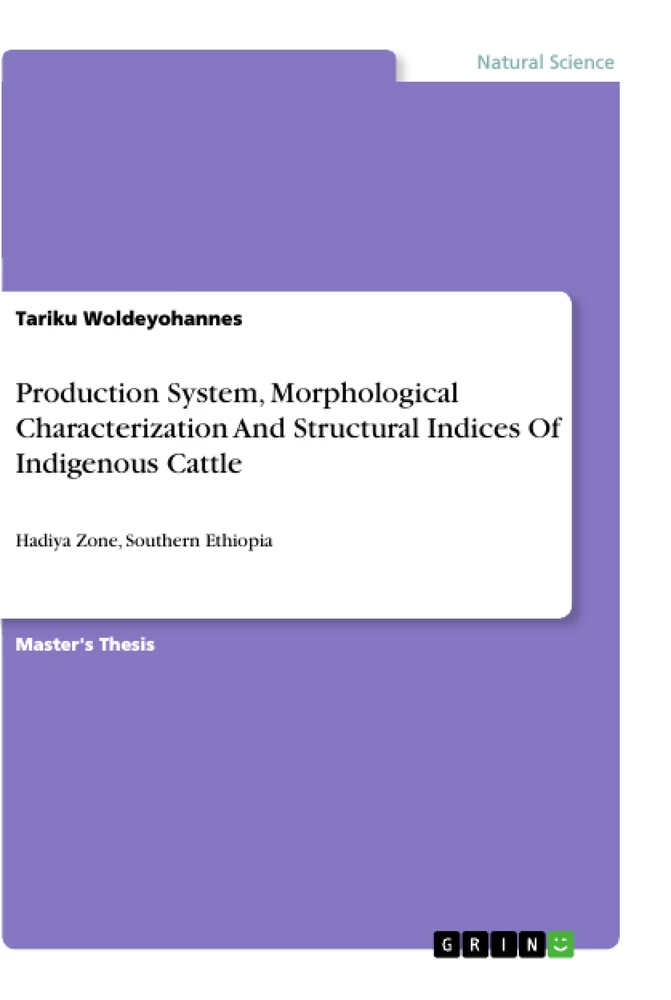
Table of Contents
1. INTRODUCTION
2. LITERATURE REVIEW
2.1. Domestication and Origin of Cattle in Africa
2.2. Classification and Distribution of Cattle Genetic Resources in Africa
2.3. Classification and Distribution of Indigenous Cattle Ethiopia
2.4. Importance of Cattle to the Rural Economy
2.5. Cattle Production Systems
2.6. Cattle Productive and Reproductive Characteristics in Ethiopia
2.6.1. Productive traits
2.6.2. Reproductive traits
2.6. Cattle Management and Husbandry Practice
2.6.1. Cattle feeding management
2.6.2. Housing of livestock
2.6.3. Watering management
2.6.4. Healthcare of the cattle
2.7. Characterization of Animal Genetic Resources (AnGR)
2.8. Morphological Characteristics of Cattle
2.9. Structural Indices
2.10. Indigenous Knowledge of Farmers on Cattle Production and Traits Preference
3. MATERIALS AND METHODS
3.1. Description of the Study Area
3.1.1. Location
3.1.2. Agro-ecology
3.1.3. Livestock population agricultural activities in the zone
3.2. Sampling and Data Collection Methods
3.2.1. Sampling techniques and sample size
3.2.2. Data collection on production situation and breeding
3.2.3. Data collection on Morphological and linear body measurement
3.3. Methods of Data Analysis
4. RESULT AND DISCUSSION
4.1. Socio-economic Characteristics of the Households
4.2. Land Holding Size and Use of Land of the Sampled Households
4.3. Livestock Possession of the Households in the Study Area
4.4. Socio-economic Purpose of Keeping Indigenous Cattle
4.5. Cattle Breeding and Trait Preference of Farmers
4.6. Breed and Coat Color Preference of Cattle in the Study Area
4.7. Mating System Used by Farmers to Breed their Cattle
4.8. Culling and Castration Practices of Households
4.9. Livestock Managements
4.9.1. Animal housing characteristics
4.9.2. Water sources, watering points and watering frequencies
4.9.3. Distance to watering point in different season and methods of overcoming scarcity of water
4.9.4. Feeds and feeding of cattle
4.9.5. Seasonal shortage of feeds and methods of overcoming
4.9.6. Feed supplements and Mineral source of cattle in the study area
4.10. Indigenous Knowledge of Farmers
4.11. Management and Production Aspect of Cattle in the Study Area
4.12. Time of Staring Milking and Perception to Feeding Colostrums to Calves
4.13. Households Perception About the Population Trend of Cattle
4.14. Production and Reproduction Performance of Indigenous Cattle
4.15. Animal Health Care and Frequently Occurring Diseases
4.16. Constraints of Cattle Production
4.17. Phenotypic Characterization
4.17.1. Qualitative traits
4.17.2. Quantitative measurements of cattle reared in both districts
4.18. Structural Indices Calculated from Morphometrical Traits to Assess the Type and Function of Cattle in the Study Area
4.19. Regression Analysis
5. SUMMARY AND CONCLUSION
6. CONCLUSION AND RECOMMENDATION
Research Objectives and Themes
This thesis examines the cattle production systems and morphological characteristics in the Hadiya zone of Ethiopia, aiming to characterize local breeds through morphometrical measurements and structural indices to inform future breeding and management improvements.
- Analysis of cattle production and management systems in the Hadiya zone.
- Morphological characterization of indigenous cattle using qualitative and quantitative traits.
- Assessment of cattle type and function through the calculation of structural indices.
- Identification of farmers' indigenous knowledge and trait preferences.
- Evaluation of regression models to predict body weight based on linear measurements.
Excerpt from the Book
2.1. Domestication and Origin of Cattle in Africa
Domestication of farm animal species was initiated some 12,000 years ago when people started maintaining animals for work power, food, fiber and other agricultural uses. Today about 40 mammalian and avian species have been domesticated, and have central role in the evolution of human cultures and for food and agriculture. However, the majority of the world’s livestock production is derived from only 14 species which comprise some 5,000 breeds (FAO, 1998). The exact origin of African cattle remains uncertain but it is now became widely accepted that Africa has been a center of domestication (Mwai et al, 2015). There are various opinions on the origin of domestic cattle. Archaeological remains shows that the large auroch (Bos taurus primigenius) was once numerous all over Europe, Western Asia and North Africa.
The researchers discovered that those zebu cattle were brought to Africa when farmers migrating from Asian continent, or traded, before interbreeding with African wild cattle, aurochs (Hanotte et al., 2002). They have some unique qualities, such as morphological features which distinguish them from other cattle includes horn shape and size (e.g. Ankole and Kuri) and not visible traits such as resistance to trypanosomiasis or sleeping sickness, climatic stress resistance and productivity traits also differ among breeds and the researchers considered whether this resistance evolved in domesticated cattle or in the wild African aurochs with which they interbred (Mwai et al., 2015).
Summary of Chapters
1. INTRODUCTION: Provides an overview of the agricultural landscape in Ethiopia and the vital economic role of livestock, while identifying the need for genetic characterization of indigenous cattle.
2. LITERATURE REVIEW: Examines historical domestication, classification of cattle resources, production systems, and existing methodologies for morphological and structural assessment.
3. MATERIALS AND METHODS: Details the study area, sampling techniques for households and cattle, and the specific procedures for data collection and statistical analysis used in the study.
4. RESULT AND DISCUSSION: Presents comprehensive findings on household socio-economics, livestock management, phenotypic traits, and the structural indices used to classify cattle function.
5. SUMMARY AND CONCLUSION: Synthesizes the core findings regarding cattle production in the Hadiya zone, highlighting the significance of local adaptation and the necessity of improved management.
6. CONCLUSION AND RECOMMENDATION: Offers strategic recommendations for breeding programs and management practices to enhance the productivity of indigenous cattle populations.
Keywords
Indigenous cattle, Hadiya zone, Morphometrical measurements, Structural indices, Production system, Cattle breeding, Phenotypic characterization, Livestock management, Genetic resources, Body weight estimation, Farmers' knowledge, Ethiopia, Bos indicus, Adaptation, Cattle constraints
Frequently Asked Questions
What is the core focus of this research?
The research focuses on the production systems, morphological characterization, and the determination of structural indices of indigenous cattle within the Hadiya zone of Southern Ethiopia.
What are the central themes of the work?
The central themes include cattle production management, phenotypic characterization, breed preference by local farmers, and the assessment of cattle function through biometric and structural measurements.
What is the primary goal of the study?
The primary goal is to provide a comprehensive baseline characterization of indigenous cattle to facilitate better management, conservation, and genetic improvement strategies.
Which scientific methods were applied?
The study employed household surveys, focused group discussions, and precise morphometrical linear body measurements, followed by statistical analysis using General Linear Models (GLM) and regression equations.
What topics are discussed in the main body of the text?
The main body covers socio-economic impacts, livestock management practices (housing, feeding, watering), farmers' indigenous knowledge, constraints to production, and detailed quantitative phenotypic analysis.
Which keywords best characterize this work?
Keywords such as indigenous cattle, Hadiya zone, morphometrical measurements, structural indices, production systems, and phenotypic characterization best define the study's scope.
How does this study contribute to the understanding of cattle in Soro and Misha districts?
It provides empirical data on breed differences, production constraints, and the specific morphometrical traits of cattle in these two distinct districts of the Hadiya zone.
What is the significance of the calculated structural indices?
The structural indices serve as a reliable tool to assess the physical type and functional performance of the cattle, helping to determine their suitability for draft power or other agricultural purposes.
What conclusion does the author reach regarding breed improvement?
The author concludes that breeding improvement should involve community-participatory programs, improved feed management, and robust health services rather than relying solely on crossbreeding.
Ende der Leseprobe aus 106 Seiten
- nach oben
- Arbeit zitieren
- Tariku Woldeyohannes (Autor:in), 2018, Production System, Morphological Characterization And Structural Indices Of Indigenous Cattle, München, Page::Imprint:: GRINVerlagOHG, https://www.diplomarbeiten24.de/document/517303

neugierig - aktuell - relevant
Entdecken Sie hilfreiche Tipps und Tricks rund ums Studium!

Entdecken Sie hilfreiche Tipps und Tricks rund ums Studium!
Ihre Hausarbeit / Abschlussarbeit:

- - Publikation als E-Book und Buch
- - Hohes Honorar auf die Verkäufe
- - Für Sie komplett kostenlos - mit ISBN
- - Es dauert nur 5 Minuten
- - Jede Arbeit findet Leser

- © GRIN Publishing GmbH.
- Alle Inhalte urheberrechtlich geschützt. Kopieren und verbreiten untersagt.
- info@grin.com
- AGB
- Open Publishing
Der GRIN Verlag hat sich seit 1998 auf die Veröffentlichung akademischer eBooks und Bücher spezialisiert. Der GRIN Verlag steht damit als erstes Unternehmen für User Generated Quality Content. Die Verlagsseiten GRIN.com, Hausarbeiten.de und Diplomarbeiten24 bieten für Hochschullehrer, Absolventen und Studenten die ideale Plattform, wissenschaftliche Texte wie Hausarbeiten, Referate, Bachelorarbeiten, Masterarbeiten, Diplomarbeiten, Dissertationen und wissenschaftliche Aufsätze einem breiten Publikum zu präsentieren.
Kostenfreie Veröffentlichung: Hausarbeit, Bachelorarbeit, Diplomarbeit, Dissertation, Masterarbeit, Interpretation oder Referat jetzt veröffentlichen!
Folgen Sie GRIN auf


- GRIN Verlag GmbH
-
- Nymphenburger Str. 86
- 80636
- Munich, Deutschland
- +49 89-550559-0
- +49 89-550559-10
- info@grin.com
-
