
präsentiert von

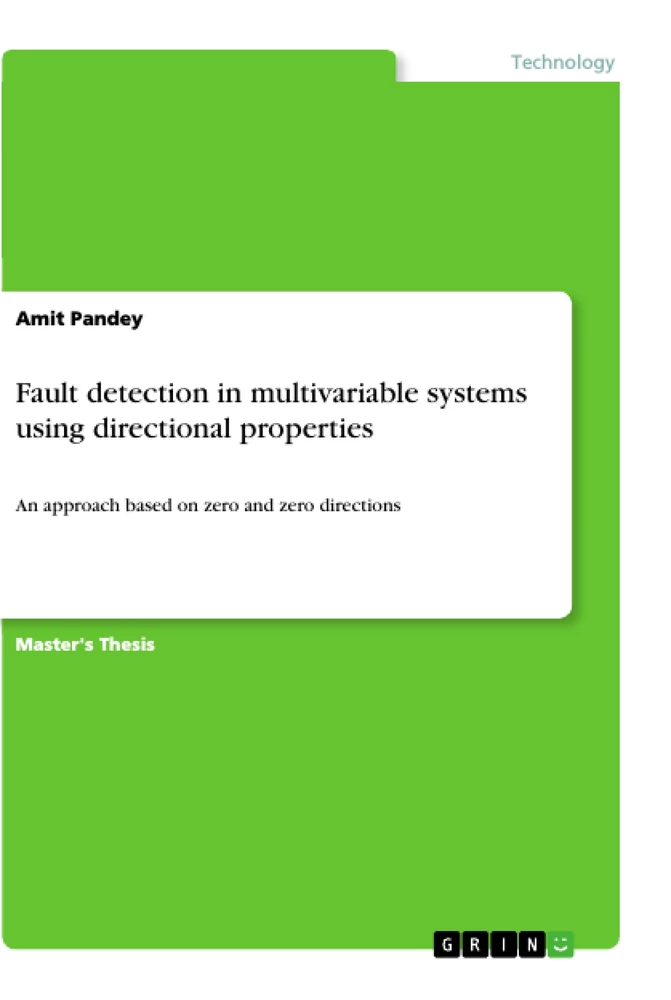
Table of Contents
CHAPTER I INTRODUCTION
1.1 Terminology
1.2 Types of Faults
1.3 Approaches to the Fault Detection and Diagnosis
1.4 Brief Description of Previous Work
1.5 Motivation for the Present Work
CHAPTER II ZEROING OF OUTPUTS IN OUTPUT-ZERO DIRECTIONS
2.1 Introduction
2.2 Definitions, Problem Setup and Assumptions
2.3 Main Result
CHAPTER III USE OF OUTPUT ZEROING THEOREM FOR FAULT DETECTION
3.1 Novel Fault Detection Scheme Using Multivariable Zeros and Zero-Directions
3.2 An Illustrative Example
3.3 Steady State Analysis
CHAPTER IV FURTHER RESULTS FOR FAULT DETECTION USING ZERO AND ZERO DIRECTIONS
4.1 Extension to Multiple Faulty Rows and Columns
4.2 Extension of Theorem 2.1 and Theorem 2.2 to the Non-Proper Systems
4.3 Main Result
4.4 Tests for Diagnosing Faults in A and C Matrices
CHAPTER V ZEROING OF OUTPUTS OF DISCRETE TIME SYSTEMS IN THE OUTPUT ZERO DIRECTIONS
5.1 Definitions, Problem Setup and Assumptions
5.2 Main Result
CHAPTER VI USE OF OUTPUT ZEROING THEOREM FOR DISCRETE TIME SYSTEM FOR FAULT DETECTION
6.1 Novel Fault Detection Scheme for Discrete Time Systems
6.2 An Illustrative Example
6.3 Steady State Analysis
6.4 Extension of Fault Detection Results to System with Multiple Faulty Rows and Columns
6.5 Tests for Diagnosing Faults in A and C Matrices
CHAPTER VII SUMMARY AND FUTURE WORK
Research Objectives and Themes
This thesis focuses on the development of a novel online fault detection scheme for linear multivariable (MIMO) systems. The primary research objective is to utilize the inherent directional properties of MIMO systems—specifically transmission zeros, input zero directions, and output zero directions—which have been largely overlooked in previous fault detection and isolation methodologies.
- Formulation of a novel algorithm for zeroing output combinations in specified directions.
- Application of the output zeroing theorem to detect faults in linear continuous-time and discrete-time MIMO systems.
- Validation of the fault detection scheme using a quadruple-tank system model.
- Extension of the fault detection logic to handle multiple faulty rows and columns, as well as non-proper systems.
- Development of diagnostic tests for identifying specific faults within the system matrices (A and C).
Excerpt from the Thesis
3.1 Novel Fault Detection Scheme Using Multivariable Zeros and Zero-Directions
Based on Theorem 2.1, Theorem 2.2 and Lemma 2.1 below is a test to find the faulty column of the transfer function matrix G(s) of plant P.
3.1.1 Column Test
If the input to the plant P and its initial conditions are given by u(t)=[0 ... 0 g_k e^{z_k t} .... 0]^T and x(0)=x_0k then the combination of the outputs in the output zero direction should be zero. A non-zero value indicates that the elements of the plant transfer function matrix corresponding to the kth input channel (i.e. the kth column of G(s)) have changed.
Based on the output zeroing result of McFarlane and Karcanias [3] stated in Chapter II the following Lemma is derived.
Lemma 3.1: Let z, x_0 and g be the transmission zero, state zero vector and the input zero direction of the plant respectively. Then for input U(t)=ge^{zt} and initial condition x(0)=x_0 the non-zero value of the kth output indicates that the kth row of the transfer function matrix is faulty.
Chapter Summaries
CHAPTER I INTRODUCTION: Provides an overview of fault detection terminology, classifies different types of faults, and reviews existing methodologies while establishing the motivation for utilizing directional properties in MIMO systems.
CHAPTER II ZEROING OF OUTPUTS IN OUTPUT-ZERO DIRECTIONS: Establishes the theoretical framework for the zeroing of output combinations, including relevant definitions and the derivation of the main results concerning the output zeroing property.
CHAPTER III USE OF OUTPUT ZEROING THEOREM FOR FAULT DETECTION: Introduces the novel fault detection scheme for continuous-time MIMO plants using row and column tests and illustrates these concepts with a quadruple-tank system.
CHAPTER IV FURTHER RESULTS FOR FAULT DETECTION USING ZERO AND ZERO DIRECTIONS: Generalizes the fault detection scheme to multiple faulty rows and columns, extends the theory to non-proper systems, and provides diagnostic tests for the A and C matrices.
CHAPTER V ZEROING OF OUTPUTS OF DISCRETE TIME SYSTEMS IN THE OUTPUT ZERO DIRECTIONS: Derives the discrete-time equivalents of the theorems presented for continuous-time systems to ensure compatibility with digital control implementations.
CHAPTER VI USE OF OUTPUT ZEROING THEOREM FOR DISCRETE TIME SYSTEM FOR FAULT DETECTION: Applies the discrete-time output zeroing theorem to create a fault detection scheme for sampled systems and verifies results using the discretized quadruple-tank model.
CHAPTER VII SUMMARY AND FUTURE WORK: Summarizes the contributions of the thesis and discusses potential future research directions, particularly regarding the extension of this geometric approach to non-linear systems.
Keywords
Fault detection, Fault isolation, Multivariable systems, MIMO, Transmission zeros, Output zero direction, Output zeroing, Quadruple-tank system, Linear systems, Discrete-time systems, Residual generation, Model-based diagnosis, Control systems, Matrix diagnosis, System identification.
Frequently Asked Questions
What is the core focus of this research?
The work focuses on creating a novel online fault detection scheme for linear MIMO systems by leveraging their specific directional properties, such as transmission zeros and zero directions, which were not previously utilized for fault detection.
What are the primary themes of this study?
The study centers on the mathematical derivation of output zeroing properties, the formulation of specific row and column tests for fault identification, and the application of these methods to both continuous and discrete-time MIMO systems.
What is the primary objective of this thesis?
The primary objective is to fully utilize the directional properties of MIMO systems to develop an efficient, model-based online fault detection and isolation mechanism that can pinpoint faulty elements in the plant's transfer function matrix.
Which scientific methods are employed?
The research employs a model-based approach, utilizing linear system theory, state-space representations, z-transform variables, and the MacFarlane and Karcanias theorem on transmission zeros and zero-blocking properties.
What does the main body of the work cover?
The main body systematically develops the theoretical foundation for output zeroing in continuous and discrete-time systems, introduces practical tests for detecting faults in transfer function matrices, and addresses generalizations for multiple faults and non-proper systems.
What are the characterizing keywords of this work?
Key terms include Fault Detection, MIMO systems, Transmission zeros, Output zero direction, Output zeroing, and Model-based diagnosis.
How does this work handle non-proper systems?
Chapter IV specifically derives versions of the zeroing theorems for non-proper systems (where the feedthrough matrix D is non-zero) to ensure the fault detection scheme remains robust.
Why is the quadruple-tank system used as a case study?
The quadruple-tank system is a standard multivariable benchmark process that effectively illustrates the directional properties and multivariable zeros, making it ideal for validating the proposed fault detection algorithm.
Ende der Leseprobe aus 88 Seiten
- nach oben
- Arbeit zitieren
- Amit Pandey (Autor:in), 2004, Fault detection in multivariable systems using directional properties, München, Page::Imprint:: GRINVerlagOHG, https://www.diplomarbeiten24.de/document/519976

neugierig - aktuell - relevant
Entdecken Sie hilfreiche Tipps und Tricks rund ums Studium!

Entdecken Sie hilfreiche Tipps und Tricks rund ums Studium!
Ihre Hausarbeit / Abschlussarbeit:

- - Publikation als E-Book und Buch
- - Hohes Honorar auf die Verkäufe
- - Für Sie komplett kostenlos - mit ISBN
- - Es dauert nur 5 Minuten
- - Jede Arbeit findet Leser

- © GRIN Publishing GmbH.
- Alle Inhalte urheberrechtlich geschützt. Kopieren und verbreiten untersagt.
- info@grin.com
- AGB
- Open Publishing
Der GRIN Verlag hat sich seit 1998 auf die Veröffentlichung akademischer eBooks und Bücher spezialisiert. Der GRIN Verlag steht damit als erstes Unternehmen für User Generated Quality Content. Die Verlagsseiten GRIN.com, Hausarbeiten.de und Diplomarbeiten24 bieten für Hochschullehrer, Absolventen und Studenten die ideale Plattform, wissenschaftliche Texte wie Hausarbeiten, Referate, Bachelorarbeiten, Masterarbeiten, Diplomarbeiten, Dissertationen und wissenschaftliche Aufsätze einem breiten Publikum zu präsentieren.
Kostenfreie Veröffentlichung: Hausarbeit, Bachelorarbeit, Diplomarbeit, Dissertation, Masterarbeit, Interpretation oder Referat jetzt veröffentlichen!
Folgen Sie GRIN auf


- GRIN Verlag GmbH
-
- Nymphenburger Str. 86
- 80636
- Munich, Deutschland
- +49 89-550559-0
- +49 89-550559-10
- info@grin.com
-
