
präsentiert von

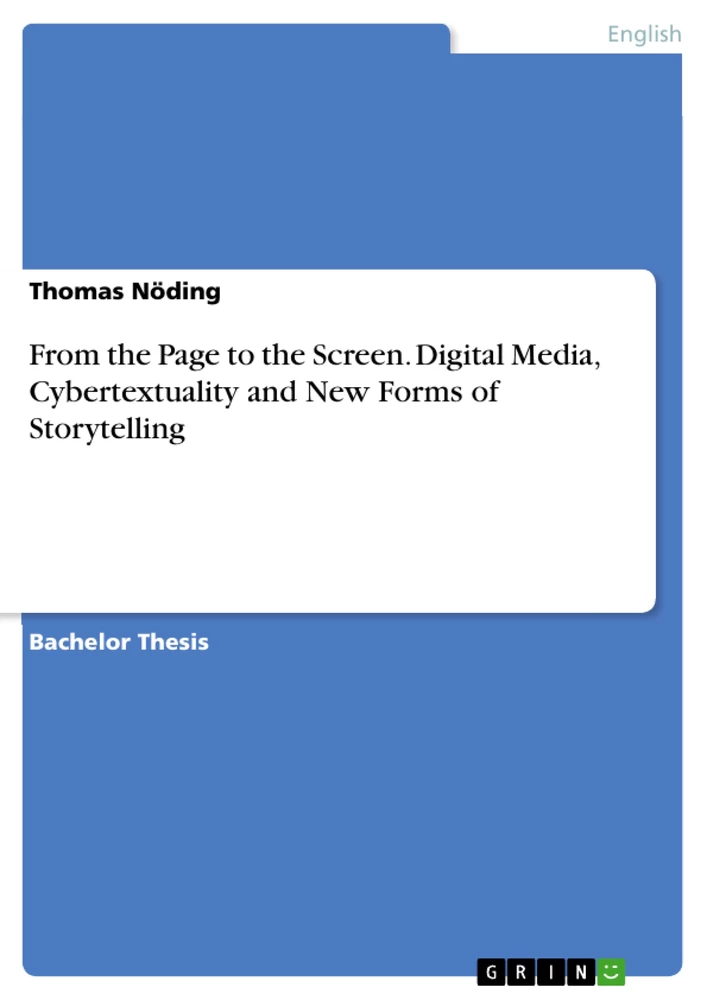
Table of Contents
1.0 Introduction
2.0 Socio-historical perspectives on the interrelation of language, technology and literature
3.0 Conceptualization of digital literature and cybertext
3.1 Virtuality, interactivity and the reader-user convergence
3.2 Narrative in digital text
4.0 The early stage of electronic literature: Hypertext
5.0 Storyspace Hyperfiction: Michael Joyce’s Afternoon, a story
6.0 The Fusion of reading, writing, and playing: text-based computer games and the multi-user dungeon
7.0 Aardwolf: A contemporary MUD
8.0 The mobile internet revolution and transmedia narrative
9.0 Murder in Passing
10.0 Conclusion
10.1 Are books dying?
10.2 What is the future of digital text and electronic literature?
Research Objectives and Themes
This thesis investigates the evolution of digital media and technology over the past three decades and their profound impact on the conceptualization of textuality, literature, and narrative structures. It seeks to answer how emerging digital forms influence traditional reading experiences and the future of literary production.
- Historical interrelation between language, technology, and society.
- Defining electronic literature and the concept of "cybertext".
- Analysis of early hypertext fiction (Michael Joyce's Afternoon, a story).
- The role of interactivity in multi-user dungeons (MUDs) and computer games.
- Contemporary transmedia storytelling and its societal impact.
Excerpt from the Book
3.1 Virtuality, interactivity and the reader-user convergence
Cybertexts break with the common assumptions of semiotics and linguistics who sought texts to be “chains of signs” which are “therefore linear by definition” (Aarseth 1997, p.26). What sets cybertext apart from the classic print text is, that it does not deliver a completed and predefined arrangement of its textual units. Due to the incorporation of the reader into the text production, a cybertext by itself only provides (a part of) the textual material which is yet waiting to be assembled into a textual whole. Due to the distinct qualities and functionalities of digital media, they present a marvelous medium in which cybertext can be presented.
Some terminologies often associated with computers and other digital devices are cyberspace and the virtual. A connection which receives affirmation by popular expressions like “surfing the net” and the “information superhighway” which attribute a sense of spatiality to the digital medium (Nunes, 1999, p.62). This virtual spatiality provides a fertile ground for cybertext and electronic literature, especially because text and literature can be considered as highly virtual entities themselves. Given the fact that (almost) every text originates from the human mind, which is itself a strongly metaphysical and virtual environment, digital media offer a textual realm, quite similar to the text’s origin. “What the marriage of postmodernism and electronic technology has produced is not the virtual text itself, but the elevation of its built-in virtuality to a higher power” (Ryan, 1999, p.96).
Chapter Summary
1.0 Introduction: Introduces the technological shifts of the last decades and how they have transformed our perception and interaction with text.
2.0 Socio-historical perspectives on the interrelation of language, technology and literature: Examines the historical co-evolution of language and technology as the fundamental basis for civilization and literacy.
3.0 Conceptualization of digital literature and cybertext: Defines electronic literature, emphasizing texts that utilize the machine as a space of performance and require active reader participation.
4.0 The early stage of electronic literature: Hypertext: Explores the 1980s and 90s era of hypertext, highlighting how linking structures changed textual linearity.
5.0 Storyspace Hyperfiction: Michael Joyce’s Afternoon, a story: Provides a case study of a pioneering hypertext work, focusing on its non-linear and cyclic reading patterns.
6.0 The Fusion of reading, writing, and playing: text-based computer games and the multi-user dungeon: Discusses the move from individual reading to collaborative, networked interaction in digital game worlds.
7.0 Aardwolf: A contemporary MUD: Analyzes a modern MUD to illustrate how complex interactivity and multi-tasking define the contemporary gaming experience.
8.0 The mobile internet revolution and transmedia narrative: Investigates the impact of mobile technology and Web 2.0 on how stories are dispersed across multiple media channels.
9.0 Murder in Passing: Studies a recent transmedia whodunit to show how audiences engage with fragmented story elements to piece together a narrative.
10.0 Conclusion: Summarizes the transformation of literature and offers reflections on the future coexistence of print and digital media.
Keywords
Digital literature, cybertext, hypertext, narrative theory, interactivity, transmedia storytelling, electronic literature, MUD, virtuality, reader-user convergence, digital media, media studies, textual machinery, computer games, Web 2.0
Frequently Asked Questions
What is the central focus of this thesis?
The work focuses on how digital technologies have reshaped the concepts of literature, textuality, and storytelling over the last three decades.
What are the primary themes discussed?
Central themes include the transition from print to digital, the role of the reader as an active participant, and the evolution of narrative across various media.
What is the main research objective?
The objective is to explore how different stages of digital evolution—from early hypertext to modern transmedia narratives—have influenced our understanding of reading and text production.
What scientific methods are utilized?
The author employs a chronological analysis of digital literary developments, supported by definitions from media theory and practical case studies of digital works.
What is covered in the main body of the work?
The main body examines the historical interrelation of language and technology, defines "cybertext," and analyzes specific examples such as Afternoon, a story, Aardwolf, and Murder in Passing.
Which keywords best describe the work?
Key terms include digital literature, cybertext, hypertext, interactivity, transmedia storytelling, and reader-user convergence.
How does the author define a "cybertext"?
A cybertext is defined as a text that functions as a "machine," requiring the reader to actively participate in the textual production process by navigating and manipulating the medium.
What is the significance of the "reader-user convergence"?
It marks the shift from a passive reader to an active user or player who effectively becomes a co-creator of the text within a digital framework.
What is transmedia storytelling?
Transmedia storytelling is a technique where story elements are dispersed systematically across multiple platforms to create a unified, coordinated entertainment experience.
Why does the author argue against the "death of the book"?
The author argues that digital literature does not seek to replace print but rather to establish a coexistence, noting that print remains the preferred medium for most readers.
Ende der Leseprobe aus 51 Seiten
- nach oben
- Arbeit zitieren
- Thomas Nöding (Autor:in), 2014, From the Page to the Screen. Digital Media, Cybertextuality and New Forms of Storytelling, München, Page::Imprint:: GRINVerlagOHG, https://www.diplomarbeiten24.de/document/519992

neugierig - aktuell - relevant
Entdecken Sie hilfreiche Tipps und Tricks rund ums Studium!

Entdecken Sie hilfreiche Tipps und Tricks rund ums Studium!
Ihre Hausarbeit / Abschlussarbeit:

- - Publikation als E-Book und Buch
- - Hohes Honorar auf die Verkäufe
- - Für Sie komplett kostenlos - mit ISBN
- - Es dauert nur 5 Minuten
- - Jede Arbeit findet Leser

- © GRIN Publishing GmbH.
- Alle Inhalte urheberrechtlich geschützt. Kopieren und verbreiten untersagt.
- info@grin.com
- AGB
- Open Publishing
Der GRIN Verlag hat sich seit 1998 auf die Veröffentlichung akademischer eBooks und Bücher spezialisiert. Der GRIN Verlag steht damit als erstes Unternehmen für User Generated Quality Content. Die Verlagsseiten GRIN.com, Hausarbeiten.de und Diplomarbeiten24 bieten für Hochschullehrer, Absolventen und Studenten die ideale Plattform, wissenschaftliche Texte wie Hausarbeiten, Referate, Bachelorarbeiten, Masterarbeiten, Diplomarbeiten, Dissertationen und wissenschaftliche Aufsätze einem breiten Publikum zu präsentieren.
Kostenfreie Veröffentlichung: Hausarbeit, Bachelorarbeit, Diplomarbeit, Dissertation, Masterarbeit, Interpretation oder Referat jetzt veröffentlichen!
Folgen Sie GRIN auf


- GRIN Verlag GmbH
-
- Nymphenburger Str. 86
- 80636
- Munich, Deutschland
- +49 89-550559-0
- +49 89-550559-10
- info@grin.com
-
