
präsentiert von

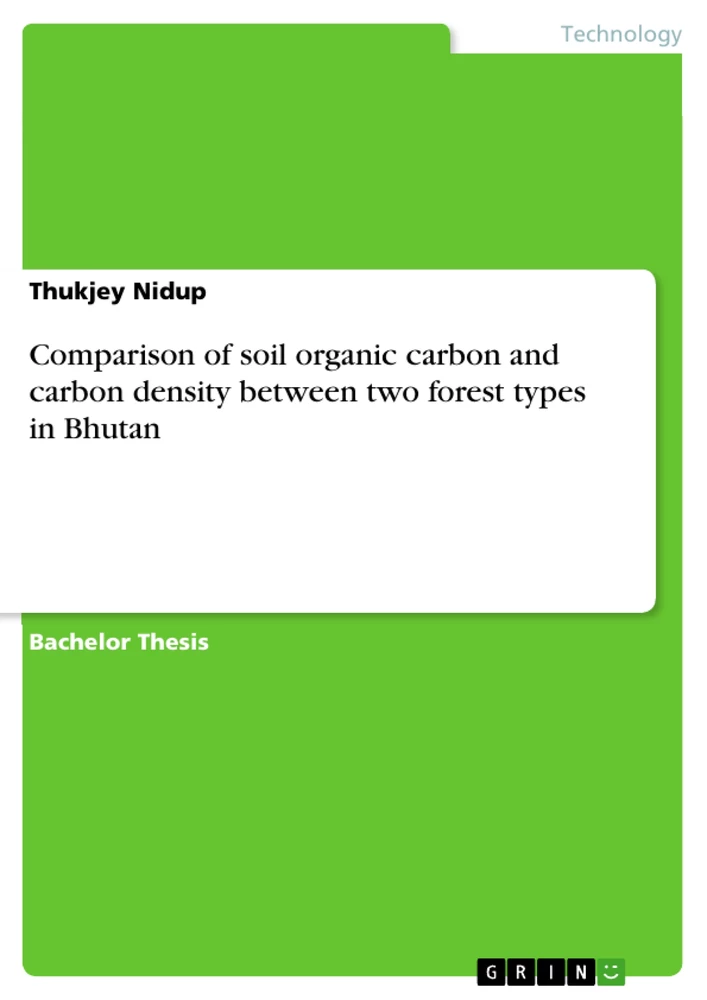
Table of Contents
Introduction
Background
Problem statement
Research objectives
Literature Review
Soil Carbon sequestration
Soil Carbon stocks in different slope and aspect
Soil organic carbon stock along the altitudinal gradient
Vertical variation of carbon stock
Influence of succession of soil organic carbon storage
Soil Bulk density
Method for measuring Carbon
Loss on Ignition method
Walkley-Black method
Non-Destructive Techniques
Materials and Methods
Study area
Soil sampling procedure
Determination of soil organic matter and organic carbon
Determination of soil bulk density
3.2.3. Calculation of Carbon Density
Statistical data analysis
Results and Discussion
Checking Normality of data
Soil bulk density of different forest types
Soil organic carbon concentration in two types of forest
Organic carbon density at different aspect
Organic carbon at different slope
Soil organic carbon and carbon density along altitudinal gradient
Variation of soil organic carbon density with depth
Conclusion
References
Research Objectives and Themes
This study aims to investigate soil organic carbon (SOC) dynamics in the Nahi Gewog region of Bhutan by analyzing how topographic variables such as elevation, slope, and aspect influence carbon density and storage across different soil depths in Chirpine and mixed broadleaf forests.
- Assessment of SOC density across varying elevation gradients.
- Comparison of carbon content between two distinct forest types.
- Evaluation of the influence of slope and aspect on soil carbon distribution.
- Analysis of vertical carbon variation within 0-25cm and 25-50cm soil depths.
- Establishment of baseline data for future carbon sequestration research in the region.
Excerpt from the Book
Vertical variation of carbon stock
Globally, Jobbagy and Jackson (2000), described vertical distributions of soil organic carbon for different ecosystems and demonstrated that vegetation type determined vertical distributions of SOC through its root-shoot allocation and root distributions along soil profile. According to Gill et al. (1999), the vertical patterns of soil organic carbon are determined by a dynamic balance between carbon inputs from plant production and outputs through microbial decomposition. As a major source of carbon inputs in soil, vertical distributions of roots play an important role in shaping vertical distributions of soil organic carbon (Jobbagy, & Jackson, 2000). Soil organic matter appears to be concentrated in the first 25 cm, where the mineralization and immobilization Carbon processes are slightly active (Alcantara, Garcia, & Espejo, 2015). In addition to that, Weaver et al., (1935),has reported the depth-dependent decomposition rates as an another potential mechanism for explaining vertical patterns of soil organic carbon because a higher proportion of total root biomass occurred in surface soil than that of deeper soil profile. In general, Sevgi and Tecimen (2009), concluded that the soil organic carbon decreases with the increase in depth of soil.
Summary of Chapters
Introduction: Provides the background on carbon pools, the global importance of soil organic carbon in climate mitigation, and outlines the problem statement regarding the lack of specific carbon density studies in Bhutan.
Literature Review: Reviews existing knowledge on soil carbon sequestration, the factors influencing SOC stocks such as slope, aspect, and altitude, and explores common measurement methodologies like the Loss on Ignition method.
Materials and Methods: Details the study area in Nahi Gewog, the systematic soil sampling procedure at varying depths, and the laboratory techniques used to calculate carbon density and statistical data analysis.
Results and Discussion: Presents the analytical findings, including soil bulk density comparisons between forest types, correlations between organic carbon and environmental variables, and the observed vertical variations in carbon density.
Conclusion: Synthesizes the study results, confirming the influence of elevation, slope, and depth on SOC, while suggesting the need for further research incorporating meteorological data.
Keywords
Aspect, Carbon density, Elevation, Slope, Soil depth, Soil organic carbon, Chirpine forest, Mixed broadleaf forest, Loss on Ignition, Carbon sequestration, Bhutan, Soil bulk density, Altitudinal gradient, Climate change, Carbon stocks.
Frequently Asked Questions
What is the primary focus of this research?
The research focuses on assessing the density and distribution of soil organic carbon in the Nahi Gewog region of Bhutan, specifically examining how topography and forest types affect carbon storage.
What are the core thematic areas?
The core themes include carbon sequestration potential, the impact of physical environment (slope, aspect, elevation) on soil chemistry, and vertical carbon stratification in forest soils.
What is the main research objective?
The objective is to quantify the relationship between organic carbon content and topographic variables while comparing carbon density between Chirpine and mixed broadleaf forest ecosystems at different soil depths.
Which methodology was utilized to measure soil carbon?
The study employed the Loss on Ignition (LOI) method to determine soil organic matter and organic carbon, combined with statistical analysis using SPSS and MS-Excel.
What does the main body cover?
The main body covers a comprehensive literature review of global carbon dynamics, detailed field sampling procedures, statistical results regarding carbon correlation with environmental factors, and a discussion on vertical carbon distribution.
Which keywords characterize this work?
Key terms include Aspect, Carbon density, Elevation, Slope, Soil depth, Soil organic carbon, Chirpine forest, and Carbon sequestration.
How does forest type affect bulk density according to the findings?
The study found that Chirpine forests exhibit higher bulk density compared to mixed forests, suggesting that mixed forests contain more surface organic matter and are less compact.
What is the significance of the soil depth analysis?
The research concludes that soil organic carbon density is significantly higher in the top 0-25cm layer compared to the 25-50cm layer, primarily due to higher organic matter input from leaf litter and root biomass in the surface soil.
Ende der Leseprobe aus 23 Seiten
- nach oben
- Arbeit zitieren
- Thukjey Nidup (Autor:in), 2020, Comparison of soil organic carbon and carbon density between two forest types in Bhutan, München, Page::Imprint:: GRINVerlagOHG, https://www.diplomarbeiten24.de/document/520406

neugierig - aktuell - relevant
Entdecken Sie hilfreiche Tipps und Tricks rund ums Studium!

Entdecken Sie hilfreiche Tipps und Tricks rund ums Studium!
Ihre Hausarbeit / Abschlussarbeit:

- - Publikation als E-Book und Buch
- - Hohes Honorar auf die Verkäufe
- - Für Sie komplett kostenlos - mit ISBN
- - Es dauert nur 5 Minuten
- - Jede Arbeit findet Leser

- © GRIN Publishing GmbH.
- Alle Inhalte urheberrechtlich geschützt. Kopieren und verbreiten untersagt.
- info@grin.com
- AGB
- Open Publishing
Der GRIN Verlag hat sich seit 1998 auf die Veröffentlichung akademischer eBooks und Bücher spezialisiert. Der GRIN Verlag steht damit als erstes Unternehmen für User Generated Quality Content. Die Verlagsseiten GRIN.com, Hausarbeiten.de und Diplomarbeiten24 bieten für Hochschullehrer, Absolventen und Studenten die ideale Plattform, wissenschaftliche Texte wie Hausarbeiten, Referate, Bachelorarbeiten, Masterarbeiten, Diplomarbeiten, Dissertationen und wissenschaftliche Aufsätze einem breiten Publikum zu präsentieren.
Kostenfreie Veröffentlichung: Hausarbeit, Bachelorarbeit, Diplomarbeit, Dissertation, Masterarbeit, Interpretation oder Referat jetzt veröffentlichen!
Folgen Sie GRIN auf


- GRIN Verlag GmbH
-
- Nymphenburger Str. 86
- 80636
- Munich, Deutschland
- +49 89-550559-0
- +49 89-550559-10
- info@grin.com
-
