
präsentiert von

Contents
CHAPTER 1 INTRODUCTION
1.1 PREVALENCE OF HOSPITAL ACQUIRED INFECTIONS (HAI) IN DEVELOPING COUNTRIES
1.2 EPIDEMIOLOGIC TRIAD OF HAI
1.3 PRIMARY PREVENTION OF HAI THROUGH EFFECTIVE HAND HYGIENE
1.4 SIGNIFICANCE OF THIS STUDY
CHAPTER 2 LITERATURE REVIEW
2.1 LITERATURE SEARCH STRATEGY
2.2 SUMMARY OF LITERATURE SEARCH
2.2.1 Effectiveness of hand hygiene
2.2.2 Hand hygiene compliance in lower middle-income countries (LMIC)
2.2.3 Demographics and training factors associated with hand hygiene compliance in LMIC
2.2.4 Knowledge, attitude and practices associated with hand hygiene in LMIC
2.2.5 Hand hygiene compliance in Zambia
2.3 RESEARCH GAPS
CHAPTER 3 METHODS
3.1 BACKGROUND
3.2 AIM
3.3 OBJECTIVES
3.4 EPISTEMOLOGICAL APPROACH
3.5 STUDY DESIGN
3.6 SETTING
3.7 SAMPLING APPROACH/FRAME
3.8 SAMPLE SIZE
3.9 ETHICS
3.10 INCLUSION AND EXCLUSION CRITERIA
3.11 RECRUITMENT AND DATA COLLECTION METHODS
3.12 MINIMISING BIAS
3.13 POTENTIAL CONFOUNDERS
3.14 INSTRUMENT
3.15 DATA RESPONSES TO HAND HYGIENE
3.15.1 Knowledge related questions
3.15.2 Perception related questions
3.16 PILOT TESTING
3.17 DATA CLEANING AND ANALYSIS
3.17.1 Descriptive statistics
3.17.2 Inferential statistics – Bivariate Analysis
3.17.3 Inferential statistics – Multivariate Analysis
CHAPTER 4 RESULTS
4.1 DESCRIPTIVE INFORMATION
4.1.1 Demographic and training factors for nursing students
4.1.2 Hand hygiene Knowledge of Participants
4.4.3 Hand hygiene Perception of Participants
4.2 ASSOCIATION BETWEEN DEMOGRAPHICS/ TRAINING FACTORS AND HAND HYGIENE KNOWLEDGE – CROSSTABULATION AND FISHER’S EXACT TEST
4.2.1 Year of Study
4.2.2 Program of Study
4.2.3 Routine use of Alcohol-based hand rub
4.2.4 Average percentage of patients to develop HAI
4.3 UNIVARIATE ANALYSIS WITH MULTINOMIAL REGRESSION
4.3.1 Selection of predictor variables at p=0.1 cutoff
4.4 MULTIVARIATE ANALYSIS WITH MULTINOMIAL REGRESSION
4.4.1 Adjusted odds ratio for nursing students hand hygiene knowledge by demographic and training factors
4.5 MISSING DATA
CHAPTER 5 DISCUSSION
5.1 PUBLIC HEALTH CONTEXT
5.2 IMPLICATIONS OF THIS STUDY’S FINDINGS
5.2.1 Knowledge of hand hygiene
5.2.2 Perception about hand hygiene
5.2.3 Program of Study
5.2.4 Year of Study
5.2.5 Routine use of alcohol-based hand rub
5.3 RESEARCH PROCESS
5.3.1 Critical analysis of the research process
5.3.2 Study Strengths
5.3.3 Study Limitations
5.3.4 Validity and Reliability
5.3.5 Generalisability
5.3.6 Lessons learnt
5.3.7 Why Chi-Square was not used
5.4 RECOMMENDATIONS
CHAPTER 6 CONCLUSION
Research Objectives & Core Topics
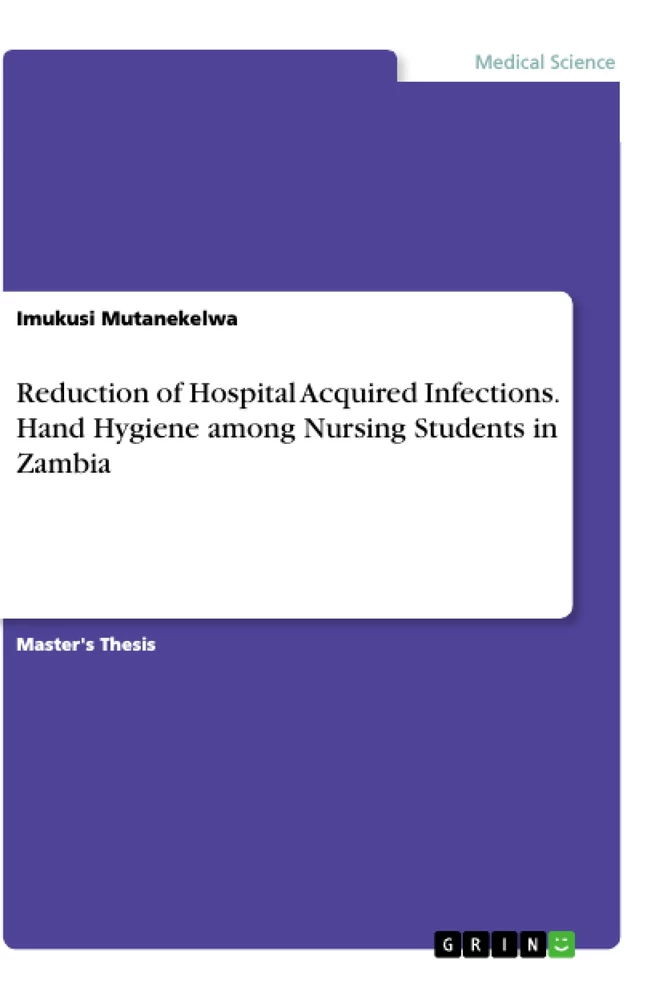
The primary aim of this research is to identify the demographic and training factors associated with nursing students' knowledge of hand hygiene in Solwezi, Zambia, to provide evidence-based information for interventions aimed at reducing Hospital Acquired Infections (HAI).
- Prevalence and public health impact of Hospital Acquired Infections (HAI) in developing countries.
- Assessment of nursing students' current hand hygiene knowledge and perception levels.
- Evaluation of demographic and training-related predictors of hand hygiene competence.
- Application of quantitative survey methods using WHO-validated questionnaires.
- Formulation of targeted primary prevention strategies for nursing education programs.
Excerpt from the Book
1.1 PREVALENCE OF HOSPITAL ACQUIRED INFECTIONS (HAI) IN DEVELOPING COUNTRIES
World Health Organisation (WHO) defines Hospital Acquired Infections (HAI) as infections that occur during the care of a patient in the hospital/healthcare facility which was absent or in the incubating period at admission (WHO, 2009). Because most (84.4%, 124/147) developing countries (Zambia inclusive) don’t have a functional national surveillance system in place, the prevalence of HAI is either unknown or underestimated because of the intricacies of making such a diagnosis (WHO, 2010; Nejad et al., 2011).
Nonetheless, HAI is a major public health problem with the prevalence ranging from 5.7% - 19.1% and up to 37% for those admitted in intensive care units in developing countries (WHO, 2009; Nejad, et al., 2011; Khan, et al., 2017). Despite limited evidence on the economic burden of HAI in Zambia, in developed nations, the annual direct medical cost is more than US$ 35 billion due to prolonged stay in hospital which attracts more laboratory investigations, treatments and nursing care (WHO, 2016). An understanding of how HAI spreads is necessary to improve existing public health interventions that reduce its prevalence, this is discussed below.
Summary of Chapters
CHAPTER 1 INTRODUCTION: Outlines the public health burden of Hospital Acquired Infections (HAI) and defines the significance of the study in the Zambian context.
CHAPTER 2 LITERATURE REVIEW: Analyzes existing studies on hand hygiene compliance, training factors, and knowledge gaps in lower middle-income countries (LMIC).
CHAPTER 3 METHODS: Describes the cross-sectional survey design, the use of WHO-validated questionnaires, and the statistical approaches employed to analyze data.
CHAPTER 4 RESULTS: Presents descriptive findings on demographic factors and the results of inferential statistical tests regarding hand hygiene knowledge.
CHAPTER 5 DISCUSSION: Interprets the findings in the context of public health, evaluates study strengths and limitations, and provides actionable recommendations.
CHAPTER 6 CONCLUSION: Synthesizes the core findings and reiterates the necessity for tailored nursing education to reduce the incidence of HAI.
Keywords
Nurse, infection prevention, hand hygiene, Hospital Acquired Infection, primary prevention, Zambia, nursing students, cross-sectional study, handwashing, public health, training factors, knowledge, perception, epidemiology, HAI reduction.
Frequently Asked Questions
What is the core focus of this research?
The research focuses on assessing the hand hygiene knowledge and perception among nursing students in Solwezi, Zambia, to identify demographic and training-related factors that impact their infection prevention capabilities.
What are the central thematic areas addressed?
Key areas include the epidemiology of Hospital Acquired Infections (HAI), the role of primary prevention, the impact of nursing education on hygiene compliance, and the statistical association between training variables and knowledge scores.
What is the primary objective of this dissertation?
The primary objective is to determine which specific training and demographic factors contribute to the variation in hand hygiene knowledge among students, ultimately enabling the creation of tailored interventions to reduce HAI prevalence.
What scientific methods were used in the study?
The study employed a quantitative cross-sectional survey design using a WHO-validated, self-administered questionnaire. Data was analyzed using descriptive statistics, Fisher's exact test, and multinomial logistic regression.
What topics are covered in the main body?
The main body covers the literature review of global and local hand hygiene practices, detailed methodology, statistical presentation of knowledge and perception data, and a critical discussion of the research process and results.
Which keywords characterize this work?
The work is characterized by terms such as hand hygiene, Hospital Acquired Infection (HAI), nursing students, primary prevention, public health, and infection prevention practices.
Why was the program of study significant in the results?
The study found that the program of study was the only factor significantly associated with hand hygiene knowledge; general nursing students were found to be 24 times more likely to possess a moderate knowledge score compared to public health nursing students.
What is the clinical implication of the findings regarding student nurses?
The findings imply that public health nursing students in Solwezi pose a higher risk of spreading HAI due to lower hand hygiene knowledge, necessitating specific refresher lessons tailored to their program attributes.
Ende der Leseprobe aus 96 Seiten
- nach oben
- Arbeit zitieren
- Imukusi Mutanekelwa (Autor:in), 2019, Reduction of Hospital Acquired Infections. Hand Hygiene among Nursing Students in Zambia, München, Page::Imprint:: GRINVerlagOHG, https://www.diplomarbeiten24.de/document/535696

neugierig - aktuell - relevant
Entdecken Sie hilfreiche Tipps und Tricks rund ums Studium!

Entdecken Sie hilfreiche Tipps und Tricks rund ums Studium!
Ihre Hausarbeit / Abschlussarbeit:

- - Publikation als E-Book und Buch
- - Hohes Honorar auf die Verkäufe
- - Für Sie komplett kostenlos - mit ISBN
- - Es dauert nur 5 Minuten
- - Jede Arbeit findet Leser

- © GRIN Publishing GmbH.
- Alle Inhalte urheberrechtlich geschützt. Kopieren und verbreiten untersagt.
- info@grin.com
- AGB
- Open Publishing
Der GRIN Verlag hat sich seit 1998 auf die Veröffentlichung akademischer eBooks und Bücher spezialisiert. Der GRIN Verlag steht damit als erstes Unternehmen für User Generated Quality Content. Die Verlagsseiten GRIN.com, Hausarbeiten.de und Diplomarbeiten24 bieten für Hochschullehrer, Absolventen und Studenten die ideale Plattform, wissenschaftliche Texte wie Hausarbeiten, Referate, Bachelorarbeiten, Masterarbeiten, Diplomarbeiten, Dissertationen und wissenschaftliche Aufsätze einem breiten Publikum zu präsentieren.
Kostenfreie Veröffentlichung: Hausarbeit, Bachelorarbeit, Diplomarbeit, Dissertation, Masterarbeit, Interpretation oder Referat jetzt veröffentlichen!
Folgen Sie GRIN auf


- GRIN Verlag GmbH
-
- Nymphenburger Str. 86
- 80636
- Munich, Deutschland
- +49 89-550559-0
- +49 89-550559-10
- info@grin.com
-
