
präsentiert von

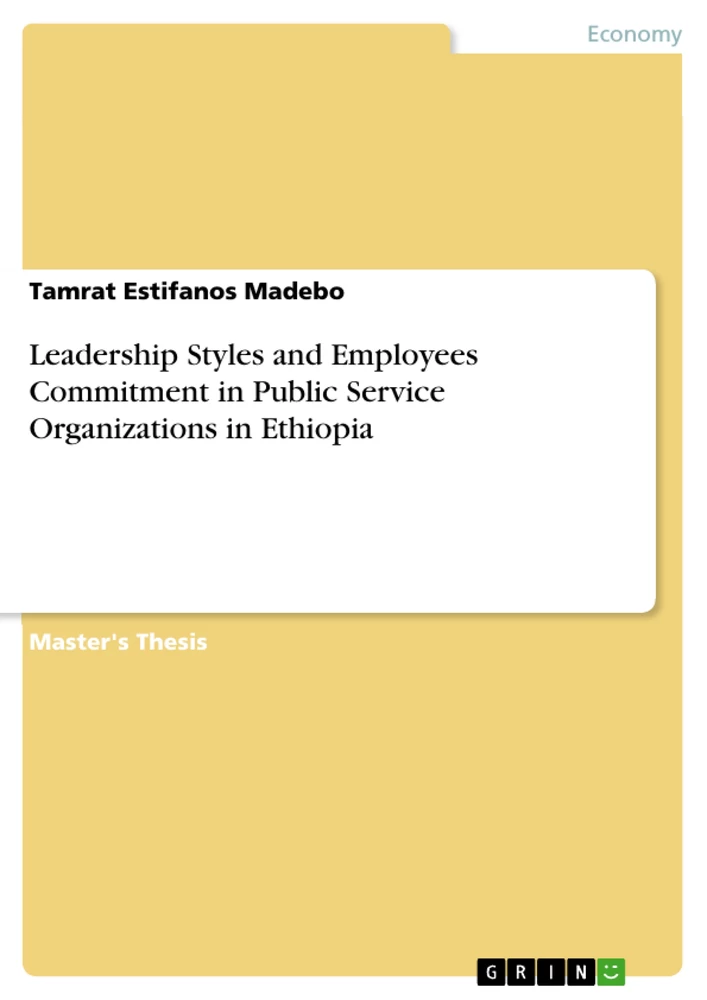
Table of Contents
1.1 Background of the Study
1.2 Statement of the Problem
1.3 Purpose of the Study
1.4 Objective of the Study
1.4.1 General Objective
1.4.2 Specific Objectives
1.5 Research Questions
1.6 Significance of the Study
1.7 Limitation of the Study
1.8 Scope of the Study
1.9 Operational Definition of Terms
1.10 Organization of the Study
2 Introduction
2.0 The Concept of Leadership
2.1 Leadership versus Management
2.2 Leadership Theories
2.3 Full Range Leadership Styles
2.4 Organizational Commitment
2.5 The Three Components of Organizational Commitment
2.6 The Relationship between Leadership styles and Employee Commitment
2.7 Conceptual Framework
3.0 Introduction
3.1 Description of the Study Area
3.2 Rationale of the Study
3.3 Research Design and Approach
3.4 Operational Definition of Variables
3.5 Sample Design
3.6 Reliability and Validity
3.7 Method of Data Analysis
3.8 Ethical Considerations
4.1 Introduction
4.2 Response Rate
4.3 Validity and Reliability of the Instrument
4.4 Quantitative Data Analysis
4.5 Qualitative Data Analysis
5.1 Introduction
5.2 Reliability of the Findings
5.3 Summery of the Results
5.4 Conclusion
5.5 Recommendations
Research Objectives and Themes
This study aims to investigate the relationship between leadership styles and the different types of organizational commitment within the public service organizations of the Yeka Sub City Administration in Addis Ababa, Ethiopia.
- Identification of dominant leadership styles based on employee perception.
- Assessment of the levels and dimensions of organizational commitment among employees.
- Examination of the correlation between identified leadership behaviors and employee commitment.
- Evaluation of the influence of transactional, transformational, and laissez-faire leadership on organizational performance.
Excerpt from the Book
1.1 Background of the Study
Human factors play an important role in the organization’s ability to grow and change continuously. One of these factors is the leadership behavior of the management and how it can affect the employees towards organizational commitment and effective performance. The success of any organization is dependent upon the collection of individuals, including leaders and followers, and the amount of effort each individual puts in to it (Hughes, 2005).
Burns (1978) pointed out that leadership is one of the most observed phenomena on earth, but the least understood. It is often regarded as the most critical factor in the success or failure of an institution (Bass, 1990a). However, leaders must understand their impact on employees, and ultimately the organization. Leaders mobilize employees toward commitment (Gardner, 1990).
While the interest in leadership is growing in its perceived importance to business, the interest in exploring its nature, and attempting to identify what makes for effective leadership, is by no means new (Nave, 2005). Early leadership studies focused on trait and behaviour theories. Trait approach emphasizes attributes of leaders such as personality, motives, values and skills. However, researchers have realized that there is no trait would guarantee leadership success (Yukl, 2010).
Summary of Chapters
CHAPTER ONE: INTRODUCTION: This chapter provides the research background, problem statement, objectives, research questions, and the operational definition of terms used throughout the thesis.
CHAPTER TWO: REVIEW OF LITERATURE: This section presents existing theories regarding leadership styles and organizational commitment, culminating in the development of the study's conceptual framework.
CHAPTER THREE: RESEARCH METHODOLOGY: This chapter outlines the research design, study area, sampling techniques, data collection instruments, and the analytical methods utilized for the study.
CHAPTER FOUR: ANALYSIS, INTERPRETATION AND DISCUSSION OF FINDINGS: This chapter presents the quantitative and qualitative data findings, including response rates, reliability of instruments, and the statistical correlations observed between leadership behaviors and commitment.
CHAPTER FIVE: SUMMERY, CONCLUSION AND RECOMMENDATIONS: The final chapter summarizes the research results, draws conclusions based on the findings, and provides recommendations for the Yeka Sub City Administration and future researchers.
Keywords
Leadership Styles, Organizational Commitment, YSCA, Transformational Leadership, Transactional Leadership, Laissez-Faire, Affective Commitment, Continuance Commitment, Normative Commitment, Public Service Organization, Ethiopia, Addis Ababa, Employee Performance, Management, Human Factors.
Frequently Asked Questions
What is the primary focus of this research?
The research focuses on assessing the relationship between leadership styles—specifically transformational, transactional, and laissez-faire—and the organizational commitment of employees within the Yeka Sub City Administration in Addis Ababa.
What are the central thematic fields covered in this study?
The study centers on organizational behavior, leadership theory, and the dimensions of organizational commitment (affective, continuance, and normative) within a public sector context.
What is the main research question of the study?
The research asks what type of leadership style is dominant in the Yeka Sub City Administration, what the levels of employee commitment are, and how these leadership styles correlate with the identified dimensions of organizational commitment.
Which scientific methods were employed for this analysis?
The researcher utilized a mixed-methods approach, combining quantitative analysis (using the Multifactor Leadership Questionnaire and Organizational Commitment Questionnaire) with qualitative analysis (through semi-structured, open-ended interviews with key informants).
What does the main body of the work treat?
The main body covers the theoretical underpinnings of leadership and commitment, the research methodology used for the specific case study, and a detailed statistical analysis and discussion of the results obtained from the survey data.
Which keywords characterize this work?
Key terms include Leadership Styles, Organizational Commitment, YSCA, Transformational, Transactional, Laissez-Faire, and Public Service Organizations.
How does the study define the role of transactional leadership in the Yeka Sub City context?
The study identifies transactional leadership as the dominant style in the Yeka Sub City Administration, finding that it has a positive and moderate correlation with continuance and normative commitment.
What conclusion does the author draw regarding laissez-faire leadership?
The author concludes that laissez-faire leadership is the most ineffective form in this context, showing a negative and significant correlation with affective organizational commitment.
Ende der Leseprobe aus 95 Seiten
- nach oben
- Arbeit zitieren
- Tamrat Estifanos Madebo (Autor:in), 2016, Leadership Styles and Employees Commitment in Public Service Organizations in Ethiopia, München, Page::Imprint:: GRINVerlagOHG, https://www.diplomarbeiten24.de/document/535951

neugierig - aktuell - relevant
Entdecken Sie hilfreiche Tipps und Tricks rund ums Studium!

Entdecken Sie hilfreiche Tipps und Tricks rund ums Studium!
Ihre Hausarbeit / Abschlussarbeit:

- - Publikation als E-Book und Buch
- - Hohes Honorar auf die Verkäufe
- - Für Sie komplett kostenlos - mit ISBN
- - Es dauert nur 5 Minuten
- - Jede Arbeit findet Leser

- © GRIN Publishing GmbH.
- Alle Inhalte urheberrechtlich geschützt. Kopieren und verbreiten untersagt.
- info@grin.com
- AGB
- Open Publishing
Der GRIN Verlag hat sich seit 1998 auf die Veröffentlichung akademischer eBooks und Bücher spezialisiert. Der GRIN Verlag steht damit als erstes Unternehmen für User Generated Quality Content. Die Verlagsseiten GRIN.com, Hausarbeiten.de und Diplomarbeiten24 bieten für Hochschullehrer, Absolventen und Studenten die ideale Plattform, wissenschaftliche Texte wie Hausarbeiten, Referate, Bachelorarbeiten, Masterarbeiten, Diplomarbeiten, Dissertationen und wissenschaftliche Aufsätze einem breiten Publikum zu präsentieren.
Kostenfreie Veröffentlichung: Hausarbeit, Bachelorarbeit, Diplomarbeit, Dissertation, Masterarbeit, Interpretation oder Referat jetzt veröffentlichen!
Folgen Sie GRIN auf


- GRIN Verlag GmbH
-
- Nymphenburger Str. 86
- 80636
- Munich, Deutschland
- +49 89-550559-0
- +49 89-550559-10
- info@grin.com
-
