
präsentiert von

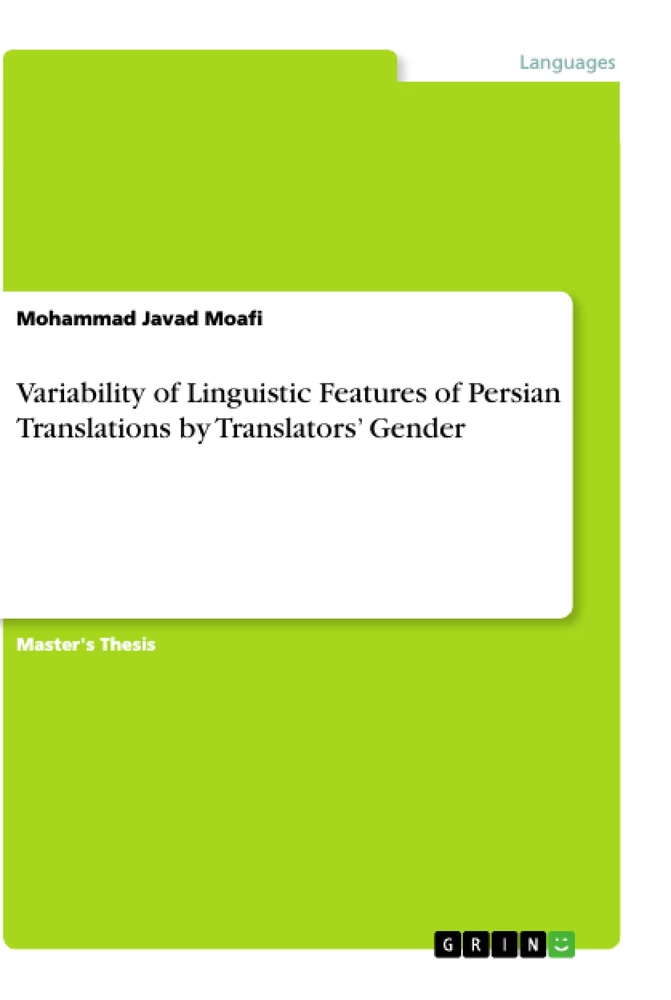
Table of Contents
Chapter One: INTRODUCTION
1.1 Overview
1.2 Statement of the Problem
1.3 Significance of the Study
1.4 Domain of the Study
1.5 Research Questions
1.6 Research Hypotheses
1.7 Definition of Key Terms
Chapter Two: LITERATURE REVIEW
2.1 Overview
2.2 Translation Studies
2.3 Equivalence
2.4 Gender Studies
2.5 Gender and Discourse
2.6 Gender and Feminist Linguistics
2.7 Gender and Translation
Chapter Three: METHODOLOGY
3.1 Overview
3.2 Design
3.3 Participants
3.4 Materials
3.5 Procedures
Chapter Four: DATA ANALYSIS AND RESULTS
4.1 Overview
4.2 Data Analysis and Results
Chapter Five: DISCUSSION AND CONCLUSION
5.1 Discussion
5.2 Conclusion
5.3 Implications of the Study
5.4 Limitations of the Study
5.5 Suggestions for Further Research
Objectives and Research Themes
The primary goal of this study is to investigate the potential relationship between a translator's gender and their linguistic output when rendering an English source text into Persian. The research seeks to identify if male and female translators exhibit consistent differences across various grammatical and textual features, specifically aiming to provide empirical evidence on whether gender influences translation performance at micro and macro levels.
- Analysis of gender-related variability in translation performance.
- Examination of linguistic features including pronouns, conjunctions, verb tenses, and sexually-explicit terminology.
- Evaluation of translation accuracy and discourse-level differences between genders.
- Exploration of the intersection between gender, ideology, and translation strategies.
Excerpt from the Book
2.5 Gender and Discourse
According to the traditionally-held beliefs and later-conducted studies, the language of the men and women varies to some degree. As a case in point, no one doubts the fact that one of the characteristics of female speech is the higher pitch enjoyed by women (as cited in Fromkin, Rodman & Hyams, 2003, p. 486). That is why Owens (2001) brings up the term “genderlect” (p. 33). Coates (1993) refers us to Lord Chesterfield’s (1754) contribution to the English newspaper The World that claims women change the meanings of the words as in “vastly glad” or “vastly little” (as cited in Sunderland, 2006).
The Danish linguist Jespersen (1922) made various claims about gender differences and speech tendencies that women have smaller vocabularies, show extensive use of certain adjectives and adverbs, produce less complex sentences and break off, more often than men, without finishing their sentences. Jespersen’s ideas were chiefly based on impressionistic data, reflecting the epistemologies of his time, and there seems to be a lack of “empirical investigation” conducted by scholars of the kind at that juncture (Sunderland, 2006, p. 5). Also, Goddard and Patterson (2000) criticize Jespersen’s claims as “stereotyped although written into academic literatures” (p. 95). Goddard and Patterson (2000) refer to the stereotypes like “silence” or “talkativeness” and popular sayings like “Nice girls don’t swear” or “Talk in a lady-like manner” as folklinguistics. However, it is interesting to note that a few of these ideas have been put to experiment and approved by empirical studies like the importance of learners’ gender, as far as teaching is concerned, since researches consistently found that girls outdo their male peers when it comes to language learning (Schmitt, 2002, p. 171).
Summary of Chapters
Chapter One: INTRODUCTION: This chapter introduces the study's background, problem statement, research questions, and hypotheses regarding gender differences in translation.
Chapter Two: LITERATURE REVIEW: This chapter reviews existing literature on translation studies, gender studies, feminist linguistics, and the intersection of gender and discourse in translated texts.
Chapter Three: METHODOLOGY: This chapter outlines the study's design, participant selection (senior English students in Qom, Iran), materials (Wuthering Heights plot summary), and the descriptive data analysis procedures used.
Chapter Four: DATA ANALYSIS AND RESULTS: This chapter presents the statistical findings derived from t-tests and Chi-square analyses, examining linguistic variables such as verb usage, pronouns, and conjunctions.
Chapter Five: DISCUSSION AND CONCLUSION: This chapter interprets the research findings, addresses the study's limitations, provides implications for the field, and offers suggestions for future investigations.
Keywords
Translation Studies, Gender, Linguistics, Discourse Analysis, Feminist Translation, Persian Translation, Linguistic Features, Comparative Analysis, Translation Equivalence, Genderlect, Sociolinguistics, Empirical Research.
Frequently Asked Questions
What is the core focus of this research?
The research investigates whether there is a meaningful relationship between a translator's gender and the linguistic features of their translations when rendering English texts into Persian.
What are the central themes explored in the study?
The study centers on the intersection of translation studies and gender studies, focusing on how male and female translators handle specific grammatical and discourse-level items like pronouns, verbs, and conjunctions.
What is the primary research goal?
The primary goal is to determine if female and male translators vary significantly in their linguistic performance and to see if these differences are consistent enough to inform text assignment practices in translation.
Which scientific method is applied?
The study utilizes a descriptive and quantitative approach, employing t-tests and Chi-square tests to analyze data collected from 60 participants (30 male and 30 female) based on their translations of a standardized text.
What topics are covered in the main body?
The main body covers a literature review on gender and language, a detailed description of the methodology used for student selection and data collection, and an extensive analysis of 22 linguistic variables.
Which keywords define this work?
Key terms include translation studies, gender, linguistic features, discourse analysis, feminist linguistics, and Persian translation, among others.
Did the study find significant gender differences?
The study found meaningful differences in 6 out of 22 variables, such as pronoun usage, the use of past vs. present tense, and the accuracy of translating conjunctions, though it notes that overall grammar and discourse did not differ significantly.
How were participants screened?
Participants were undergraduate senior English students in Qom, Iran, who were selected based on their proficiency levels through the IELTS listening, reading, and writing sub-tests.
Ende der Leseprobe aus 81 Seiten
- nach oben
- Arbeit zitieren
- Mohammad Javad Moafi (Autor:in), 2010, Variability of Linguistic Features of Persian Translations by Translators’ Gender, München, Page::Imprint:: GRINVerlagOHG, https://www.diplomarbeiten24.de/document/536488

neugierig - aktuell - relevant
Entdecken Sie hilfreiche Tipps und Tricks rund ums Studium!

Entdecken Sie hilfreiche Tipps und Tricks rund ums Studium!
Ihre Hausarbeit / Abschlussarbeit:

- - Publikation als E-Book und Buch
- - Hohes Honorar auf die Verkäufe
- - Für Sie komplett kostenlos - mit ISBN
- - Es dauert nur 5 Minuten
- - Jede Arbeit findet Leser

- © GRIN Publishing GmbH.
- Alle Inhalte urheberrechtlich geschützt. Kopieren und verbreiten untersagt.
- info@grin.com
- AGB
- Open Publishing
Der GRIN Verlag hat sich seit 1998 auf die Veröffentlichung akademischer eBooks und Bücher spezialisiert. Der GRIN Verlag steht damit als erstes Unternehmen für User Generated Quality Content. Die Verlagsseiten GRIN.com, Hausarbeiten.de und Diplomarbeiten24 bieten für Hochschullehrer, Absolventen und Studenten die ideale Plattform, wissenschaftliche Texte wie Hausarbeiten, Referate, Bachelorarbeiten, Masterarbeiten, Diplomarbeiten, Dissertationen und wissenschaftliche Aufsätze einem breiten Publikum zu präsentieren.
Kostenfreie Veröffentlichung: Hausarbeit, Bachelorarbeit, Diplomarbeit, Dissertation, Masterarbeit, Interpretation oder Referat jetzt veröffentlichen!
Folgen Sie GRIN auf


- GRIN Verlag GmbH
-
- Nymphenburger Str. 86
- 80636
- Munich, Deutschland
- +49 89-550559-0
- +49 89-550559-10
- info@grin.com
-
