
präsentiert von

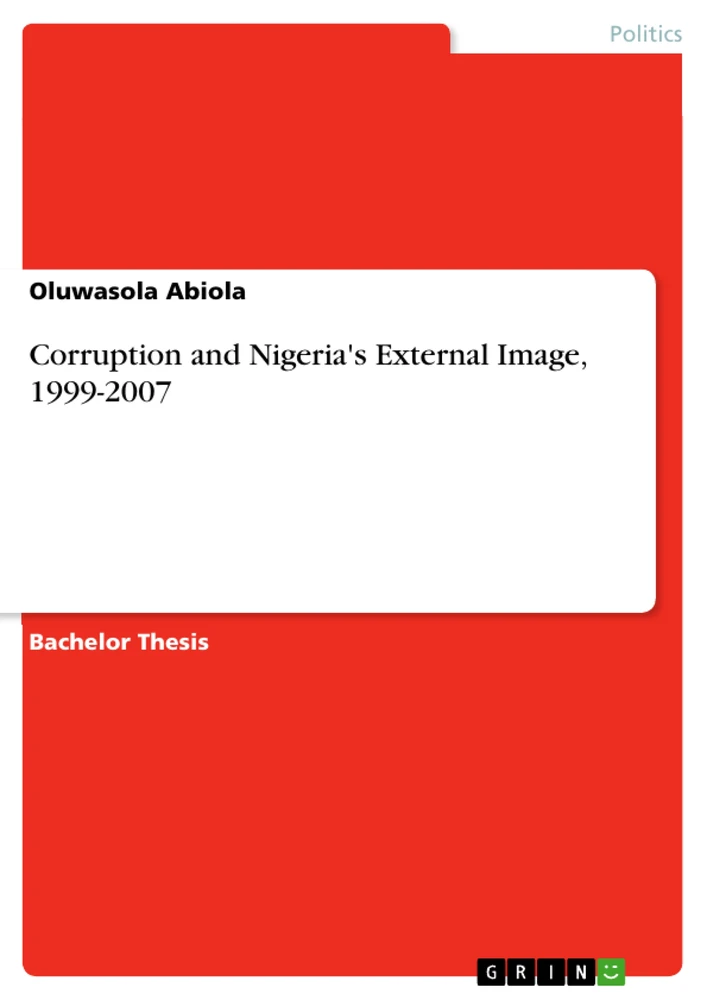
Table of Contents
CHAPTER ONE: INTRODUCTION
CHAPTER TWO: FRAMEWORK FOR ANALYSIS
CHAPTER THREE: CONCEPTUALISING CORRUPTION AND EXTERNAL IMAGE
CHAPTER FOUR: CORRUPTION AND NIGERIA’S EXTERNAL IMAGE, 1999-2007
CHAPTER FIVE: SUMMARY, FINDINGS AND CONCLUSION
Research Objectives and Themes
This study aims to investigate the profound impact of pervasive corruption on Nigeria's reputation and external standing within the international community during the Obasanjo administration (1999–2007), while examining the government's efforts to mitigate this crisis.
- The historical evolution and systemic nature of corruption in Nigeria.
- The relationship between political elite behavior and state corruption.
- The role of "Image Theory" in shaping international perceptions of the Nigerian state.
- The effectiveness of anti-corruption agencies like the EFCC and ICPC during the Fourth Republic.
Excerpt from the Book
4.4 Corruption and Nigeria’s external image
The positive perception of any country's image is an important gauge for judging her standing in the international community. A good image translates to respect, influence and prestige. On the other hand a bad or negative perception of a country's image indicates that such a country lacks respect, influence and prestige in the international system. As a consequence, all countries endeavour to build, maintain and enhance their images in relation to other countries. The factors that determine a nation’s image (for good or for bad) can be both internal and external. Internally, a succession of regimes of bad policies and practice can lead to this as demonstrated in the case of Sani Abacha and other military rulers in the country. Externally, it could be through participation in foreign military and humanitarian missions, this part has given Nigeria good image on countless occasions as Nigeria has involved itself in a whole lot of humanitarian activities, the fight for liberation of fellow African states and lot more.
An image problem usually occurs when there are both internal and external factors that sway the pendulum towards a bad/negative image. Whatever the source of an image problem, many a country would do all that is possible to overcome such an image.
Nigeria’s external image prior to 1999 was a mixture of negative and positive perception from the outside world. It was positive because of Nigeria’s involvement in many humanitarian activities since its independence especially in Africa and very bad because a whole lot of
Summary of Chapters
CHAPTER ONE: INTRODUCTION: This chapter outlines the background of the study, defining the research problem regarding corruption's negative influence on Nigeria's global image between 1999 and 2007.
CHAPTER TWO: FRAMEWORK FOR ANALYSIS: This section provides a literature review and establishes the theoretical framework, specifically utilizing elite theory and image theory to analyze the subject matter.
CHAPTER THREE: CONCEPTUALISING CORRUPTION AND EXTERNAL IMAGE: This chapter defines the core concepts of corruption and image, while tracing the historical genesis of corrupt practices in Nigeria from the pre-colonial era to the Fourth Republic.
CHAPTER FOUR: CORRUPTION AND NIGERIA’S EXTERNAL IMAGE, 1999-2007: This chapter provides an in-depth examination of the nature of corruption during the Obasanjo administration, its international dimensions, and the state's attempts to combat it through new institutional bodies.
CHAPTER FIVE: SUMMARY, FINDINGS AND CONCLUSION: The final chapter synthesizes the research findings, confirming that corruption significantly damaged Nigeria's external reputation during the study period, and offers final conclusions.
Keywords
Corruption, Nigeria, External Image, Fourth Republic, Obasanjo Administration, Elite Theory, Image Theory, EFCC, ICPC, Public Funds, Political Economy, Transparency International, Governance, Accountability, Development.
Frequently Asked Questions
What is the core focus of this research?
The research explores the link between systemic corruption in Nigeria and the resulting negative external image of the country during the Fourth Republic, specifically from 1999 to 2007.
What are the primary thematic areas covered?
The study centers on the definition of corruption, the historical origins of corrupt behavior in Nigeria, the role of the political elite, and the government's response through institutional reforms.
What is the central research question?
The study seeks to answer how corruption shaped Nigeria's international reputation between 1999 and 2007 and assesses the effectiveness of the administration's strategies to tackle this problem.
Which scientific methods were employed?
The research uses a descriptive design and a case study approach, relying on secondary data sources to provide an in-depth analysis of the relationship between domestic corruption and foreign perception.
What is discussed in the main body of the work?
The main body examines the nature of corruption, the actors involved—particularly the political elite—and the efficacy of anti-corruption agencies like the EFCC and ICPC in restoring Nigeria's image.
How can the key terms of this study be described?
The study is characterized by terms such as systemic corruption, elite dominance, international perception, institutional reform, and the political economy of the Fourth Republic.
Why is the Obasanjo administration (1999-2007) the specific focus of this study?
This period is significant because it marked the beginning of the Fourth Republic, where the country returned to democratic rule, but also experienced high-profile cases of corruption that heavily influenced how the international community viewed Nigeria.
What role does the "Elite Theory" play in this analysis?
The Elite Theory is used to explain how a small, organized group of political and economic actors maintains power and benefits from corruption at the expense of the masses, thereby damaging the nation's integrity.
Ende der Leseprobe aus 47 Seiten
- nach oben
- Arbeit zitieren
- Oluwasola Abiola (Autor:in), 2019, Corruption and Nigeria's External Image, 1999-2007, München, Page::Imprint:: GRINVerlagOHG, https://www.diplomarbeiten24.de/document/536791

neugierig - aktuell - relevant
Entdecken Sie hilfreiche Tipps und Tricks rund ums Studium!

Entdecken Sie hilfreiche Tipps und Tricks rund ums Studium!
Ihre Hausarbeit / Abschlussarbeit:

- - Publikation als E-Book und Buch
- - Hohes Honorar auf die Verkäufe
- - Für Sie komplett kostenlos - mit ISBN
- - Es dauert nur 5 Minuten
- - Jede Arbeit findet Leser

- © GRIN Publishing GmbH.
- Alle Inhalte urheberrechtlich geschützt. Kopieren und verbreiten untersagt.
- info@grin.com
- AGB
- Open Publishing
Der GRIN Verlag hat sich seit 1998 auf die Veröffentlichung akademischer eBooks und Bücher spezialisiert. Der GRIN Verlag steht damit als erstes Unternehmen für User Generated Quality Content. Die Verlagsseiten GRIN.com, Hausarbeiten.de und Diplomarbeiten24 bieten für Hochschullehrer, Absolventen und Studenten die ideale Plattform, wissenschaftliche Texte wie Hausarbeiten, Referate, Bachelorarbeiten, Masterarbeiten, Diplomarbeiten, Dissertationen und wissenschaftliche Aufsätze einem breiten Publikum zu präsentieren.
Kostenfreie Veröffentlichung: Hausarbeit, Bachelorarbeit, Diplomarbeit, Dissertation, Masterarbeit, Interpretation oder Referat jetzt veröffentlichen!
Folgen Sie GRIN auf


- GRIN Verlag GmbH
-
- Nymphenburger Str. 86
- 80636
- Munich, Deutschland
- +49 89-550559-0
- +49 89-550559-10
- info@grin.com
-
