
präsentiert von

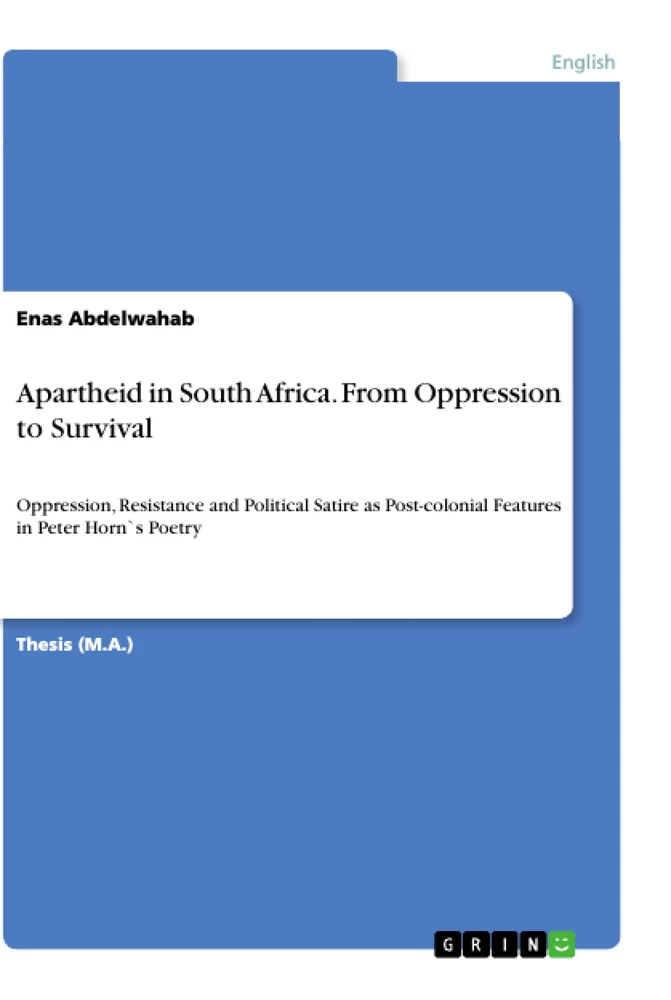
Table of Contents
1. Introduction
2. Chapter 1: Theoretical and Historical Background
3. Chapter 2: Diaspora and Colonial Oppression
4. Chapter 3: Post-colonialism and Political Satire
5. Chapter 4: “Culture of Resistance”
6. Conclusion
7. Works Cited
8. Summary
9. Arabic Abstract
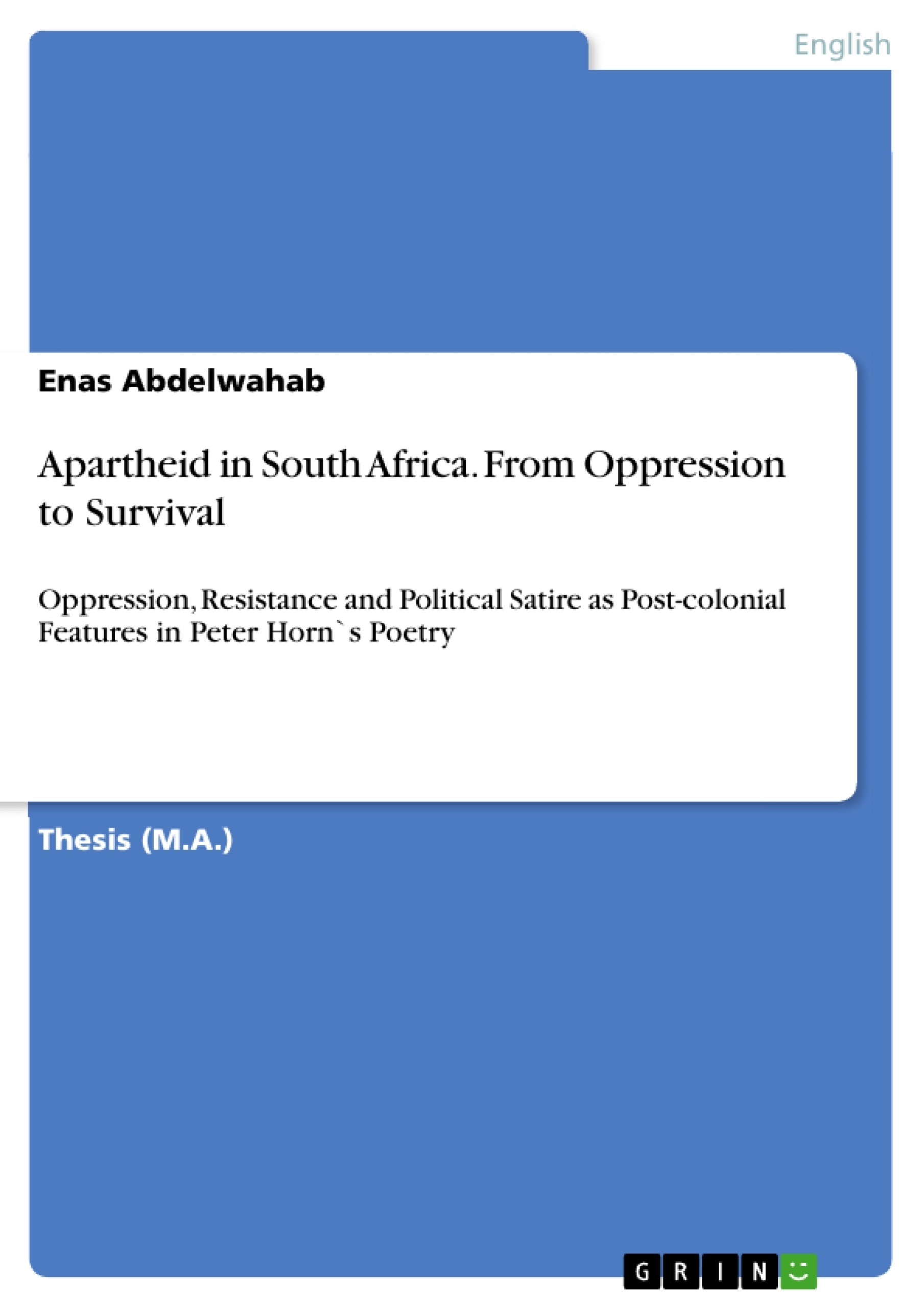
Objectives and Topics
This thesis explores the intersection of post-colonial theory and political expression in South African literature, specifically through the poetry of Peter Horn. The primary research goal is to examine how Horn employs literary techniques to address the historical and political trauma of the apartheid regime, challenging colonial hegemony and advocating for resistance.
- The impact of colonial oppression and the apartheid system on South African society.
- The role of political satire and irony as tools for subverting authoritarian power structures.
- The definition and manifestation of a "Culture of Resistance" within marginalized communities.
- The analysis of diaspora, identity distortion, and hybridity in a post-colonial context.
- The synthesis of Marxist ideology with anti-colonial struggles to envision a more equitable social structure.
Excerpt from the Book
Political satire
When the political situation of a specific country reaches the worst case, the political satire takes its place. It is a kind of amusement, which comes from a political situation or a political speech. Actually, it is a technique used by writers or thinkers to express their own ideas or comments on a specific matter in an indirect way. When governments are not achieving justice and the political situation begins to be shaken, political satire is a way to express the suppressed voices that are forbidden to appear. It is a way of entertainment about a severe political situation.
Political satire is not a direct way to protest against the political situation. It can be used as a means to arouse the spirit of resistance against the errors of a political regime of a specific government. In post-colonial studies, the reflection of oppression, subjugation, exploitation, injustice, bondage and even resistance can be found in political satire. Some writers use this technique to palliate the difficulty of the political situation and to make it be funny instead of the gloomy case of the colonized people. However; it is not just a means of amusement all the time, as it can be used also to evoke the revolutionary spirit inside the suppressed citizens. It can start by making fun and laughter, but it will lead to questioning about how this political predicament will be ended. Political satire raises just questions, and the reader will take the responsibility of answering them.
Chapter Summary
Introduction: This chapter outlines the study's aim to explore colonial oppression, political satire, and resistance within Peter Horn's poetry while providing a brief overview of the post-colonial context in South Africa.
Chapter 1: Theoretical and Historical Background: This section details the theoretical foundations of post-colonialism, incorporating Edward Said’s perspectives, and contextualizes Horn’s biographical influence on his anti-apartheid literary production.
Chapter 2: Diaspora and Colonial Oppression: This chapter examines the historical settlement of South Africa by Dutch and British colonizers and analyzes how the apartheid system functioned to marginalize the black majority.
Chapter 3: Post-colonialism and Political Satire: This section investigates the relationship between the political situation in South Africa and the use of satire and irony as strategic techniques in Horn’s poetry to critique the ruling regime.
Chapter 4: “Culture of Resistance”: This chapter discusses the mechanisms of resistance against apartheid, highlighting the role of key figures like Nelson Mandela and analyzing Horn’s poetic calls for liberation and revolutionary change.
Conclusion: This final chapter provides a critical evaluation of the findings, reinforcing Horn's role as a significant voice against colonial oppression and his advocacy for a just, post-colonial society.
Keywords
Apartheid, Colonialism, Diaspora, Hybridity, Marxism, Oppression, Peter Horn, Political Satire, Post-colonialism, Resistance, South Africa, Subjugation, White Supremacy.
Frequently Asked Questions
What is the primary subject of this thesis?
The thesis investigates the intersection of post-colonial theory and political satire in the poetry of South African writer Peter Horn, focusing on how he portrays the hardships of the apartheid era.
What are the central themes discussed in the work?
The central themes include colonial oppression, the psychological impact of the apartheid regime, the role of political satire, and the necessity of cultural and political resistance.
What is the core research question or objective?
The objective is to explore how Horn uses his poetry as a tool to criticize political injustices, expose the cruelty of the colonizers, and incite a spirit of resistance among the oppressed.
Which scientific methodology is applied?
The study utilizes a literary and theoretical analysis, drawing primarily on Edward Said’s post-colonial perspectives and Marxist critiques to deconstruct the power dynamics between colonizers and the colonized.
What is the focus of the main body of the work?
The main body examines the historical background of South African colonialism, the nature of apartheid legislation, and specific satirical techniques used in Horn's various poetry volumes to challenge the status quo.
Which key terms characterize the study?
Key terms include "apartheid," "post-colonialism," "resistance," "political satire," "diaspora," and "hybridity."
How does the author define the "Culture of Resistance" in the context of South Africa?
The author defines it as a systematic ideological and cultural reaction against the colonizers' culture, aimed at preserving native South African identity and dismantling the oppressive apartheid structures.
Why is political satire considered a "double-edged weapon" in this study?
It is viewed this way because while it serves to mock and critique the tyrant regime, it can also lead to "dirty resistance" or hypocrisy if the colonized adopt colonial-like structures to survive, potentially fracturing their own identity.
How does Peter Horn's personal biography impact his work?
His experience as an immigrant who fled Europe after World War II allowed him to empathize deeply with the displacement and suffering of the oppressed black majority in South Africa.
Ende der Leseprobe aus 200 Seiten
- nach oben
- Arbeit zitieren
- Enas Abdelwahab (Autor:in), 2019, Apartheid in South Africa. From Oppression to Survival, München, Page::Imprint:: GRINVerlagOHG, https://www.diplomarbeiten24.de/document/537717

neugierig - aktuell - relevant
Entdecken Sie hilfreiche Tipps und Tricks rund ums Studium!

Entdecken Sie hilfreiche Tipps und Tricks rund ums Studium!
Ihre Hausarbeit / Abschlussarbeit:

- - Publikation als E-Book und Buch
- - Hohes Honorar auf die Verkäufe
- - Für Sie komplett kostenlos - mit ISBN
- - Es dauert nur 5 Minuten
- - Jede Arbeit findet Leser

- © GRIN Publishing GmbH.
- Alle Inhalte urheberrechtlich geschützt. Kopieren und verbreiten untersagt.
- info@grin.com
- AGB
- Open Publishing
Der GRIN Verlag hat sich seit 1998 auf die Veröffentlichung akademischer eBooks und Bücher spezialisiert. Der GRIN Verlag steht damit als erstes Unternehmen für User Generated Quality Content. Die Verlagsseiten GRIN.com, Hausarbeiten.de und Diplomarbeiten24 bieten für Hochschullehrer, Absolventen und Studenten die ideale Plattform, wissenschaftliche Texte wie Hausarbeiten, Referate, Bachelorarbeiten, Masterarbeiten, Diplomarbeiten, Dissertationen und wissenschaftliche Aufsätze einem breiten Publikum zu präsentieren.
Kostenfreie Veröffentlichung: Hausarbeit, Bachelorarbeit, Diplomarbeit, Dissertation, Masterarbeit, Interpretation oder Referat jetzt veröffentlichen!
Folgen Sie GRIN auf


- GRIN Verlag GmbH
-
- Nymphenburger Str. 86
- 80636
- Munich, Deutschland
- +49 89-550559-0
- +49 89-550559-10
- info@grin.com
-
